Becoming a Fan Favorite: Writing Description and Direction

In today’s post, I talk about stage directions in fiction, writing natural descriptions, why some books are constantly reread by readers, and, to an extent, immortality.

Orderly Description

Ever played that “blind drawing” party game? You close your eyes or put a piece of paper on your head and someone gives you direction upon direction to cram into one picture?

Here’s an example for the party planning website Sophie’s World (which, consequently, is the title of one of my favorite books):

“I’d like you to draw the outline of a house. Just a simple little house, right in the middle of the page… Now, beside the house I’d like you to add a tree, a medium sized tree, not too big, not too small… Oh, I forgot! You need a front door on your house. Please draw a front door so that the people can come in and out easily… Oh, did I tell you there are apples in your tree? Draw a few apples, maybe 5 or 6, in your tree now… And don’t forget the windows in the house! I think two would be nice… Did I remind you to draw a chimney? Let’s put a chimney on the house, with some smoke coming out the top… Oh, and look! There’s a dog in the yard… And a picket fence… And of course there’s a family…”

This is the kind of experience a reader has when you describe something in an unnatural order:

blind drawing
It’s also what it’s like when description is given out of order. When describing a scene, consider camera shots.

Zoom in from broad descriptions, ending on one specific detail. Or zoom out, starting on a detail and working your way out to observing the whole. Pan in one direction. Going in an unnatural order gives the nauseating effect of “shaky cam.”

Adding details too late, after the reader has already created the image in his or her mind, gives what I like to call the “awkward goat” effect.

Writer: “I went to give the goat a kiss. Then the other goat—”
Reader: “Wait, there’s another goat?”
Goat: “SURPRISE! I’ve been here the whole time!” (maniacal goat bleating)
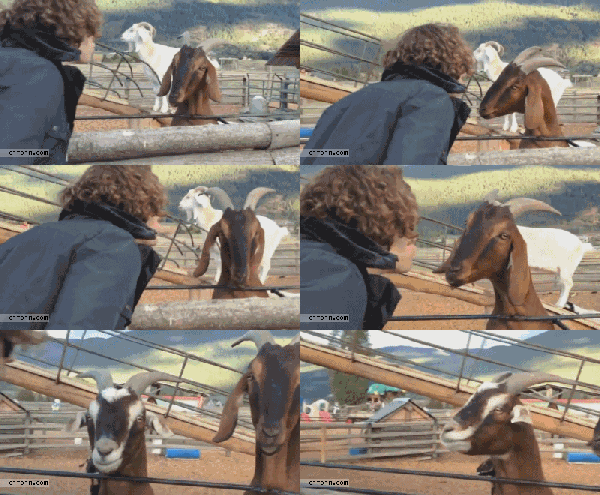
surprise-goat
While this is used effectively in visual comedy, redirection doesn’t really work in fiction.

Overcomplicated Stage Directions

Another problem of ineffective description is overcomplicated stage directions. I see sentences like this all the time in unpublished manuscripts:

“Come with me,” Jorge said and turned around while kissing my hand as we ran away together.

Though these are most often found in dialogue tags, I see overcomplicated stage directions all over. That sentence above is just one I made up, but let’s rewrite it so it doesn’t seem like “he” is doing a hundred things at once.

First, find the perps: “and,” “as,” and “while.” The two latter words can often be cut in stage directions. The former is a fine word that sometimes gets overused. Let’s focus on no more than two actions at once.

Said + turned, kissing + ran

“Come with me,” he said, turning around. He kissed my hand, inviting me to run away with him.

Let’s also apply what we just learned about orderly directions, and cut the unnecessary dialogue tag.

Jorge turned around. “Come with me.” He kissed my hand, inviting me to run away with him.

What did I just do? I took advantage of my friend the progressive verb.

A progressive verb is a verb ending in -ing. That ending tells us that the -ing verb is happening while something else is going on, while letting us cut the “while” or “as.”

“While” and “as” aren’t bad words. It’s not about the word, it’s how you use it. By all means, use “as” to make a simile (e.g., “as [adjective] as a [noun]”). “While” is an innocent preposition until proven guilty. The problem is using them to show more than one thing happening concurrently. Show me a manuscript which uses “while” or “as” in the first page in stage directions, and there’s a big chance that same construction will keep showing up over the next ten pages.

Doing a find/replace search for all instances of “as I,” “as we,” “as she,” “as he”  (depending on your POV), repeating the search with “while,” will help you see if you’re going overboard. Also be on the look-out for “then” and “before,” more signs of wordiness and or disorderly directions.

Use them a few times, and that’s fine. Do it a few times per page—or worse, per paragraph—and you’re just being unnecessarily wordy. Gone are the days when novelists are paid by the word.

The Divine Detail

Remember, your novel has to compete with online, in-demand television and movies. You need to keep your reader’s attention. That doesn’t mean your novel needs explosions or murders every other chapter; it means your prose needs to be immediate and precise rather than longwinded and wordy. You want to be Robin Williams giving his Seize the Day speech, not Ben Stein droning about economics. The difference isn’t just subject, it’s diction. Do diction right, and you’ll engage readers that otherwise don’t care one iota about your subject. That is, until they start reading your book.

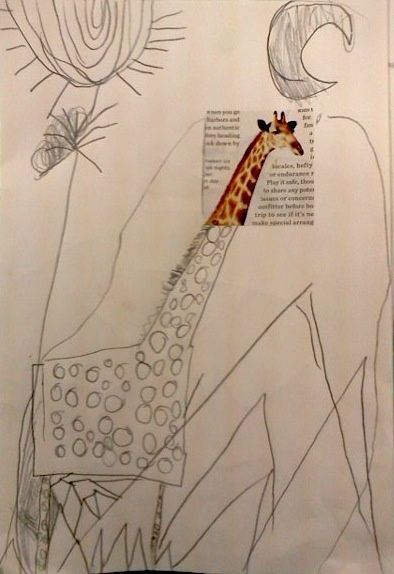
When describing, choose one or two vivid details, referred to by editors as “divine details” that can set the scene or characterize, and let the reader fill in the rest of the image. Compare the chaos of the drawing above (ain’t I an artiste?) with expansion drawings done by children:
expand-drawing

Image via ArtMommie. Click for more images.

When the reader is allowed to contribute, your work takes on a new form. It evolves in the readers’ individual minds. It’s a spark which they build upon to create a conflagration.

Letting the Reader In

It doesn’t matter how brilliant of a writer you are—writing and reading are collaborative efforts, and that collaborative effort will bring more life and beauty to your work than you could hope to do by yourself.

Sometimes we write because we’re control freaks. We are the masters of the universe, and we will plot and plan and tell our characters exactly what they should do. But when we let our characters breathe and give them freedom, when we let the reader have some creative liberty, our work takes on a life of its own.

Maybe that’s a cliche, but if you want your work to live on after you’re gone, you need to let your reader experience your world naturally. You need to let them read between the lines and contribute to the meaning and world of your fiction. When you let them participate, readers will not only want to buy your books, they will want to reread your books over and over again, letting them become part of their life, seeing how their interpretations change over the years.

Beta Readers vs. Manuscript Critiques

MS Editor Elizabeth talks about the difference between Beta Readers and professional MS critiques. I’ll add that strangers can be Beta Readers, but it’s best to pick acquaintances—they are objective, yet you can get a hold of them IRL if they drop off the planet or steal your work (FYI, this happens way less often than writers think). I had twelve friends read my novel and give feedback anonymously using a Google form—it worked well!

Elizabeth B.'s avatarMS Editors

You just finished writing the last page of your story—congratulations! Whether you pumped out a NaNoWriMo victory or spent the last five years agonizing over your dream book, you now have a full manuscript sitting in front of you. Give yourself a pat on the back; you deserve it for making it to the end. Now what? You want to make your story better, but you’re still too close to see its weaknesses and discern whether readers would enjoy it. It’s time to get an outside opinion.

If you take your work seriously, you should show your story to someone other than your mother or best friend. Run far away from anyone who has an obligation to tell you that your story is great as is! No book will be ready for publication without major revisions, so you need to hook up with someone who can give you informed feedback…

View original post 765 more words

Friday Reads: THE CONSPIRACY OF US by Maggie Hall

My resolution for 2015 is all about organization. That means introducing new blog series, switching some style guides, and improving reader experience! You’ll notice that “Write Lara Write” is now “Write, Edit, Repeat.” Same URL to keep things simple (writelarawrite.wordpress.com), but a new name, since this blog is about the crafts of writing and editing, not my personal writing site (which is coming…eventually).

And since it’s not just me anymore, I’m opening the blog up for guest posts! Apply here.

Friday Reads is a new series on Write, Edit, Repeat. I’ll only be blogging about my favorites (no room for negativity here), and I’ll end with a writing prompt. Be sure to subscribe if you haven’t already, and then you won’t miss out. Adult fiction, YA fiction, MG, graphic novels, picture books—I’ll cycle through them all, sometimes posting monthly, sometimes weekly.

For the archive of Friday Reads posts, visit bit.ly/LaraReads.

Today I’m reviewing The Conspiracy of Us, a YA romantic thriller by Maggie Hall, and one of the most highly anticipated YA reads of 2015.

First Impressions

First Impressions walks through my method of judging books by their title, cover, and cover copy before I pick up a book.

The Title

“The Conspiracy of Us” is a strange, yet evocative title (I’ll be using the word “evocative” a lot when talking about covers and titles—sorry/not sorry). The word “conspiracy” suggests the thriller genre akin to The Da Vinci Code; “us” suggests romance or a close relationship. Since this is a romantic thriller, the title is extremely effective with its word choice.

The Cover

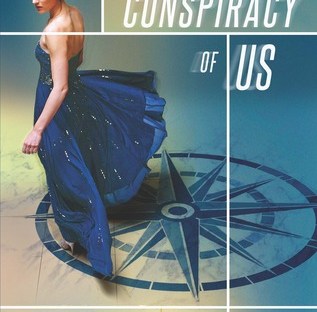
Consp

If you couldn’t tell this was a thriller from the word “conspiracy,” you’ll get the worldwide-thriller vibe from the cover. The city overlays, the compass—travel. The skewed phantom text shadowing the title implies mystery or possibly some chase scenes.

And we’ve got the subject, a teen girl in a gorgeous ball gown. Intrigue! Mystery! Travel!

Then you look at the tagline: “An ancient puzzle. A trail of clues. An unwanted destiny.”

So basically a teen girl is part Chosen One, part Indiana Jones. If there’s remotely a connection to Indiana Jones or Han Solo, I am so there.

The Blurb

Instead of breaking down the blurb like I did with After I Do and Maybe in Another Life, we’re going to do the 69 test instead, because it was such a great representation of the book, that’s what the publisher put on the back cover:

Elisa led me to a three-way mirror, where a girl who hardly looked like me stared back in triplicate. In the silver gown, the girl looked more serious, more elegant, then they changed me into the gold dress again, and she was glamorous, striking.

I found myself hoping fiercely that my mom would let me stay for the ball, and even a little longer. Meet the Saxons, find out more about my father’s family and the rest of the Circle. To feel like I belonged in this strange, fascinating world.

“You have to choose eventually.” Elisa smiled. In the mirror, the gold sequins shimmered. But there was something about the silver. It belonged on me.

Aimee unzipped the gold dress and left me to get out of it, following Elisa downstairs to wrap the silver one. I watched it go. I couldn’t believe that, just like that, it was going to be mine.

I was about step out of the gold dress when I heard footsteps coming up the stairs. “Elisa?” I said. “Aimee?” There was no answer.

In case it was one of the men come to escort me down, I zipped the dress up.

The girls were nowhere in sight, but the man who had let us in stood at the top of the staircase.

“Sorry, I’m not ready yet,” I said. I smiled at him, and he reached into his jacket pocket.

He pulled out something that, for a moment, didn’t register. It was too discordant with the marble floors, the dresses, the Bach chiming from the speakers.

It was a knife.

Read more about Maggie’s 69 Test here. And participate in #70Pit in July to share your page 69 or 70 and possibly win edits or get agent requests!

Reading

This was a fun novel to read. If you go in expecting the prophecy and Chosen One tropes (they’re implied right there on the cover), then you probably won’t expect this to be something that it’s not. What it is, is fun. And there really are similarities to Indiana Jones and the Last Crusade, with the Chosen One storyline like The Mummy Returns. Like those movies, there’s slow building romance (yes, please), plenty of sexual tension (all PG-13), some melodrama in parts, chase scenes, murderous bad guys, kinda murderous good guys, and adventure.

Those movies are called popcorn flicks. Not quite sure what the book equivalent is called, but keep your arms inside the vehicle and enjoy the ride.

Recommendations

If you like The Conspiracy of Us, you might like books by Ally Carter.

Writing Prompt

The main character, Avery West, is destined to be important, but she resists her destiny. Write about either 1) a time you were anxious about an outcome you knew was coming but had no power over, or 2) a time you rejected someone else’s plan for you.

Cover Reveal: MAYBE IN ANOTHER LIFE by Taylor Jenkins Reid

I know the protocol for offering cover reveals is to make you read through a bunch of text in anticipation and finally reveal the cover at the end.

Well, I’m a graphic designer and reader, and my first encounter with a book is usually with its cover. So I’m starting there, with my first impressions, just like I did with Taylor Jenkins Reid’s After I Do. Then we’ll talk about the story.

First Impressions

The Title

“Maybe in Another Life” is another great title from Reid. Seriously, this woman should teach a class on evocative titles. To me, it sounds like something any woman might say while daydreaming. “I’m unsatisfied with my current life. Maybe in this other, hypothetical life, I’d be more satisfied.”

But then we see the cover…

The Cover

MIAL_Reid_cover

So what does the cover tell us? It’s all in the subjects and the symmetry. This book is about a classy lady with a decision between two parallel choices, either one of which you, Reader, would probably love to escape to.

Take away the aqua and the modern font (which hearkens to style magazines), and this might be a memoir or a stuffy novel about a museum curator. With the typeface and color choice, we know it’s Women’s Fiction.

How efficient is that? I’d like to give the highest of fives to the designers that work on Reid’s novels. Every one of them seems to say “Women’s Fiction is legit Lit, y’all!” (and it’s true).

And just in case you didn’t get the gist of the contents from the image, there’s a tagline which, yet again, is evocative and ties everything together.

Are you excited for this book? Because I am. I’m ready to preorder right now …

PREORDER:

IndieBound | Amazon | Barnes & Noble | Books-a-Million | Apple | Blio | Google

But if you really want to read the blurb before ordering, then …

The Blurb

From the publisher:

At the age of twenty-nine, Hannah Martin still has no idea what she wants to do with her life. She has lived in six different cities and held countless meaningless jobs since graduating college, but on the heels of a disastrous breakup, she has finally returned to her hometown of Los Angeles. To celebrate her first night back, her best friend, Gabby, takes Hannah out to a bar—where she meets up with her high school boyfriend, Ethan.

It’s just past midnight when Gabby asks Hannah if she’s ready to go. Ethan quickly offers to give her a ride later if she wants to stay.

Hannah hesitates.

What happens if she leaves with Gabby?

What happens if she leaves with Ethan?

In concurrent storylines, Hannah lives out the effects of each decision. Quickly, these parallel universes develop into surprisingly different stories with far-reaching consequences for Hannah and the people around her, raising questions like: Is anything meant to be? How much in our life is determined by chance? And perhaps most compellingly: Is there such a thing as a soul mate?

Hannah believes there is. And, in both worlds, she believes she’s found him.

Let’s break this down.

“Hannah Martin” Anybody else think Hanna Marin from Pretty Little Liars? Just me? Okay.

“high school boyfriend … Hannah hesitates” The fact that she hesitates tell me there’s still something there between Hannah and Ethan. I’m not a fan of on-again, off-again relationships, so I’m hoping that the “something there” is mostly attraction with some underlying drama that will give off plenty of heat, but no HEA for those two.

You should all know by now that I’m not super into romance, and that my favorite movies have “happy for now” endings rather than “happily ever after” ones. But I do have a not-so-secret affinity for Hilary Duff movies. So if these two end up together, I want it to be Sweet Home Alabama style, with a clear, good reason they broke up and an ending that’s a no-brainer that they need to be together. None of that “we couldn’t handle being apart from each other for more than a month, so we broke up” nonsense.

“In concurrent storylines”. Aww yiss. I love me some nonlinear storytelling.

with far-reaching consequences” Double yesss. Fiction without consequences is just irresponsible. Curious George is horrible. But seriously, I am a fan of chain-reaction plots. Just because I don’t believe in love at first sight—attraction, OF COURSE. Have you seen my husband?—that doesn’t mean I don’t enjoy stories about fate. The fact that this is a cause-effect sort of plot lets me know there won’t be random coincidences.

“soul mate” I’ll buy it. “The One”? No. I’ve known too many widows. But I like to think that my husband and I are linked more than just mentally, socially, and physically.

Reading

You’ll have to wait until I read it for me to give a review! But now you know what kind of expectations I have going into it.

Author Chat

You can follow Taylor Jenkins Reid on Twitter @tjenkinsreid. I’m sure she’ll be interviewed about Maybe in Another Life soon.

Recommendations

I haven’t read it yet! But Reid herself recommended books by Emily Giffin or Amy Hatvany after I enjoyed After I Do.

Writing Prompt

Write about a decisive moment in your life, and what happened as a consequence. Turn it into a story, a short blurb of a memory, or a flow chart. Or ask a friend or relative about a seemingly insignificant choice they made that ended up changing their or someone else’s life.

An example: A man switched from a music major to a history major, which meant he spent five years in college instead of four. His fifth year was the first year a “colloquium” class was offered—an independent study tied to a spring break trip to Ireland and the UK. It was my freshman year, and I also signed up for the trip. We were low on numbers, and needed a couple more students to sign up before the trip could be booked. He invited his brother, a Junior history major, whose topic of choice was the historicity of King Arthur. My topic was Arthurian literature. We became study buddies, then friends, then more than friends, and now we’re married. I introduced my now-brother-in-law to one of my college roommates, and they were married last November.

So there you have it. A “major” change that didn’t actually affect his career at all, but certainly affected his family. Now he has a wife, a sister-in-law, and two nephews because of it.