How Improv Can Improve Your Writing

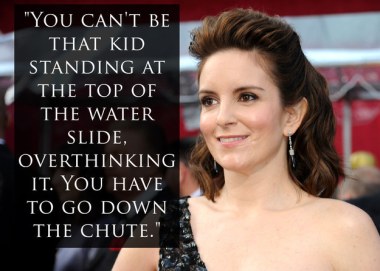
Wednesday on the MS Editors blog, I applied Tina Fey’s rules of improv to writing first drafts. Check it out!

You can't be that kid standing at the top of the water slide overthinking it. You have to go down the chute_Tina Fey

Lara's avatarMS Editors

I’ve mentioned before (in 7 Tips for Writing Realistic Dialogue) that trying improv (the art of performed improvisation) can improve your writing.

Well, currently I’m reading Bossypants by Tina Fey, and in it she gives the rules of improv and describes how these rules have changed her life. The rules are as follows:

  1. Say “YES”
  2. Say “YES, AND…”
  3. Make statements
  4. There are no mistakes, only opportunities

Applying these rules to your writing will help you soldier through a crummy first draft by shutting up your internal editor. The trick is to improv against yourself.

Say “YES”

Stop arguing with yourself and start writing. Stop saying you can’t do it, or it’s too hard, or you need to learn more before you can start. Just start. Your improv partner (you) might be crazy, but go with it. In fact, craziness usually translates into energy, so embrace the crazy and hammer out that…

View original post 653 more words

pg70pit writing contest logo

April 7th on 7th

This is 2016’s second 7th on 7th, where I take a blog subscriber’s seventh page and show you how I’d improve it for the upcoming #pg70pit contest. See the #70pit16 contest schedule here. See more about how to enter the contest here.

Check out the first 7th on 7th, in which I talk about wordiness, breath units, and cleverness.

pg70pit writing contest logo

7th on 7th

THE ORIGINAL PAGE

[Adult Literary Horror]

The backpack’s been emptied every time I shop, but I go through it again, and then the sturdy dressers. Finally I pull the suitcase from underneath the bed. It’s still heavy with stuff that I apparently hadn’t unpacked. Continue reading

What Pop Songs Teach Us about Voice

We’re going to play a game: Name that tune. Can you name the songs listed below? No cheating! I picked a variety of decades and artists. See if you can name them all.

  1. You may say I’m a dreamer / but I’m not the only one
  2. A singer in a smoky room / a smell of wine and cheap perfume
  3. Hanging out the passenger side /of his best friend’s ride / trying to holler at me
  4. Gold teeth and a curse for this town were all in my mouth.
  5. We count our dollars on the train to the party.

What Pop Songs Can Teach Us about Writing Voice

That first song has a line which grabs your attention.

The second line sets the scene with sensory details.

The third comes from a song that defined a term for a generation. But it doesn’t tell us the [Urban] Dictionary definition straight out—it shows us through a scene.

The fourth song uses a handful of similes and other fresh imagery.

The fifth song characterizes the singer and her friends.

Together, these five songs show how important a unique voice is—and how popular a strong one can become.

How do you improve voice?

The opposite of strong voice is a generic, impersonal one. To create a strong voice, do the following.

  • Be relatable and understandable. (Don’t write in a way that the reader can’t follow. Don’t try to spell out dialect or accents phonetically.)
  • Use sensory detail that your character would notice.
  • Show what you mean using people or situations unique to your character’s experiences.
  • Use similes and metaphors. Revise cliches into fresh imagery.
  • Characterize through specific word choice.

Writing Exercise—Fifteen Blinks

Option One: Read this to find out what a Fifteen Blinker is. Choose five to ten specific words or images from one of the songs below and write a Fifteen Blinker using those words.

Option Two: Pick a song with memorable lyrics. Look up those lyrics. Rewrite the song by swapping out the words and imagery for those of another character’s point of view. Some ideas:

  • One of your characters
  • Romeo, the lovestruck Shakespearean teenager
  • A pothead (e.g. one of Cheech’s, Chong’s, or Seth Rogen’s portrayals)
  • A proper British lady trying desperately to impress her in-laws
  • A man who has been cryogenically frozen through several decades and just woke up
  • A seven-year-old who wishes to be a princess
  • A toddler

Want more writing exercises? See my tag. Want some critique partners to exchange work with? Join the community at StoryWorldCon. Want a writing workshop tailored to your work and your budget? Choose your course at StoryWorldCon. Subscribe to my blog for course dates!

Answers:

Click on the links below to read the full lyrics.

  1. “Imagine,” John Lennon
  2. “Don’t Stop Believing,” Journey
  3. “No Scrubs,” TLC
  4. “New Slang,” The Shins
  5. “Royals,” Lorde

I’ve been listening to The Shins for years, but I never actually paid attention to the lyrics in “New Slang” until today. As I referenced above, they’re full of great imagery:

  • Turn me back into the pet I was when we met.
  • I’d ‘a danced like the king of the eyesores
  • New slang when you notice the stripes, the dirt in your fries.
  • Hope it’s right when you die, old and bony.
  • Dawn breaks like a bull through the hall

Every time “Royals” comes on the radio (which is very frequently), I am awed by the fantastic diction. This was written by a fifteen year old: 

  • I’ve never seen a diamond in the flesh / I cut my teeth on wedding rings in the movies
  • We’re driving Cadillacs in our dreams
  • And we’ll never be royals. / It don’t run in our blood, / That kind of luxe just ain’t for us.

What song has your favorite lyrics? I remember in tenth grade English needing to bring a song in to share with the class. I brought Fiona Apple’s cover of “Across the Universe.”

When Voice Doesn’t Match

Have you ever gotten feedback that your book is too literary?

Have you ever been told your protagonist is too old for his or her voice?

But my book is is full of sex and violence! How could you say it sounds middle grade?

Even if your content matches your age category and genre, your voice needs to match, too.

How do you make your voice match genre and age category?

First, determine whether you are using enough Anglo-Saxon or Latinate English.

See my post on the difference between the two by clicking here or on the image below.

diction anglo-saxon latinate-01

Second, make sure your tone and subtext reflect the outlook of your protagonist’s age.

Here are a few observations for three age categories:

A Middle Grade protagonist is concerned about her abilities. She will observe what others are doing and how she fits in—because she does not want to be perceived as babyish or unable—but she still has fun without much effort. A MG voice uses more “can,” “could” and “will” language, probably because preteens think about what they can do currently and what they’ll be able to do in the future.

A Young Adult protagonist is concerned with his identity. What kind of person is he? Who influences the way he thinks? What circles is he in, and how does he act within each? How can he still have fun without wrecking relationships? Others’ perceptions might be more important than self awareness. Writing a YA voice isn’t about injecting slang, which is too easy to do wrong—it’s about implications and subtext that imply tone and feelings. It’s about generating emotional reactions. A teen is also thinking about the physical world in a relational context, so he/she is more likely to talk about body parts than MG or non-romance adult literature.

An Adult protagonist is concerned with purpose and priorities. She’s also going to be more concerned with practicality since she’s got to take care of herself (and possibly others). Work is important, her relationships are important, and she’s still learning more about herself. She’ll be more concerned about consequences than teens or children, so when figuring out personal pursuits, she’s more likely to question whether she’s shirking responsibilities. An adult is more likely to be nostalgic about his or her childhood, looking to the past to inform the future. He or she might also have more regret. Words like “would” and “could” are more likely to creep in.

See Kyra Nelson’s post on her linguistic studies of YA literature and how it differs from children’s and adult lit. It’s fascinating!

Do you agree with these observations? Disagree?