Short Fiction vs Novels AND ALSO…Setting

First, a little bit about my background. Then, the difference between Short Stories and Novels. Last, a word about writing setting, and why it’s more important than I thought. Skip around if you want. I won’t be offended.

my writing background

If you’d asked me as a child what I wanted to be when I grew up, I would have had one of three answers: 1) goalie in the NHL, 2) marine biologist, or 3) actress.

1—I grew up in the desert of Colorado and none of my friends wanted to play street hockey with me.

2—As a child I was deathly afraid of whales. They still totally creep me out.

3—Seemed most viable.

Problem was, this tiny little town I grew up in had very little culture, very few opportunities for me to pursue theater until it was introduced in 8th grade as an elective. Until that point, I read Shakespeare and wrote my own scripts. Writing was a means to an end.

My eighth grade year, my school also finally included a creative writing elective. It wasn’t much, but it was my first real instruction in writing, and it was short stories. I learned that writing could be its own reward.

I continued taking creative writing in high school and decided to major in writing in college (my grandparents, who helped me pay my tuition at this private liberal arts university, forbade me from majoring in the arts. Writing I got away with because I could train as a technical writer). Halfway through my junior year, I changed my major to a combination of writing and graphic design. That choice meant I had to give up some writing classes, and one that I gave up was “Writing of Place.”

I thought it was a good choice at the time. When reading, I usually skimmed or completely skipped paragraphs of exposition, unless I REALLY liked the book and was determined to read every. single. word. Setting seemed secondary to the rest of the novel. Who wants to read twelve paragraphs about how undulating the hilly landscape is? Not I.

Sometimes I just wished that all books were illustrated…

When writing skits or plays, I don’t have to write setting—I can write a line or two and leave the rest to the set designer. Setting was an afterthought.

I have a problem few others share. Most writers write too much and then have to edit, edit, edit, edit to trim the fat. I write a skeleton of a story and then revise and revise to give it some more fat.

So it comes as no surprise that, when I decided to try NaNoWriMo a few year’s back, I got about 3,000 words into my novel and realized that I was about halfway through the plot. That’s not a novel. That’s a pathetic, anemic excuse for a novel. I learned then that a novel is in a completely different league than short stories (not to mention plays).

the difference between novels and short fiction

First, there’s a difference in length.

  • Length—Novels are longest, novellas are shorter, and short stories are shortest. See the numbers below for my recommendations. For more information, check out this post on Novel-Writing-Help.com
    • Novel                  80,000–100K words
    • Novella               20,000–50,000 words
    • Short Fiction    2,500–10,000 words
    • Flash Fiction     fewer than 1,000 words

With all those extra words, novels have more room to explore…more.

There’s a difference in scope.

  • CHARACTERS—Short stories usually focus on one or two characters. Novels often introduce a larger cast of protagonists, antagonists, secondary characters, and minor characters.
  • PLOT—Novels have longer, more complex plots. Short stories have to be simpler than novels because of the length constraint. However, I think there’s more freedom with short stories because they have a selective plot. Making Shapely Fiction is a great resource on the variety of “shapes” short fiction can take.
  • SETTING—Novels take you to more places, switch scenes more often, or stay in one place through more seasons.

And there’s a difference in depth.

  • CHARACTERS—Novels can explore depth of character in more words. But this can be a pitfall, because it tempts writers to spend far too much time in backstory. Feel free to get carried away during the drafting process, but kill, kill, kill! during revision
  • PLOT—Novels have plots, subplots and twists to keep the reader turning pages. Short stories usually focus on one plot line.
  • SETTING—A more generous word count means novels spend more time exploring setting. 

setting

Too much setting, and the reader’s eyes glaze over and they skip a few paragraphs. Too little setting, and you have a novel that no one can connect with because all they can visualize is a bunch of nobodies floating around in nothingness doing nothing. Unless you are Samuel Beckett writing Waiting for Godot, it’s not going to work. In fact, I think that Waiting for Godot is a waste of ink.

You really don’t want to know what I know about writing setting because…I really have no idea what I’m doing yet. But the best resource I have yet found on the subject is “Four Ways to Bring Settings to Life” by Moira Allen. You can read it here. Yes, the website isn’t the prettiest, but the text is what is important.

practice

So here’s your Monday Motivation.

  1. Take a character you know fairly well. Your WIP’s protagonist, your favorite fictional character, yourself, etc.
  2. Choose a mood for your character. Angstful? Annoyed? Embarrassed? Lonely? Something else?
  3. Pick a setting/situation and place your character in it.
  4. What is happening? How does your character react? What does your character notice? Keep his or her mood in mind—how we feel influences what we see and what we do.
  5. Write until you feel satisfied that you learned something or challenged yourself.

The Storybook Synopsis


Today we talk about using as few words as possible to tell a story. It’s a great exercise for synopses writing, query letters, and elevator speeches.

I’ve been reading more picture books to my son lately, and some of his favorite are the five-page, itty bitty board books by Disney.

my first library

His collection seems to be out-of-print. I’d like to think it’s because those stories were so blatantly sexist. But I digress. I’m supposed to be comparing this to a summary of a story.

Think of a Disney movie. Take, for example, my favorite, The Lion King. We’ve already examined The Lion King using my 8 C’s of plotting, so we know that there’s a full story there.
But Disney merch has shown us a plethora of synopses for the story. There are chapter books, story books, picture books, and yes, a 5-page board book. Each is the same story, condensed in varying degrees of complexity.

Some of the 5-page board books have no plot at all. They have one page per character in the story. And you know what else? They are stupid. When agents/editors/publishers read your query letter or synopsis, they don’t want a page per insignificant character. They want to know what your story is. Yes, that means they want to know the plot, right down to the happy or unhappy ending.

Another digression:

I read in How Not to Write a Novel the chapter “How Not to Sell a Novel.” One mistake new writers sometimes make when trying to sell the book is not giving away the ending . Maybe in children’s merchandise you don’t want to tell little 2-year old Sally about the prince slaying the dragon, but I’m pretty sure 3-year old Sally wants to know that the prince is worth his salt. And Publisher Sally wants to know that the new writer she’s considering is worth his salt and can write a decent ending. Don’t annoy the publisher or agent in an attempt to be mysterious.

The best of the 5-page books are like a good movie trailer. They spell out the plot in a condensed manner, but they don’t give everything away. Still, they at least hint at the ending. My husband and I hate watching TV Spots for movies, because lately they seem to never actually tell you what the movie is about. There’s more fading to black than there is content.

Disney will probably sue me and take my puppy away if I give you an example of one of the stories they published, so let me make up an example. Each page has 1-2 sentences. No page has more than 15 or so words. Here’s my uninspiring “5-page board book” of The Hunger Games:

  1. Katniss is a skilled hunter with trust issues.
  2. Peeta can decorate a cake like nobody’s business.
  3. Katniss and Peeta have to fight in the Hunger Games.
  4. They fight for themselves. Children murder other children.
  5. Katniss and Peeta fight for each other.

There, see? I just wrote a synopsis. You can do it, too. Try this method—it’s less painful than gauging your eyes out with a pipe cleaner.

Optional Part One: Pick a Disney movie. Find all the Disney-sponsored books you can about that movie. Chapter books, novels, story books, picture books, coloring books, story books. Read them.

Optional Part Two: Write your own 5-page board books of your favorite books or movies. Then try it out on your own stories.

Non-negotiable Part One Point Five: Enjoy yourself. If you aren’t having fun, pick a different hobby, like coil-building clay pots or macramé.


Brainstorming? Try Mind Mapping

Lately been getting ready for my son’s birthday party and chasing a toddler and puppy around the house. Needless to say, my days have been filled with bodily excretions I’m sure you don’t want me to describe here.

Next week, after Labor Day, we should be back on schedule for blogging here on Write Lara Write. And by “we,” I mean that I will be writing and I hope you will be reading.

Anyway, I wanted to share a really awesome new brainstorming tool called Exobrain. It’s BRAND NEW mind-mapping software. What’s mind mapping, you ask? Remember those webs you had to draw in seventh grade when brainstorming ideas for term papers? They look like this:

via ContentNotes

Well, now you can make a really ridiculously good-looking one even if you have the handwriting of a five-year old and the artistic ability of a naked mole rat.

It’s called Exobrain and it was introduced to be by a designer friend via Twitter. Actually, he tweeted about it to someone else, but it popped up on my feed, and, well, that’s the beauty of Twitter. (P.S. Writers need Twitter, in moderation. You can follow me @Larathelark or click the Twitter button on the top right side of this page to be taken to my profile.)

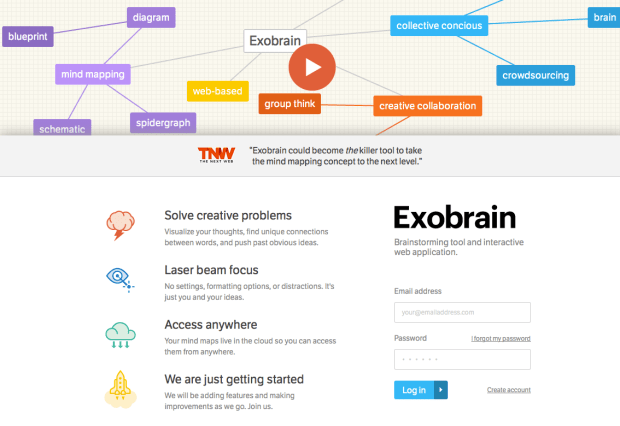
This is what Exobrain looks like when you go to Exobrain.co:

And here’s something you can make with it:

(image taken from video, below)

And here’s a video of how it works:

I’ve been using it today for some of my design work and am really enjoying it. I am excited to try it out for brainstorming new story ideas.

You DO need to log in and create an account, but you create an account simply so that you can access your mind maps (or “webs”) from anywhere in the world. There’s no need to back-up the information—Exobrain saves automatically. There are other mind mapping websites out there, but they can be a bit clunky with too many options and no real eye for design. This is a beautiful piece of software, and they are improving it everyday. There isn’t an availability to collaborate and share maps as of August 30, but they are working on that.

Once you create an account, you are given a default map. READ IT—it describes how the functions work. Then you can alter and add or delete as you please! You can save multiple maps, too.

Have fun with your brainstorming!

Pixar Story Rules

And also a bit of

The moving truck that has all of our personal belongings (i.e. all of my books) is still somewhere between here and the Ozarks. So while I intended to write this week’s Fiction Friday about writing scenes—a topic I definitely struggle with—that’s not going to happen until next week.

So, again, in lieu of a post, I’ll share with you a great site and resource for writers. This blog post is a compilation of tweets by Pixar story artist Emma Coats. She shares, in 140 characters or fewer, more than 20 story writing ideas and tools. Here’s one:

#11: Putting it on paper lets you start fixing it. If it stays in your head, a perfect idea, you’ll never share it with anyone.

Check it out, try some of the writing exercises. HOPEFULLY our moving truck will be here on Monday, so I can get you a legitimate blog post on setting.

Adieu for now!