Chapter Outlining like a Pantser

I know, I should be writing my novel and not using up words by blogging. But there’s something about a baby’s screaming that sucks the creativity right out of me. So say hi to baby R, everyone. He’s on my lap sniffling while I type this one-handed. 
Chapter Outlining Like a Pantser | Write Lara Write

I wanted to share how I’m outlining my novel. I’m a pantser, but my pantsing has yet to flesh out a working manuscript, because novels are so very different from short fiction and because I can’t write by the seat of my pants when I’m writing about a setting I’m still largely unfamiliar with (England, 12th century). Research has to come first, and then the exposition follows.
My last few attempts at fleshing out this manuscript have been as a plotter, but after all the planning, I have a skeleton and some ligaments. Now it’s time to add the meat, then the skin, the hair, the eyeballs, some freckles, and some pimples before I can present it as a living thing that can go out into the world.

Step One: Have (at least a vague idea of) a plot.

I’ve written many posts on plot for you, complete with my own method for plotting and downloadable worksheets for you to try. If you don’t have the 8 C’s, though, at least have an idea of the introduction, rising action, climax, falling action, and resolution. Obviously I came up with my own method for a reason—the other methods weren’t hacking it for me, because I needed something more spelled out—but I also recommend the Plot Rollercoaster found in the novel planning workbook from NaNoWriMo. Download the workbook for free here.

Step Two: Outline

My outline is basically a Plot Treatment. Read about plot treatments and its value for both plotters and pantsers in my post “Letters from Anne Lamott.” But instead of writing paragraphs for each chapter, I’ve basically made it into a hybrid plot treatment and beat sheet.

Here’s the basic format.

Chapter [number or title]

Point A (How it begins)

Point B (How it ends)

What happens between those points?

What questions are answered?

What questions are still unanswered?

What needs to be researched?

That last one is especially applicable for me, because I’m writing historical fiction, so it might not be as important for you.

I suggest being open with the beat sheet part (the “what happens between those points”) at first, especially if you’re a pantser, so that your outline doesn’t limit your creative juices while pantsing it from A to B.

Here’s the format filled out for the first chapter of The Hunger Games:

Point A (How it begins):

This is the day of the reaping

Point B (How it ends):

Prim is chosen

What happens between those points?

  • Introduce Prim and mom, Buttercup the evil cat
  • Establish setting: District 12, the Seam
  • hunting is illegal
  • The capitol, dystopia
  • Gale; he wants to leave
  • Establish setting: The Hob
  • Madge
  • the reaping: its system for choosing tributes, getting ready, Effie and Haymitch

What questions are answered?

  • Who is the protagonist?
  • Who are her friends and family?
  • Where does this take place?
  • What kind of world is it?
  • Why should I read this book?
  • What’s Panem? What are the Hunger Games?
  • Will Katniss be chosen?

What questions are still unanswered?

  • How will Katniss react to Prim’s being chosen? How will every one else react?
  • Who will be chosen as the boy tribute?
  • Who will survive?

Research:

Suzanne Collins may have needed to research hunting for this chapter.

I’ve got the first twelve chapters laid out like this so far. I make sure the chapters will end at a point that leaves more questions than that chapter has answered. Then the next chapter either begins with a reaction to that point, or it goes somewhere else entirely, and then comes back to that reaction. I’ve heard the quote, “Never take your reader where they want to go.” In this context, another way of saying that is “Don’t answer your reader’s questions right away.” Your suspense will keep them reading.

Since my book will have a sequel, there will be some questions that won’t be answered at the end of this book, but most of them will be tied up to form a conclusion. Try to answer at least a couple questions per chapter to appease the reader. They need to be far enough away from the answer to keep them running after it, but close enough that they can remain interested. If you want a dog to chase a rabbit, the dog has to be able to smell the rabbit.

Next steps for me are finishing this outline, choosing a chapter I want to write, doing the research for that chapter, and then writing that chapter like I would write a short story—with as much pantsing as possible to connect from point A to B. If I end up at point x, then I adjust my outline once I get stuck, and then I keep going.

Do you outline? Do you use beat sheets? Do you use them while writing? During revisions?

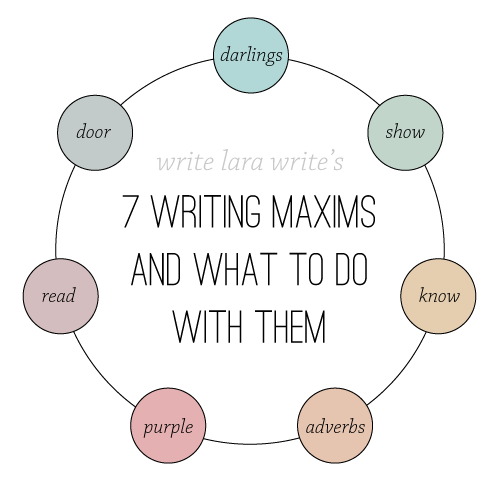
7 Writing Maxims and What to Do with Them

To the recent influx of new followers: Salutations! In your honor, I thought I’d welcome you with a post on the most common writing advice I hear, and whether or not you should actually listen to it. I hope you enjoy your stay at my little corner of the blogoverse.
maxim

Contents:

  1. Kill your darlings
  2. Show, don’t tell
  3. Write what you know
  4. Eliminate adverbs
  5. Avoid purple prose
  6. If you don’t have time to read, you don’t have time to write.
  7. Write with the door closed. Rewrite with the door open.

1. Kill your darlings

I hear this all the time. I also look forward to the movie. The actual quote is “murder your darlings” and comes from Sir Arthur Quiller-Couch’s On the Art of Writing:

“Whenever you feel an impulse to perpetrate a piece of exceptionally fine writing, obey it—whole-heartedly—and delete it before sending your manuscript to press. Murder your darlings.”

Sometimes authors take “kill your darlings” somewhat literally and kill off their favorite characters. If it’s taken completely literally, as suggested by the movie title, then writers would be murderers.

How it’s usually applied: “If I am attached to something I wrote, then I can’t be objective about it, so I won’t cut it out when revising, even though it doesn’t belong.”

Sometimes I’ve seen “kill your darlings” taken to extreme: “If I liked writing this, it must be awful. I’d better cut it out.” Give yourself some credit! If you enjoyed writing it, then someone else might enjoy reading it. However, the question to ask yourself is whether it belongs in this story.

Even Stephen King, whom I will refer to frequently in this post because On Writing is so widely read, used the “kill your darlings” mantra:

“Mostly when I think of pacing, I go back to Elmore Leonard, who explained it so perfectly by saying he just left out the boring parts. This suggests cutting to speed the pace, and that’s what most of us end up having to do (kill your darlings, kill your darlings, even when it breaks your egocentric little scribbler’s heart, kill your darlings)…I got a scribbled comment that changed the way I rewrote my fiction once and forever. Jotted below the machine-generated signature of the editor was this mot: ‘Not bad, but PUFFY. You need to revise for length. Formula: 2nd Draft = 1st Draft – 10%. Good luck.’” —Stephen King (quote taken from here)

What’s interesting is that when Quiller-Couch said “murder your darlings,” he wasn’t talking about being sentimental about good writing, and he wasn’t talking about pacing, either. He was talking about ornamental writing (see #5). So whenever you hear “kill your darlings” or are tempted to use it yourself, swap it out for this instead, which is what people really mean when they quote it:

“Don’t put anything in a story that does not reveal character or advance the action.” —Kurt Vonnegut

Does it have to reveal the character of the protagonist? No, you can characterize even background characters. The Sun Is Also A Star does this with every speaking character. But each of those characters should be relevant to the theme and their actions should affect your main plot.

What’s important: Pacing, character, and action are important. Think of these things when you are revising, and then take out whatever slows down the action or doesn’t reveal character. To help with that, this scene questionnaire from The Script Lab is a great resource worth bookmarking.

Boot it or take it to heart? 

boot Boot the idea that you should get rid of writing that you’re attached to.

heart Take to heart that pacing and character or thematic development trump your sentimental attachment. If a scene is self-serving and not story-serving, take it out. Keep it for a different story or save it for “deleted scenes” you can share with fans on your website or in future printings.

2. Show, don’t tell

The reason this is such a war cry for editors and writing professors is because it’s good advice. A story becomes more resonant with a reader if it’s experienced. If you paint a picture with your words, then the reader has a more intimate connection with your writing than if you just tell them what to feel.

For example, you could tell me that a guy had big, bulgy muscles, or you could describe him throwing a hay bale into the back of his pickup truck, the buttons on his shirt puckering from the stress, revealing a sliver of sweaty skin. And then you’d delete that if you weren’t writing romance, and if you were writing romance, you’d rewrite the whole thing, or at least the “sliver of sweaty skin” part because alliteration is sometimes one of those darlings that points to the writer and takes readers out of the story.

Do you need to tell us that one of your characters is 6’10”? If you want the reader to know that a character is tall, have them duck under a low-hanging chandelier, or have someone else stand next to them at chin-level. Something else to show how tall a character is. Does your world even have feet and inches? Do you want to limit casting options for an adaptation of your work?

How it’s usually applied: it’s better for a reader to feel things for him/herself than be told how to feel.

However, is telling always bad? No. I refer you to “5 situations where it’s better to tell than show in your fiction” on io9 for that information. Just remember your narration style when working information in. You can’t use the example from io9, “Diana was a mutant, but so far the only mutant power she’d manifested was passive-aggressiveness,” no matter how clever it is, if you don’t have a clever narrator, and you can’t reveal anything at all as the narrator if you’re using a Third Person Objective/Cinematic narrator.

What’s important: Giving your reader an experience and keeping your narrator’s voice consistent

Boot it or take it to heart? 

boot Boot the idea that telling is always worse. It’s much better to say that a character opened up a door than go into excruciating detail about the journey to the other side of the room and the way the doorknob feels in her hand.

heart Take to heart that we are more apt to remember experiences than words, so use your words to create an experience for the reader. Also remember that “show, don’t tell” is feedback that should be given only in certain instances—novels still need narration, or else they wouldn’t be novels! “Show, don’t tell” is not a universal rule. It means, “Don’t use abstract words here when you could give concrete evidence.

3. Write what you know

I could write a whole post on this, but I’ll spare us both the time and skip ahead:

Boot it or take it to heart? 

boot Boot any part of this that limits you as a writer. You are a human being, and you know what it’s like to be a human being. Empathize with your characters. Focus on the emotions you and your characters have felt, and use them in your writing.

heart Take to heart that authority is important to readers. If you don’t know something, you can do research, and then you will know. Don’t know what it’s like to be a murderer? You can probably figure that one out using your imagination without actually killing something. Or if you want, you could interview a murderer or read a memoir of one. Just remember that people lie. Don’t know the difference between annuals and perennials? Look it up on Wikipedia, for heaven’s sake. Just remember that Wikipedia lies. And if you’re writing about a culture that isn’t your own, for heaven’s sake, do research, and then humbly ask people from that culture to read your work. Sensitivity readers, unlike usual beta readers, are usually paid for their time because they are coaching you on their life experience.

Some narratives are not yours to tell. Make room for #ownvoices.

4. Eliminate adverbs

Adverbs are guilty until proven innocent. —Howard Ogden

Adverbs aren’t the cause of lazy writing, but they are often a symptom of either redundancy or vagueness. Let’s use dialogue tags as an example.

“Hurry, Bella,” Alice interrupted urgently.

This is an example in redundancy from Stephanie Meyer. First off, “interrupted urgently” is redundant. If you are interrupting, you are being urgent. Second, the dialogue itself (“Hurry”) suggests urgency and an interruption. Third, do we really need to be told that Alice is interrupting urgently, when we could be shown that Alice is urgent with her actions, hopefully with something less cliche than her foot tapping?

Maybe Meyer used so many dialogue tags because she was afraid of vague or boring verbs. Why say “said angrily” when you can say “hissed”? (Want more examples of obtrusive dialogue tags? Look no further. ) Well, when it comes to dialogue tags, less is more. Sorry, Meyer. But in other situations, it is better to go with a more descriptive verb than a verb who lets an adverb pull all the weight. It’s better to say “heaved” than “picked up with difficulty” and it’s better to say “charged” than “ran forcibly.”

“Very” can almost always be eliminated:

Substitute “damn” every time you’re inclined to write “very.” Your editor will delete it, and the writing will be just as it should be. —Mark Twain

This fantastic “10 Mistakes List” lists some “empty adverbs” you should avoid. It also includes a section on showing versus telling.

You don’t have to eliminate all adverbs. But do eliminate ones that intensify a lazy verb as well as the lazy adverbs

Boot it or take it to heart? 

boot Boot the idea that all adverbs are evil. Do examine them to see if they are trying to cover up lazy writing.

heart Take to heart that adverbs are often a sign of redundancy and vagueness. Do a search in your document for “very” and “ly” to find most adverbs and see if they could be improved with better writing, and then go through your work sentence by sentence looking for other signs of redundancy (like two-word prepositions) and vagueness. Ask your Beta readers to look for redundancy and vagueness as well. And read my posts on revising if you’d like to enhance your voice further.

5. Avoid purple prose

“I notice that you use plain, simple language, short words and brief sentences. That is the way to write English—it is the modern way and the best way. Stick to it; don’t let fluff and flowers and verbosity creep in. When you catch an adjective, kill it. No, I don’t mean utterly, but kill most of them—then the rest will be valuable.” —Mark Twain (letter to D. W. Bowser, March 1880)

Writers. Violent, right? First we talk about murdering darlings, then we talk about eliminating adverbs… now adjectives are facing genocide from wordsmiths.

Purple prose, or ornamentation, or lofty, flowery language—this is what the great writers will warn you to stay away from. THIS is what Sir Arthur Quiller-Couch was referring to when he said to “murder your darlings”:

To begin with, let me plead that you have been told of one or two things which Style is not; which have little or nothing to do with Style, though sometimes vulgarly mistaken for it. Style, for example, is not—can never be—extraneous Ornament. You remember, may be, the Persian lover whom I quoted to you out of Newman: how to convey his passion he sought a professional letter-writer and purchased a vocabulary charged with ornament, wherewith to attract the fair one as with a basket of jewels. Well, in this extraneous, professional, purchased ornamentation, you have something which Style is not: and if you here require a practical rule of me, I will present you with this: ‘Whenever you feel an impulse to perpetrate a piece of exceptionally fine writing, obey it—whole-heartedly—and delete it before sending your manuscript to press. Murder your darlings.’ (On Style, Wednesday, January 28, 1914)

Why would he say this? Because amateur writers cling to their thesauruses like lovers, believing that an affair with vocabulary will win them the jealousy and affection of others. Unfortunately, it’s often true. Look at the book sales of Eragon. Look at the kinds of politicians people used to vote for.

Many of the most beloved writers of all time write about this subject:

“Prose is architecture, not interior decoration.” ― Ernest Hemingway

“One day I will find the right words, and they will be simple.” —Jack Kerouac

“Any word you have to look up in a thesaurus is the wrong word. There are no exceptions to this rule” —Stephen King

I’ve said before, when mentioning his disdain for writer’s notebooks, that Stephen King must have a better memory than I do, because I often refer to the thesaurus to help me find the word that is at the tip of my tongue. The point is that you don’t use a thesaurus to pick out words you don’t already know. If, though, you are like me, and you find yourself saying “What’s that other word for ‘distracted’? The one where, you know, you can’t focus because you’re concerned with something else? …pulls up thesaurus.com... Oh, yes. Preoccupied.”—If you’re like that, it’s really okay to use a thesaurus. Just be sure you already know what the word means.

And poetic language is beautiful! There’s a time and place for everything. Gorgeous observations are better placed in sections of “sequel” after the more quickly paced “scenes” of action. Don’t stop to write a paragraph on the smell of roses when your main character is being chased by an axe murderer unless you’ve already made room for that silliness in your style leading up to the scene.

Boot it or take it to heart? 

boot Boot the little Stephen King that sits on your shoulder and judges you when you use a thesaurus to help resuscitate your vocabulary.

heart Take to heart that pompous language separates you from your reader. You can use a five-dollar word once or twice, but use diction appropriately for your genre and audience. (Check out my posts on diction here.) Know your genre and what level of poetic language that audience expects.

6. If you don’t have time to read, you don’t have time to write.

If you want to be a writer, you must do two things above all others: read a lot and write a lot. —Stephen King

One thing I learned in my writing classes was that writing is really an ongoing conversation. When you write, you converse with the reader, but you also converse with the writers you’ve been reading. You will never improve as a writer if you aren’t reading. Not just any reading, either. Most magazines and newspapers won’t cut it. Status updates and tweets certainly won’t. Nope, not even blogs. You need to read poetry and good fiction in and outside of your genre.

Read widely and with discrimination. Bad writing is contagious. —P.D. James

Try for a diverse and balanced reading diet: award-winning and bestselling; recently published and old favorites; fiction and nonfiction; poetry and prose; in and out of your genre and age category.

You can’t figure out what “bad writing” is without reading a lot and making that decision for yourself. What kind of writing do you want to emulate? What kind of publisher do you want to work with? What genre and audience do you want to write in and for?

Boot it or take it to heart? 

boot Boot the idea that any reading is good reading.

heart Take to heart that reading is just as important as writing, but don’t let reading nonfiction about writing keep you from writing fiction. Read poetry and fiction that inspires you to write. If you’re just getting started, try Li-Young Lee’s poetry, Letters To A Young Poet by Rainer Maria Rilke, and Interpreter of Maladies by Jhumpa Lahiri. Suggest your favorite things to read in the comments. Join Goodreads and get ideas for books in your genres that way.

7. Write with the door closed. Rewrite with the door open.

This is another Stephen King quote, which I frequently have heard quoted out of context. At first I read it in terms of distraction. Hide yourself in a cave or rent out a hut in the forest when you’re writing, but when you rewrite, embrace the chaos around you. You can tell I work from home and have littles running around. Maybe you read something else into this quote. Anyway, here’s the context:

“Your stuff starts out being just for you, in other words, but then it goes out. Once you know what the story is and get it right — as right as you can, anyway — it belongs to anyone who wants to read it. Or criticize it.”

So basically it’s like Anne Lamott’s Sh*tty First Drafts. Just get out the first draft (Hemingway refers to them as excrement), and then figure out what your story is about. Then rewrite it. THEN let other people help you as you continue rewriting it.

You’ll notice he doesn’t say, “Write with the door closed. Open up the door when you’re good and finished.” Rewriting is a process, and though introverts like me hate to admit it, rewriting needs the help of another pair of eyes. We need to get out that first draft, make sure it’s coherent, and then give it to other people—beta readers—to give us feedback so we can rewrite it better. Then we give it to our agents and editors, who give us suggestions. Then we rewrite some more. Then we get published, then the readers get the final product.

Boot it or take it to heart? 

boot Boot people out the door when you are trying to write your first draft. Better yet, try to get away with people having no clue you’re writing something. I’ve heard the more people you talk to about a work, the less likely you are to write it and finish it. Tell your significant other and immediate family, so they don’t think you’re a p*rn addict when you lock yourself in your room with your computer, but try to keep to yourself until you have something to share and rewrite.

heart Take to heart that writing is a community effort, even if you are a self-publishing introvert. No matter how good you are as a writer, you are blind to your mistakes sometimes, and an outsider’s point of view is necessary to bring you up to a greater potential. If you ever want another person to read your work, then you are going to have to involve other people into your rewriting process. Don’t worry, it still belongs to you!

And please don’t think I’m against self-publishing. Absolutely not! I’m against writing without input or editing. Unfortunately it can be hard to tell when independent writers invested in getting outside feedback and when they hit “publish” with editing and proofreading as an afterthought.

Next time: The Myth of Writer’s Block

Further Reading: Kate Brauning’s Twitter thread on showing and telling

Your turn: What other writing maxims have you heard? What are your opinions on these seven?

QUIZ: How should you start your novel?

First, a Pop Quiz

I’m going to give you four openings of books, and you tell me how they hook the reader. Why does the reader keep reading?

1. In my younger and more vulnerable years my father gave me some advice that I’ve been turning over in my mind ever since. “Whenever you feel like criticizing anyone,” he told me, “just remember that all the people in this world haven’t had the advantages that you’ve had.”

2. First Lieutenant Jimmy Cross carried letters from a girl named Martha, a junior at Mount Sebastian College in New Jersey. They were not love letters, but Lieutenant Cross was hoping, so he kept them folded in plastic at the bottom of his rucksack.

3.  When I wake up, the other side of the bed is cold. My fingers stretch out, seeking Prim’s warmth but finding only the rough canvas cover of the mattress. She must have had bad dreams and climbed in with our mother. Of course, she did. This is the day of the reaping.

4. When Mr. Bilbo Baggins of Bag End announced that he would shortly be celebrating his eleventy-first birthday with a party of special significance, there was much talk and excitement in Hobbiton.

Here are the sources for the openings:

  1. F. Scott Fitzgerald, The Great Gatsby
  2. Tim O’Brien, The Things They Carried
  3. Suzanne Collins, The Hunger Games
  4. J.R.R. Tolkien, The Fellowship of the Ring

Here are my answers of what might be going through a reader’s mind as s/he reads the openings:

  1. That’s an intriguing idea. I wonder what more the author has to say or show about it. (Answers)
  2. I want to know more about this guy; he seems interesting. (Character)
  3. Immediate: What’s the Reaping? By the end of the chapter: What happens next? (Answers, Time)
  4. Who’s Bilbo? Where’s Bag End? Eleventy-first birthday? A Party? Hobbiton? (World)

Earlier this week I posted about WATCH, a method of figuring out which of four elements your novel focuses on. Each novel has all four, but novels generally stress one over the others. When you know which element is your focus, you have a good idea of how to start and end your novel, giving it continuity. The four elements are World, Answers (or theme), Time (or events), and Character. Read about them on the previous post.

Tricky Beginnings and Endings

Beginning and ending your book with your focus element is a helpful tip. It isn’t a rule. To Kill A Mockingbird begins with a statement about Jem, Scout’s brother, then talks about events leading up to his injury, and then the book ends on theme.

Tuck Everlasting begins with a mystery and ends with a theme, but the epilogue ends with more events. All together, the story is a Time story—readers want to know what happens next.

The Outsiders starts by talking about the narrator and ends with him wanting to tell the world about his friends. The book’s themes and plot and world are important, but the story begins and ends with character.

A Study in Scarlet is a mystery, but the first chapter is about Dr. Watson introducing himself and then being told about Sherlock Holmes. But even the character of Holmes is its own mystery, which is why the reader doesn’t want to know how the characters grow so much as answer the question of who they are.

Isaac Asimov’s Foundation begins with an “excerpt” from the Encyclopedia Galactica. It’s not difficult to guess that World is definitely a focus in his books.

A Note Regarding Prologues

Agents want to read and represent a book that hooks them from the first paragraph. That’s why plenty of agents despise prologues. But wait, you say, plenty of fantasy and sci-fi books start with prologues. If World is your focus, you’re more likely to get away with a prologue. If the focus is Character or Answers, then you likely should not have a prologue—backstory and answers should be revealed throughout the book. Don’t give your milk away for free if you’re trying to sell a cow.

If you are debating about including a prologue, first consider the following:

  • Is there any other way you can effectively incorporate this information without putting it at the beginning?
  • Is it really that necessary?
  • Do you care that many readers will skip over it?
  • Do you care that it might annoy potential agents or publishers?

If you absolutely must include a prologue, I suggest titling it Chapter One rather than Prologue. Include a date or time stamp there and on Chapter 2 to show a shift in time or place.

YOUR Beginning: Another Quiz!

When writing or revising your beginning, ask yourself what is important to you as a writer and as a reader.

Answer each question yes/no. Then rank your “Yes” answers in order of what matters most to you.

  1. Do you want to be thought of as poignant or thought-provoking?
  2. Do you want to be known as exciting?
  3. Do you want to be known for your imagination?
  4. Do you want to be known as an intimate person?
  5. Do you read books to escape?
  6. Do you put down a book if it’s boring?
  7. Do you enjoy books that make you think?
  8. Do you tend to forget about the plot in books you’ve read, but always remember the people?
  9. Do you want people to fall in love with your characters?
  10. Do you want people to enjoy your fictional universe as much as (or more than) you do?
  11. Do you want your book to be memorable for its themes?
  12. Do you want your book to be a page-turner?

What matters most from questions 1–4: ___ (1-A, 2-B, 3-D, 4-C)

What matters most from questions 5–8: ___ (5-D, 6-B, 7-C, 4-A)

What matters most from questions 9–12: ___ (9-C, 10-D, 11-A, 12-B)

If you answered mostly A’s (Answers)—Start your book with a theme and end it with the final statement on the theme. For the rest of the novel, be sure to illustrate (show) rather than explain (tell) so you don’t get preachy. These are the books that, when thematic and done right, change people’s lives and become their most beloved books. When structured as mysteries or capers, these are the most open to becoming series.

If you answered mostly B’s (Time)—Start your book immediately with the inciting incident, and end each chapter with a change of events. Finish the book with a final change of events (which might be a cliff-hanger if this is part of a series). These books are the ones that people can’t put down and recommend to their friends because it’s such a thrilling read.

If you answered mostly C’s (Characters)—Start and end your book with interesting details about the character. Voice is everything. So is making the character sympathetic by using rooting interests. These are the books that people fall in love with, that generate the most fan fiction.

If you answered mostly D’s (World)—Fascinate them with the world you create. Start with a regular day, if it’s really amazing. Otherwise begin with the most interesting places or event in your world, and end once the world finds a new normal. These are the books that people immerse themselves in—the ones that generate the most cosplays and fan art. They have a very high potential for spin-offs. (They are also the ones that have the highest costuming and CGI budgets when transferred to film!)

Choosing the best kind of beginning for your book

Relevant Links

WATCH, or: Where to Start and End your Novel

This post explains the acronym WATCH, asks what kind of novel you’re writing, and then teaches you where/how to begin and end your novel. Short fiction writers—don’t fret. You can learn about beginning and ending your stories effectively, too.

I’ve been reading Characters and Viewpoints by Orson Scott Card* and learning so much about point of view and types of novels that I’ve not read anywhere else. So of course I’m going to share what I’m learning with all of you!

[*EDIT: When I read the book and wrote this post, I was unaware that Orson Scott Card is homophobic. As such I do not recommend his book. I still learned something from it though, and I’ve shared that below.]

My main takeaway was his idea of a “MICE Quotient.” He says there are four types of stories. Each story has all four elements, but stories will emphasize one more than the others. M.I.C.E. stands for Milieu, Idea, Character, and Event.

I think his use of “Idea” is a bit misleading, and I’d probably have to look up “milieu” again every time I saw it in the future. So I created my own mnemonic device that works well in the context of my time-traveling historical fantasy.

W.A.T.CH.: Which will you focus on in your writing?

WATCH

  1. World
  2. Answer
  3. Time
  4. CHaracter

Okay, I know the H in “character” is silent. Nobody’s perfect.

World

This is Card’s “Milieu,” but “world” is far less pretentious and more memorable, in my humble opinion. You’ve probably heard of “world building” if you are familiar with Sci-Fi and fantasy, or the broader term “universe.” World concerns itself with setting, place, time, culture, customs, manners, and the like. Every novel has some degree of its own world. In some stories, though, the world-building is so central to the book, it almost becomes a character itself.

Westerns, epic fantasy, and historical fiction tend to focus on World.

Answer

This is what Card refers to as “idea,” but I think “Idea” has connotations of “theme” and not much else. An Answer story poses a question or a problem that needs to be answered or solved by the end. The question could be obvious—”Who murdered Mr. Boddy?”—or it could be figurative. If it’s figurative, the answer might very well be the theme of the story. Take The Great Gatsby, for example. While the World (1920s), Time (events), and Characters (Gatsby, Carraway, Tom, Daisy, etc.) are all important and well-developed, they are all used to illustrate the themes (money, power, time, etc.). An allegorical story like Pilgrim’s Progress has universal, and thereby flat, characters, but it can get away with it, because the story is about finding answers. What is Christian’s purpose? To get to the Celestial City.

Mysteries, capers, allegory, and some sci-fi and classical fiction focus on Answers or theme.

Examples: Sherlock Holmes mysteries, Ocean’s Eleven, Pilgrim’s Progress, The Great Gatsby

Time

Time deals with events. Cause and effect. The plot. What happens. If you’re trying to get a writing degree at a respectable university, they will tell you that Character must always trump plot. And while that’s true for literary fiction, it’s not true for all fiction. Anne Lamott, whom many of us regard as one of the finest writing instructors alive, urges writers to think about characters and their motivations, hang the plot. But in Bird by Bird, she confesses that she had to rewrite one of her novels countless times, because the plot made no sense, and her editor kept telling her it didn’t work. So she learned how to do a plot treatment, and she fixed it. Plot gets thrown under the bus by some respectable writers, but it’s definitely important.

I really enjoy character-driven short fiction, but if I pick up a novel in which nothing actually happens, I’ll throw it across the room and rage about it to my poor, unsuspecting husband. Popular fiction, the kind that is nearly impossible to put down, focuses on Time and what happens in the book. Hopefully the characters will change by the end of the book, but that isn’t always the case. Katniss Everdeen isn’t the deepest character on the shelf, but she sure does a lot.

Time novels start with something amiss that needs to be fixed. They right a wrong; they “save” women from spinsterhood. Or at least they try to fix the problem. They primarily try to change what happens, though the people in the story are usually changed, too.

Because they deal with problems, the line between Time stories and Answer stories can be a blurry one. The difference is that in an Answer story, something is learned or realized, resulting in an understood truth. But in a Time story, something happens, resulting in a shift in circumstance. Answer stories have an intellectual conclusion, whereas Time stories have a physical one.

Dystopian, disaster, justice/revenge, thriller, horror, sci-fi and romance are generally Time- or event-focused.

Examples: The Hunger Games, Jurassic Park, The Count of Monte Christo, The Da Vinci Code, Dr. Jekyll and Mr. Hyde, Doctor Who, Pride and Prejudice, Bridget Jones’s Diary.

Character

A character-driven novel is one in which the most important factor isn’t what happens, when and where it happens, or the author’s intent. The important thing in a character-driven story is personal growth. The character should change for the better or for the worse. If the character doesn’t change, the reader grows in understanding of why that character will never change.

Contemporary literary fiction concerns itself primarily with character: who characters are and why they act the way the way they do. Motivation, motivation, motivation.

General fiction, literary fiction, and the bildungsroman (a coming-of-age story) depend primarily on character.

Examples: To Kill a Mockingbird, The Things They Carried, Huckleberry Finn

How to begin and end the story

Bilbos-Birthday-Party

World

When the world in your story is the focus, you begin by introducing the world. “In a hole in the ground there lived a hobbit.” Tolkien created a gigantic universe that is Middle Earth. His stories begin by showing what life is like. Then things begin to shake that world up a bit. Orson Scott Card gave the example of The Lord of the Rings. Why does the story not end when the One Ring is destroyed? Because the story isn’t just about Frodo Baggins and his Fellowship; it’s about how Middle-Earth completely changed. So the story ends not at Mount Doom, or at Aragorn’s coronation, or after the scouring of the Shire. It ends when the last of the elves leave Middle Earth. The world has changed. It’s changed for Frodo, too, so he leaves with the elves.

Grey Havens

Where are my tissues?

Answer

If you’ve read or watched many mysteries, you know they all start the same. They might have a couple of lines or minutes introducing the protagonist as a person capable of solving a mystery, but they really start when someone’s been murdered or another crime has been committed. They start with a mystery or a question. Why do you think some people call mysteries “Whodunits”? The story ends when you find out who did it.

study-in-pink

In theme stories, the story begins with theme and ends with theme. The Great Gatsby begins with advice (given in the past) about considering someone else’s history against your own, and how those histories have affected your presents:

“In my younger and more vulnerable years my father gave me some advice that I’ve been turning over in my mind ever since. ‘Whenever you feel like criticizing anyone,’ he told me, ‘just remember that all the people in this world haven’t had the advantages that you’ve had.'”

It ends with the message that even though we make effort to change our futures, we will always be pulled back to our past:

“So we beat on, boats against the current, borne back ceaselessly into the past.”

You end the story once the characters or the reader has a new understanding.

In a series of Answers stories, they might end on a new question. Readers read the next book to have the new question answered. That’s usually how seasons of Castle end. And if you watch Sherlock, you really know what I mean about ending on a question!

Time

Time stories begin by showing you what’s wrong. There might be a quick introduction of characters, but then we see what sort of circumstance the characters are in, and they realize they’ve got to do something about it. Or they reject it but end up doing something anyway.

Lizzie Bennet Diaries

My mom gave me this shirt.

The Hunger Games begins with the Reaping. Pride and Prejudice begins with a woman who, according to her mother, needs a husband (preferably a rich one). Doctor Who episodes usually begin with the discovery of aliens bent on the destruction of the universe.

Time stories end when circumstances change. The woman gets married; the world is saved. Justice is had; someone is avenged. They basically end when there’s nothing else to tell—nothing else happens to change the circumstance of the world or of the protagonist. At least not until the sequel. If a time story is part of a series, one story might end when the circumstances change in order to create a new story. The Hunger Games ends after circumstances change for Katniss and Peeta. They’ve hit a new normal. But Haymitch assures them that more change is to come. Catching Fire is notorious for its cliffhanger ending.

Pride & Prejudice wedding

The story ends here when it’s one about finding romance. Achievement unlocked.

Character

Character stories begin with the character living a normal life.

500 Days of Summer Todd Hanson

Everything that happens in the story affects the character somehow, and by the end of the story, the character has grown. Character stories end with the change or growth in character. A new life for the character has begun.

(500) Days of Summer is not a love story, it’s a character story. It doesn’t end with a relationship, it ends when Tom finally gets a life. (I adore this movie.)

Chris Oatley has a great post on “How to Write Great Character Introductions” [archived] over at Paper Wings Podcast. If you’re writing a character-driven story (and even if you aren’t), be sure to read it.

—-

Take some time and think about your favorite books and movies. What kinds of stories are they? Where do they begin? How do they end?

Be sure to check out WATCH Part Two—a quiz on where you should begin and end YOUR novel.

Once I get through my notes and finish Characters and Viewpoint, I’ll be starting a new series on Point of View. Subscribe or follow me on Facebook to stay in the loop!

beginning & ending your novel: a lesson in genre