I’m a visual person, so I appreciate graphs, especially color coded ones! But I’m also a design person, so color schemes get to me. While their color scheme makes me shudder a bit, I am digging this visual representation of English word origins!
Read the original study here. If you hover over the highlighted words, you can see the origin of the word. Click a word, and you’ll be taken to its entry in the etymology dictionary. Pretty nifty stuff!
Interested in English word origins? Did you know that Old English (that big pink chunk of the pie) has Germanic roots? Be sure to read my post on Anglo-Saxon versus Latinate Diction.
This is Part 6 of The 8 C’s of Plotting. Click here for the whole series on the 8 C’s. Or click the image below to be taken to the General Fiction Feed.
Since last week’s post was a bit late, I’m going to round out the rest of Act 2 today. Buckle up; it’s a lot of new stuff.
Last week we talked about Preparation and Problems, the longest section of the book. We also mentioned a thing or two about Pinch Points.
As you may have noticed, the 8 C’s is based loosely on the 3-Act structure, but there are differences. If you’d like the 3-Act structure broken down into a list of terms and regulations, read Larry Brooks’ posts on StoryFix (while I think his blog is valuable, I will say he tends to ramble, and the last time I visited the site, navigating from post to post was about as easy as scrambling up a fireman’s pole).
I’ve read literally hundreds of blog posts and articles and books about the 3-Act structure, yet I was still dissatisfied to the point of creating my own method. Why? The Midpoint. No one can seem to pinpoint it exactly. There are varying definitions: It’s an epiphany, it’s a change in tactics, it’s the turning point or “point of no return.” Yet people will take a book or movie and argue what the midpoint is. Or, if you are in a literature class looking at Freytag’s Pyramid, what the CLIMAX is. Note, the climactic scene—the highest point of tension at the end of a novel—isn’t the midpoint.
Basically, whenever people talk about the midpoint, they are really just telling you this:
Make sure something interesting happens in the middle of your book, or the plot will sag in the middle.
And whenever they talk about pinch points, they mean this:
Remind the reader about the ANTAGONISTIC FORCE, you know, so they don’t forget. And also to keep the story moving.
Blogs like Larry Brooks’ will give you exact places to put the midpoints and two major pinch points: Pinch Point I at 37.5% (3/8ths), Midpoint IN THE MIDDLE, Pinch Point II at 62.5% (5/8ths). Adhere to that if you wish. I probably will whether I intend to or not. But plenty of novelists and screenwriters will throw things around at earlier or later points in the story, and they are just fine. But note, certain strict adherents might blog about your straying from the holy percentage points.
Bottom line: somewhere around the halfway point, make the protagonist change tactics or realize a new goal. In Tangled, the midpoint is the elation, when Rapunzel finally gets to see the lights and realizes that being Flynn’s honey is her new goal. In The Hunger Games, the collapse is the midpoint.
It’s fine to stray from these targets! Think of the 8 C’s as an accordion. You can stretch or shrink as needed.
Now let’s get back to the 8 C’s.
C4—Confrontation
Like the explosive C-4, the Confrontation is pretty perilous. And like its name suggests, it’s the first confrontation between the protagonist and the [capital-A] Antagonist after the protagonist has prepared and acquired skills and allies in preparation & problems. If your protagonist is a boxer, the confrontation will be the last match in the semi-finals.
I say “Capital-A Antagonist” because in the preparation and problems sequence of events, your protagonist(s) will face a number of antagonists and antagonistic forces. The Confrontation is the “First Battle” with whichever antagonist they will face-off with in the Final Battle.
In The Hunger Games, the confrontation is a physical confrontation between protagonist and antagonist: [the Tracker Jacker scene, when Katniss is stuck up in a tree and the Careers are waiting to kill her below]
(Highlight between brackets to reveal SPOILERS)
In The Lion King, Simba is confronted by an antagonistic force, when we are reminded of his inner conflict: [Simba meets Rafiki, sees vision of Mufasa, who tells him, “Remember who you are.”]
The confrontation ends with a KO—a knock out. Or maybe a TKO, a technical knock out. Either way, your protagonist wins, propelling them into…
Elation
The victory celebration. This is the moment of the protagonist’s greatest confidence, hope, or pleasure. (You can probably guess what happens in the romance genre during the elation!)
Endorphins are surging. In The Lion King, the Confrontation was the midpoint, when Simba decides to stop running from his past and run TOWARD it, backed up by a motivating Swahili chant.
This is the elation scene, and it lasts less than twenty seconds.
In The Hunger Games, the elation segment is a bit longer, which is a nice relief for us readers, who have been on the edge of our seats, getting paper cuts from turning pages so quickly. It’s when Katniss allies with Rue and makes a plan [to blow up the Careers’ stash of food].
Happiness is…making allies with fellow tributes
However long the Elation lasts is up to you. Decide how much relief the reader needs after the confrontation and before being trampled by the…
C5—Collapse
This is the near-fatal blow to the protagonist. The boxer gets punched in the face and falls to the canvas.
(Major Spoiler) In The Hunger Games, [Rue is killed by another tribute].
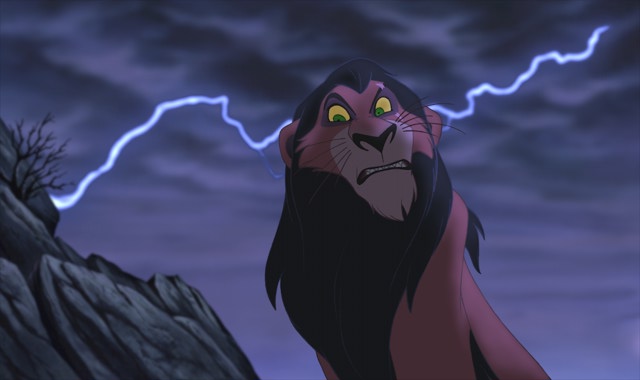
In The Lion King, we learn a tip about the Collapse: foreshadow its coming with setting and atmosphere. A few scenes before the collapse, we see the current state of Pride Rock, and it looks like this:
Later, it starts raining with thunder and lightning. You might not be able to control the soundtrack for your novel—your readers may be listening to Miley Cyrus, for all you know—but you can control the mood of the novel with word choice and atmosphere.
The collapse in The Lion King is when Simba sees firsthand the consequence of his leaving, and what is at stake if he fails, when he witnesses [Scar hitting Sarabi, Simba’s mother].
The collapse reminds the audience what the protagonist stands to lose.
Depending how severe the collapse is, you may end your chapter on it. Just be careful that it is a cliffhanger that keeps the reader reading. If it’s a real sock to the gut, then you’ll need at least a glimmer of hope for the reader before the chapter ends, so he or she knows all hope isn’t lost. Sometimes writers add a cliffhanger directly before the near-fatal blow, delivering that sucker-punch in the first line of the next chapter. THAT will definitely keep your reader going, since they know it isn’t the end of the story!
Gloom
The gloom is whatever follows the collapse, and can be long and drawn out or just a few sentences. Either things can get worse, and they do, or they can’t possibly get any worse. The Princess Bride chooses the former route. Buttercup and Westley hit their elation when they survive the Fire Swamp together as a couple. They are separated in the collapse. For Westley and Buttercup, things only get worse: [He’s tortured to death, and she’s forced to marry the nasty Prince]. Meanwhile, William Goldman takes the opportunity to give lavish backstory on Inigo and Fezzik, to the point that the “Gloom” is the longest section of the original novel. Yet it works! See, there is freedom.
In The Hunger Games, we see what the gloom serves to do when the collapse is pretty brutal. In cases such as these, the gloom should:
allow the protagonist to react to or grieve the collapse, and
provoke the protagonist (and reader) to move on with a new determination
We see both in The Hunger Games when [Katniss buries Rue and grieves for her] and [Katniss recognizes that The Capitol was the real killer (Pinch Point 2)].
In the gloom of The Lion King, Simba has to face his problems and its consequences: [He tells the lionesses that he was to blame for Mufasa’s death. Then Scar calls him a murderer and backs him off a cliff. “This looks familiar”].
Summary: The gloom is the natural outplay of whatever happens in the Collapse. It is primarily reaction and is a great opportunity to spend some time in other viewpoints or on the B story. The protagonist can only make progress towards the goal again after the comprehension.
C6—Comprehension
This one’s big. It’s the Awakening, either figuratively or physically. When all hope seems to be lost, the Hero learns new information, regains consciousness, or gets help from someone or -thing.
Comprehension aligns pretty nicely with Plot Point II,* and it’s what ends the second act. It’s the BIG turning point. Everything after this is the ending. This is the stuff you won’t see in the trailer, because the Comprehension is the thing the writer keeps up a sleeve to deal at the last, best moment.
*Note: in the 3-Act structure, the second Plot Point may be assigned to anything that happens between C5 and C6.
Let’s look at some examples of C6:
In The Princess Bride, [Westley is resurrected.]
In The Lion King, [Scar says, “I killed Mufasa.”]
In The Hunger Games, [there can be two winning tributes.]
That wraps up Act II! Next week we will talk about endings.
“Sticky Sentences”—I’d never heard that title before, but it’s a way of determining wordiness, specifically when sentences use too many short, common words. I love it.
Clichés and Redundancies
Repeated words and phrases
Deadwood and Jargon (they call it simply “Diction”)
Vague or Abstract words
Complex words
Alliteration
Poor Pacing
Dialogue tags
Wowzers.
Just for fun, I analyzed the blog that will be posted on Friday. Blogs are more conversational, so they will include more clichés, and a blog about plotting is going to repeat a lot of words (like Confrontation, Elation, Collapse, and Gloom—the subjects I’ll be covering on Friday). Still, this little program is SUPER DUPER NIFTY.
And it’s free.
Try it out here with some of your own text, and comment below with your results. What do you need to work on? What do you want more information about? Future blog posts may be devoted to your topic, but I won’t know what you want unless you tell me!
This is Part 4 of The 8 C’s of Plotting. Read parts one and two first, if you please. Click here for the whole series on the 8 C’s. Click the image below to be taken to the General Fiction Feed.
I told you that I’d start using The Lion King and The Hunger Games as examples to illustrate. To get you up to speed, here are the Prologue, Opening, Captivation, and Change for each. I’m not hiding these, because even if you haven’t seen either, this information is pretty standardly given in a movie trailer.
The Lion King
Prologue—The Circle of Life, Simba introduced
Captivation—Lions! In Africa! Great Soundtrack!
Opening—Simba Just Can’t Wait to Be King
Change/Inciting Incident—Elephant Graveyard; Scar makes a plan to become king
The Hunger Games
Prologue (Movie)—Panem, District 12
Captivation (book)—It’s the Reaping. What’s the Reaping?
Opening—The Reaping
Change/Inciting Incident—Katniss’ sister is chosen as tribute in the 74th Hunger Games. Katniss volunteers in her place.
Up to speed? Here’s the Reaction and Complication. They don’t need very long descriptions.
Reaction
The reaction is anything that happens after the Change. How does the protagonist (and/or the antagonist) react to the change?
In The Fugitive, Dr. Richard Kimble (Harrison Ford) is convicted of killing his wife, though we are pretty sure he didn’t do it. The conviction is the change. The reaction? He is sent to be executed.
In The Lion King, (highlight the area between brackets to read the spoiler) [Simba still trusts his uncle Scar, so he willingly, naively, sits at the bottom of a canyon waiting for his dad, not knowing that Scar intends to trample him with a stampede of wildebeests.]
In The Hunger Games, [Katniss and Peeta go tothe Capitol and train. Katniss isn’t very cooperative (or likable) as far as Haymitch is concerned. This includes the parade, the training, and the arrow through the apple.]
The reaction can play out in different ways, but whatever the Protagonist does during the “reaction” stage, he or she will do something else after the complication.
Before or during the Complication, it’s a good idea to show what the antagonist is doing.
Complication/Campaign
This is whatever happens to make the protagonist stop reacting (likely due to a “complication” or obstacle of some sort), and start acting (setting upon a “campaign”).
It can be a switch from passive to active, like in The Lion King.
Or it can mean a change of direction or a different approach, like in The Hunger Games.
It might also be the entrance into a new world or setting, like in the monomyth.
In a character-driven story like Toy Story, the complication:
The Complication corresponds with the 3-Act structure’s First Plot Point or the End of Act One and is often a MAJOR SCENE. Major scenes have their own beginning, middle, and end.
In The Fugitive, Kimble is riding the bus, on his way to be executed. His fellow convicts plan an escape, but that backfires. A guard gets shot. Kimble, a doctor, is unchained to help the guard. The bus crashes. It crashes on a train track. The train is coming. Kimble has to escape from the train. Once he escapes from the train, a fellow convict frees him. Now he’s free…a fugitive on the run. And because he’s a fugitive, the US Marshalls get put on the case. This introduces Gerard, the antagonist and in some ways, a secondary protagonist.
In The Lion King, [Scar kills Mufasa and blames Simba, Simba runs away.]
In The Hunger Games, [Peeta declares his love for Katniss during the interview. She freaks out, but Haymitch teaches her that she needs to play up the audience to get sponsors]
Any questions? Ask below. Just don’t include spoilers. If you disagree with my assignments of plot points, all the power to you, as long as you are thinking critically.
Next week I will devote the entire post to the Preparation and Problems segment, which nearly always takes up the longest chunk of narrative, and is what Blake Snyder calls “Fun and Games.”