Act One: Threatened Characters Make Mistakes (NaNoWriMo Week 2)

Act_One

Toy Story and its characters are owned by Pixar

Two weeks ago I shared my tips for Speed-Writing Your First Draft. Last week I talked about the five building blocks of a story as well as the three elements of scene. In the weeks to follow, I’ll give you some benchmarks and plot ideas to keep you from getting stuck.

If you haven’t read last week’s post about goals, conflict, the 12 types of antagonists, and sequels, go do so now. Today I’ll build upon those, so even if you have read it, you might want to skim through it again.

Overarching Goal = Passion or Fear

Another way to think of your character’s overarching goal is to consider what they’re passionate about. Remember, a character’s goal is what drives them. Something they only feel lukewarm about isn’t going to compel them to keep going to the end of the story.

This passion needs to be established early on.

If you’re not sure what your character is passionate about, consider what they’re most afraid of.

Consider Toy Story. Woody is afraid of being replaced as Andy’s favorite toy. But he’s not just passionate about being Andy’s toy, he’s passionate about his position as Head Toy. When Woody is Andy’s favorite toy, all the other toys look to him for guidance and reassurance.

Enter Buzz Lightyear, the coolest toy ever. Now Woody has a story, he has conflict, he has something that will change his current life and force him to make decisions.

The inciting incident is a Change which introduces fear or risks passion. 

Reaction

When your main character experiences this initial change, he or she is going to react. In my 8 C’s of plotting, I go into more detail about the reaction, so I’ll stick to the Toy Story example here.

Buzz arrives in Woody’s spot, and Woody tells him so. Buzz meets all the other toys, who are very impressed by him and compare him to Woody:

BUZZ pushes his button. “Buzz Lightyear to the rescue!”

The toys all GASP IN AWE.

SLINKY
Hey, Woody’s got something like that.
His is a pullstring, only it—

MR. POTATO HEAD
Only it sounds like a car ran over it.

Buzz is delusional and thinks he’s not a toy but an actual space ranger. Woody is the only one who seems to notice this, driving a further wedge between him and the other toys. Even Woody’s girlfriend wants Buzz to be her “moving buddy.”

A montage shows Andy favoring Buzz and replacing all his cowboy-themed (Woody) decor with space-themed (Buzz) decor. Another montage shows all of the toys who once idolized Woody now enamored with Buzz.

Then Andy has to choose between the two toys, and he picks Buzz. Woody has been replaced.

Woody has had it. He confronts Buzz, calling him a phony and shoving him. Their altercation is interrupted by Sid blowing up a toy in the yard next door. (Now this scene is a Chekhov’s Gun. If you’ve planned your story ahead of time, you will include all the factors at play during the ending within your first act. If you discover your story as you write, you’ll go back during revisions and plant foreshadowing.) After Sid shows us the worst possible outcome for a toy, Bo Peep reminds everyone that they are moving away (more foreshadowing).

Complication/Campaign

Next we have the Complication/Campaign. This step has a two-part name because it often starts with a complication and ends with the need for a new campaign or journey, which leads into Act Two. In a character-driven story like this, the complication:

  • is a bad decision, mistake, or accident
  • which grows out of the Reaction
  • and ends unfortunately,
  • resulting in the need to make new plans—the “campaign” of Act Two.

(See my 8 C’s post for other types and examples of reaction and complication, using the examples of The Fugitive, The Lion King, and The Hunger Games.)

In Toy Story, Woody actively but inadvertently causes his complication, which has its own mini-plot:

  1. Inciting incident: Andy’s Mom tells him he can bring one toy to the pizza restaurant—only one.
  2. Beginning: Woody is hopeful. He shakes the Magic 8 Ball asking if he’ll be picked. The 8 Ball says “Don’t count on it.” Woody throws the ball, which falls down behind the desk.
  3. Middle Part 1: Woody tells Buzz there’s a toy in trouble. He drives an RC car into Buzz to knock him behind the desk, but Buzz dives out of the way. There’s a chain reaction of bumps and knocks, which gets all the other toys’ attention, and
  4. Midpoint: Buzz is knocked out the window.
  5. Middle Part 2: Everyone reacts, including Woody, who didn’t mean for Buzz to fall out the window. The RC car tells the toys Woody did it on purpose, and the toys turn on him. Andy comes in, finding only Woody, and brings him into the van to the pizza restaurant.
  6. Ending: Buzz jumps out of a bush and onto the van. At the gas station, he confronts Woody. They fight, flying out of the car. They’re still fighting when Andy and his mom get back into the van. The van drives off, leaving Woody and Buzz at the gas station.

The Complication ends Act One and introduces the campaign or “ocean” of Act Two, which I’ll talk about next week! If you can’t wait that long, listen to this Paperwings Podcast on the subject.

Writing Act One

Ask yourself what your character’s immediate desire and greatest fear are.

In Tangled, Rapunzel’s passion is to see the floating lanterns. Her greatest fear is abandonment. If abandonment is her greatest fear, then her ultimate goal is to feel like she belongs in a loving family. See the 8 C’s of Tangled here.

Write your character’s fear and desire on a note and post it in your writing space. Refer to it every time you start writing. If you already know your character’s greatest desire or ultimate goal, write that down, too. Otherwise write it down as soon as you discover it.

Ask “What if…?”

Remember the 12 different types of antagonists. What kind of antagonist will introduce your character’s fear to the audience or reader during the inciting incident?

How can other types of antagonists drive your character to make the mistake that causes the Complication?

What impossible situation will your character find himself in—the “Ocean” of Act Two? How can you get your character there?

Moving On

Chances are, you have an idea of your character’s campaign or “ocean” when you write the Change.

The Change, or “inciting incident,” is what gives you a story. A character starts off with a sense of stability, something rocks the normalcy boat, and the protagonist is thrown into a sea of chaos. The boat gets shattered by a giant squid, the protagonist can’t swim, there are sharks in the water, and your guy floats on flotsam and jetsam until he gets to shore, where he finds a new stability. He kisses the sand, and the camera fades to black. —The 8 C’s of Plotting (underlined section suggests the “ocean” of Act Two)

If you’re already writing the ocean, consider what Preparation your character needs in order to survive the ocean and overcome her fear to achieve her greatest desire. What Problems will come her way? How can she win a small victory?

Next post: Act Two.
Friday Reads: THE FANGIRL’S GUIDE TO THE GALAXY by Sam Maggs

Friday Reads is a new series on Write, Edit, Repeat. I’ll only be blogging about my favorites (no room for negativity here), and I’ll end with a writing prompt. Be sure to subscribe if you haven’t already, and then you won’t miss out. Adult fiction, YA fiction, MG, graphic novels, picture books—I’ll cycle through them all, sometimes posting monthly, sometimes weekly.

For the archive of Friday Reads posts, visit bit.ly/LaraReads.

I also allow guest reviews! Today I’ve got Caitlin Vanasse reviewing The Fangirl’s Guide to the Galaxy by Sam Maggs.

Read her review, then enter for a chance to win a copy of the book!

First Impressions

The Cover

Fangirl_final_72dpi

The Blurb

Fanfic, cosplay, cons, books, memes, podcasts, vlogs, OTPs and RPGs and MMOs and more—it’s never been a better time to be a girl geek. The Fangirl’s Guide to the Galaxy is the ultimate handbook for ladies living the nerdy life, a fun and feminist take on the often male-dominated world of geekdom.

With delightful illustrations and an unabashed love for all the in(ternet)s and outs of geek culture, this book is packed with tips, playthroughs, and cheat codes for everything from starting an online fan community to planning a convention visit to supporting fellow female geeks in the wild.

Reading

First, thank you so much to Lara for letting me borrow on her blog today to review The Fangirl’s Guide to the Galaxy: A Handbook for Geek Girls by Sam Maggs.

When I heard that Sam Maggs, editor of The Mary Sue, was writing a guide to girl-geekdom, I was quite intrigued. As a girl who grew up watching Captain Janeway on Star Trek Voyager, borrowing my brother’s Nintendo Power, and reading every essential comic collection my library had, I’ve considered myself a geek girl (or a nerd) for quite sometime. When I had the opportunity to request a copy for review from Quirk Books, I was more than a little excited. (Disclaimer: I requested and received this book from the publisher, Quirk Books, for review.)

The Fangirl’s Guide to the Galaxy is a reference book in four sections: An introduction to different fandoms, an introduction to girl geek spaces on the internet, a guide to conventions, and a section on geek girl feminism. Interspersed between each section are super short (3-question) interviews with prominent women in geekdom.

I found this to be a good reference; there were definitely things I already knew, which I think will be true of most readers, but there was plenty of new information and things well said in a way that I found really helpful for figuring out how to express them myself.  My personal favorite section was the one with advice for conventions (probably because I’m at a point where I’m just starting to think about going to conventions, and so it was the most helpful personally), but I think depending on where the reader is, different sections might be more useful.

Right before picking this up I saw a review mention that the feminism section seemed a bit tacked on.  I think the meat of that section was actually really great. It contained an extensive list of recommendations of great female characters in various forms of media (books, movies, television, anime, comics, and manga) and a short section on being critical consumers of the media we love, both of which I think any geek girl would be interested in. But I think the transition to that section was really poor. Rather than suggesting that Fandom can, in some ways, be what we want it to be, it felt pushy rather than convincing. It was really a disservice to the chapter and ill-fitting considered with the tone of the rest of the book.

I also felt that the interviews, although a nice element to break up the chapters, were too short to really provide much substance. They weren’t really personalized, were fairly superficial questions, and were less than a page each. They function more as a list of interesting women in geekdom to follow than interesting content on their own.

All in all, I really enjoyed the book and could see myself referencing it or lending or gifting it to friends.

But, because I received this finished copy from the publisher I’d like to give you an opportunity to have it.  I’m giving away the finished copy I was given. I did read it, so it’s gently used, and I’ll be shipping from the US, so this giveaway is only open to US shipping addresses. But if you’re interested and eligible please do enter below!

About Caitlin

Caitlin Vanasse was raised on StarTrek Voyager and Bill Nye as well as princesses and puppies. Never afraid to call herself a nerd, you can find her on the internet talking about books on Youtube at BookChats and retweeting all manner of things on Twitter @CaitlinVanasse.

Recommendations

Follow Caitlin’s YouTube channel, BookChats, for plenty of book recommendations from this geeky girl reviewer, or read The Fangirl’s Guide for recommendations. Also read the comments here for favorite female

Writing Prompt

Two options today:

A. Write a short creative nonfiction story or poem about a geeky experience you’ve had.

B. Choose two fictional females and write a short story or scene in which they meet.

Giveaway

If you live in the US and would like the chance to win a copy of The Fangirl’s Guide, please click here to go to the Rafflecopter page. There are many ways to enter!

Becoming a Fan Favorite: Writing Description and Direction

In today’s post, I talk about stage directions in fiction, writing natural descriptions, why some books are constantly reread by readers, and, to an extent, immortality.

Orderly Description

Ever played that “blind drawing” party game? You close your eyes or put a piece of paper on your head and someone gives you direction upon direction to cram into one picture?

Here’s an example for the party planning website Sophie’s World (which, consequently, is the title of one of my favorite books):

“I’d like you to draw the outline of a house. Just a simple little house, right in the middle of the page… Now, beside the house I’d like you to add a tree, a medium sized tree, not too big, not too small… Oh, I forgot! You need a front door on your house. Please draw a front door so that the people can come in and out easily… Oh, did I tell you there are apples in your tree? Draw a few apples, maybe 5 or 6, in your tree now… And don’t forget the windows in the house! I think two would be nice… Did I remind you to draw a chimney? Let’s put a chimney on the house, with some smoke coming out the top… Oh, and look! There’s a dog in the yard… And a picket fence… And of course there’s a family…”

This is the kind of experience a reader has when you describe something in an unnatural order:

blind drawing
It’s also what it’s like when description is given out of order. When describing a scene, consider camera shots.

Zoom in from broad descriptions, ending on one specific detail. Or zoom out, starting on a detail and working your way out to observing the whole. Pan in one direction. Going in an unnatural order gives the nauseating effect of “shaky cam.”

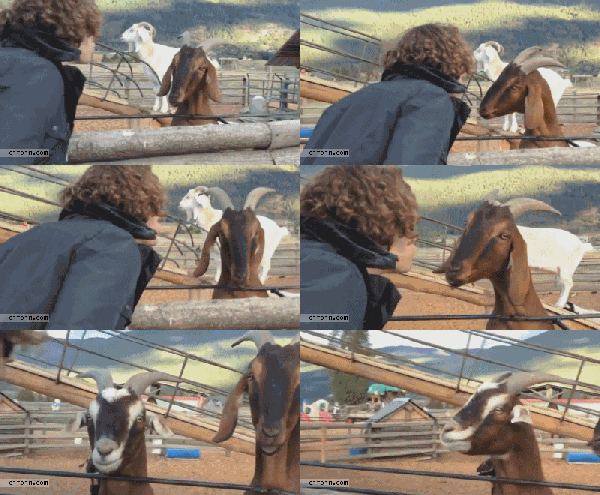
Adding details too late, after the reader has already created the image in his or her mind, gives what I like to call the “awkward goat” effect.

Writer: “I went to give the goat a kiss. Then the other goat—”
Reader: “Wait, there’s another goat?”
Goat: “SURPRISE! I’ve been here the whole time!” (maniacal goat bleating)

surprise-goat
While this is used effectively in visual comedy, redirection doesn’t really work in fiction.

Overcomplicated Stage Directions

Another problem of ineffective description is overcomplicated stage directions. I see sentences like this all the time in unpublished manuscripts:

“Come with me,” Jorge said and turned around while kissing my hand as we ran away together.

Though these are most often found in dialogue tags, I see overcomplicated stage directions all over. That sentence above is just one I made up, but let’s rewrite it so it doesn’t seem like “he” is doing a hundred things at once.

First, find the perps: “and,” “as,” and “while.” The two latter words can often be cut in stage directions. The former is a fine word that sometimes gets overused. Let’s focus on no more than two actions at once.

Said + turned, kissing + ran

“Come with me,” he said, turning around. He kissed my hand, inviting me to run away with him.

Let’s also apply what we just learned about orderly directions, and cut the unnecessary dialogue tag.

Jorge turned around. “Come with me.” He kissed my hand, inviting me to run away with him.

What did I just do? I took advantage of my friend the progressive verb.

A progressive verb is a verb ending in -ing. That ending tells us that the -ing verb is happening while something else is going on, while letting us cut the “while” or “as.”

“While” and “as” aren’t bad words. It’s not about the word, it’s how you use it. By all means, use “as” to make a simile (e.g., “as [adjective] as a [noun]”). “While” is an innocent preposition until proven guilty. The problem is using them to show more than one thing happening concurrently. Show me a manuscript which uses “while” or “as” in the first page in stage directions, and there’s a big chance that same construction will keep showing up over the next ten pages.

Doing a find/replace search for all instances of “as I,” “as we,” “as she,” “as he”  (depending on your POV), repeating the search with “while,” will help you see if you’re going overboard. Also be on the look-out for “then” and “before,” more signs of wordiness and or disorderly directions.

Use them a few times, and that’s fine. Do it a few times per page—or worse, per paragraph—and you’re just being unnecessarily wordy. Gone are the days when novelists are paid by the word.

The Divine Detail

Remember, your novel has to compete with online, in-demand television and movies. You need to keep your reader’s attention. That doesn’t mean your novel needs explosions or murders every other chapter; it means your prose needs to be immediate and precise rather than longwinded and wordy. You want to be Robin Williams giving his Seize the Day speech, not Ben Stein droning about economics. The difference isn’t just subject, it’s diction. Do diction right, and you’ll engage readers that otherwise don’t care one iota about your subject. That is, until they start reading your book.

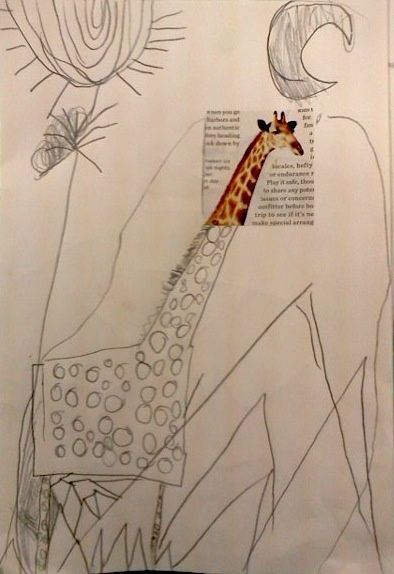
When describing, choose one or two vivid details, referred to by editors as “divine details” that can set the scene or characterize, and let the reader fill in the rest of the image. Compare the chaos of the drawing above (ain’t I an artiste?) with expansion drawings done by children:

expand-drawing

Image via ArtMommie. Click for more images.

When the reader is allowed to contribute, your work takes on a new form. It evolves in the readers’ individual minds. It’s a spark which they build upon to create a conflagration.

Letting the Reader In

It doesn’t matter how brilliant of a writer you are—writing and reading are collaborative efforts, and that collaborative effort will bring more life and beauty to your work than you could hope to do by yourself.

Sometimes we write because we’re control freaks. We are the masters of the universe, and we will plot and plan and tell our characters exactly what they should do. But when we let our characters breathe and give them freedom, when we let the reader have some creative liberty, our work takes on a life of its own.

Maybe that’s a cliche, but if you want your work to live on after you’re gone, you need to let your reader experience your world naturally. You need to let them read between the lines and contribute to the meaning and world of your fiction. When you let them participate, readers will not only want to buy your books, they will want to reread your books over and over again, letting them become part of their life, seeing how their interpretations change over the years.

Friday Reads: THE CONSPIRACY OF US by Maggie Hall

My resolution for 2015 is all about organization. That means introducing new blog series, switching some style guides, and improving reader experience! You’ll notice that “Write Lara Write” is now “Write, Edit, Repeat.” Same URL to keep things simple (writelarawrite.wordpress.com), but a new name, since this blog is about the crafts of writing and editing, not my personal writing site (which is coming…eventually).

And since it’s not just me anymore, I’m opening the blog up for guest posts! Apply here.

Friday Reads is a new series on Write, Edit, Repeat. I’ll only be blogging about my favorites (no room for negativity here), and I’ll end with a writing prompt. Be sure to subscribe if you haven’t already, and then you won’t miss out. Adult fiction, YA fiction, MG, graphic novels, picture books—I’ll cycle through them all, sometimes posting monthly, sometimes weekly.

For the archive of Friday Reads posts, visit bit.ly/LaraReads.

Today I’m reviewing The Conspiracy of Us, a YA romantic thriller by Maggie Hall, and one of the most highly anticipated YA reads of 2015.

First Impressions

First Impressions walks through my method of judging books by their title, cover, and cover copy before I pick up a book.

The Title

“The Conspiracy of Us” is a strange, yet evocative title (I’ll be using the word “evocative” a lot when talking about covers and titles—sorry/not sorry). The word “conspiracy” suggests the thriller genre akin to The Da Vinci Code; “us” suggests romance or a close relationship. Since this is a romantic thriller, the title is extremely effective with its word choice.

The Cover

Consp

If you couldn’t tell this was a thriller from the word “conspiracy,” you’ll get the worldwide-thriller vibe from the cover. The city overlays, the compass—travel. The skewed phantom text shadowing the title implies mystery or possibly some chase scenes.

And we’ve got the subject, a teen girl in a gorgeous ball gown. Intrigue! Mystery! Travel!

Then you look at the tagline: “An ancient puzzle. A trail of clues. An unwanted destiny.”

So basically a teen girl is part Chosen One, part Indiana Jones. If there’s remotely a connection to Indiana Jones or Han Solo, I am so there.

The Blurb

Instead of breaking down the blurb like I did with After I Do and Maybe in Another Life, we’re going to do the 69 test instead, because it was such a great representation of the book, that’s what the publisher put on the back cover:

Elisa led me to a three-way mirror, where a girl who hardly looked like me stared back in triplicate. In the silver gown, the girl looked more serious, more elegant, then they changed me into the gold dress again, and she was glamorous, striking.

I found myself hoping fiercely that my mom would let me stay for the ball, and even a little longer. Meet the Saxons, find out more about my father’s family and the rest of the Circle. To feel like I belonged in this strange, fascinating world.

“You have to choose eventually.” Elisa smiled. In the mirror, the gold sequins shimmered. But there was something about the silver. It belonged on me.

Aimee unzipped the gold dress and left me to get out of it, following Elisa downstairs to wrap the silver one. I watched it go. I couldn’t believe that, just like that, it was going to be mine.

I was about step out of the gold dress when I heard footsteps coming up the stairs. “Elisa?” I said. “Aimee?” There was no answer.

In case it was one of the men come to escort me down, I zipped the dress up.

The girls were nowhere in sight, but the man who had let us in stood at the top of the staircase.

“Sorry, I’m not ready yet,” I said. I smiled at him, and he reached into his jacket pocket.

He pulled out something that, for a moment, didn’t register. It was too discordant with the marble floors, the dresses, the Bach chiming from the speakers.

It was a knife.

Read more about Maggie’s 69 Test here. And participate in #70Pit in July to share your page 69 or 70 and possibly win edits or get agent requests!

Reading

This was a fun novel to read. If you go in expecting the prophecy and Chosen One tropes (they’re implied right there on the cover), then you probably won’t expect this to be something that it’s not. What it is, is fun. And there really are similarities to Indiana Jones and the Last Crusade, with the Chosen One storyline like The Mummy Returns. Like those movies, there’s slow building romance (yes, please), plenty of sexual tension (all PG-13), some melodrama in parts, chase scenes, murderous bad guys, kinda murderous good guys, and adventure.

Those movies are called popcorn flicks. Not quite sure what the book equivalent is called, but keep your arms inside the vehicle and enjoy the ride.

Recommendations

If you like The Conspiracy of Us, you might like books by Ally Carter.

Writing Prompt

The main character, Avery West, is destined to be important, but she resists her destiny. Write about either 1) a time you were anxious about an outcome you knew was coming but had no power over, or 2) a time you rejected someone else’s plan for you.