My NaNoWriMo Writing Methods

Today: My Writing Space, Plot-driven Versus Character-driven Stories, Manuscript Format, and Shutting Up the Internal Editor.

So, yesterday was Day One of NaNoWriMo. I didn’t make it to 2,500 words because, well, I took a nap. And 1,788 lent itself to a good stopping point.

I thought it might be fun to share what my writing space looks like. Not the interior of my house, because I write all over the place. Also my desk is a mess.

You can tell already this will be a frenzied post, can’t you?

So here’s what the space looks like:

As you can see, I cover nearly every pixel of my screen. On the upper left is my beat sheet, written in Evernote.

On the lower left is a summary I wrote for the novel. It helps me to get the broader picture of what I think will happen.

A note about planning plots

Though I do plan plot (as you can tell from my series on plot), I also make sure that what I am writing is character-driven. THESE ARE NOT MUTUALLY EXCLUSIVE. You can write character-driven stories and still have an idea of where you are going. There’s a difference between a plot-driven novel and a plot planned one.

Let’s say you are planning a road trip across country. You plan your route ahead of time, and you have a rough idea of where you are going. But your route takes you to a road with a closed bridge. If you adhered to the plan without faltering, you’d blast through the “ROAD CLOSED” barriers and traffic cones and gun it, hoping that your tiny sedan can make the jump and land on the other side. This is what happens when a story is plot driven. It might have a lot of excitement, but it usually doesn’t end well for everyone involved, and along the way, you’ll make somebody say, “What the heck just happened?” and not in a good way.

But, it you come up to that closed bridge and you take a detour, you change direction. Maybe you even change your destination, having an existential moment where the sun breaks through the clouds and you realize, It’s not the destination, it’s the journey. That’s the way a person writes something character-driven. It’s fluid and organic, not rigid and contrived.

But that doesn’t mean you can’t have a plan to begin with. In my opinion, you’ll have fewer projects that die by your hand if you make an effort to think towards a possible ending before you even start. I can’t tell you how many stories I’ve written that didn’t work. My current novel has already been scrapped and started over a few times. Here’s to hoping I’m heading in the right direction this time, because I truly love these characters.

Related: Outlining for Pantsers

Back to my writing space

Here it is again.

In the middle is my manuscript. I really hate writing in Times New Roman, but I decided to format my novel in the standard Manuscript format from the get-go. Some people want you to use Courier, others Times New Roman. This is how you format your novel manuscript. Remember, though, to check and see if an editor or agent has specific requirements before submitting.

On the right, I have another document that is specifically for my internal editor. I don’t have success completely gagging my internal editor, whose name is Melvin and looks like George Costanza.

Some people have semi-sadist daydreams about their internal editor, and what it takes to shut him/her/it up. With an internal editor like mine, if you fill his mouth with cotton balls, he’ll just start humming “It’s a Small World, After All” until you let him go. So I’ve found it works best to throw him into a cellar and let him shout out a couple of things now and again through the air vents. That document is a collection of his nags and pointers. I’ve found it’s best to acknowledge the internal editor, but rather than make the fixes, write the problems down on a sort of “Honey-do” list I’ll address during rewrites. Then I can keep writing quickly.

My next post is already scheduled for Motivational Monday! Follow me on Twitter @LaraEdits for NaNoWriMo updates and even more tips.

50,000 Words!

No, I haven’t written 50,000 words yet. NaNoWriMo hasn’t even started (it starts TOMORROW)!

But if you are a fellow NaNo, you might be wondering how on earth you can write 50,000 words in 30 days. I know I am.

NaNoWriMo

NaNoWriMo suggests writing 1,667 words per day for 30 days.

If you are a human being, like myself, and not a machine, it might be difficult to have a daily goal. That’s why I’m going with a weekly goal, with two days off for Thanksgiving. Here’s my plan:

Write 50,000 words in 4 weeks.

November 1–7, write 12,500 words.

November 8–14, write 12,500 more words (total 25,000 words)

November 15-21, write 12,500 more words (total 37,500 words)

November 22-23, celebrate Thanksgiving and maybe even hit the shops on Black Friday (or wake up at 3 am and write, making up for a low word count)

November 24-30, write your final 12,500 words (total 50,000 words)

If you want to take weekends off, write 2,500 words per day, 5 times per week.

Since the NaNoWriMo week starts on Thursdays this year, here’s my ambitious plan that will likely not come into fruition.

The unlikely-to-happen Plan

November 1,2, 3: Write 5,000-7,500 words total

November 4: Take day off

November 5, 6, 7: Write 5,000-7,500 words to bring weekly total to 12,500

November 8-14, 15-21: Repeat pattern above 2x

November 22-23: Take Thanksgiving off from writing (but maybe do some final plotting and planning)

November 24: 2,500 words

November 25: See if I’m up to writing 2,500 words.

November 26-30: Write up to the 50,000 words.

Deep breath before the plunge

Take a few moments today to completely forget about what you signed up for and are getting yourself into.

Didn’t work? Okay, then distract yourself by creating a desktop wallpaper for your computer with your own wordcount goals, including some images that will inspire you as you work. I’m thinking of creating one with all my “cast members” (famous or interesting-looking people that fit my mind’s image of the characters). Though I won’t likely do it today—I’ll probably do it one of the days I am experiencing some writer’s fog.

The last year I did NaNo, I took a pastoral picture of a castle and pasted my word count goals on to that for my wallpaper. If you are doing a historical novel like me, perhaps you can make a wallpaper collage of historically-accurate source images, like costumes of the era. Be creative!

See you on the other side—in November!

Lara

[Historical Fiction] Friday

Historical Fiction

I can’t believe that NaNoWriMo is less than a week away! I’ve been trying to prep by doing research, since my novel is set mostly in an alternate 12th century England (I know…I know). My intention was to be historically accurate—as much as possible. But when I started researching castles, I realized that my mental image was going to have to change in some respects. For example, here’s a rough idea of what I was picturing:

But Alas, Conwy Castle was begun in the 13th century. One hundred years later. Keep reading to see a progression showing how difficult it is to date a castle, and how people really have almost no idea what castles looked like in the 12th century.

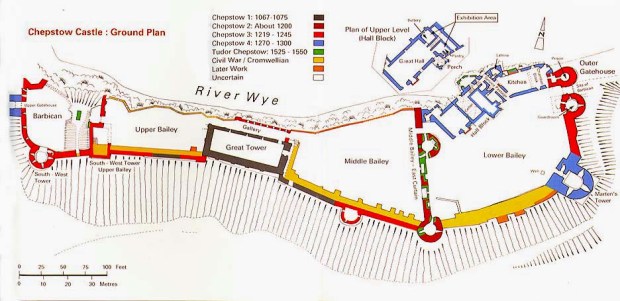
Here’s a floor plan of Chepstow Castle, showing how many renovations the castle received over a few hundred years.

Here’s a model of what the castle looked like in the 1500s, during the Tudor time period which followed the Middle Ages.

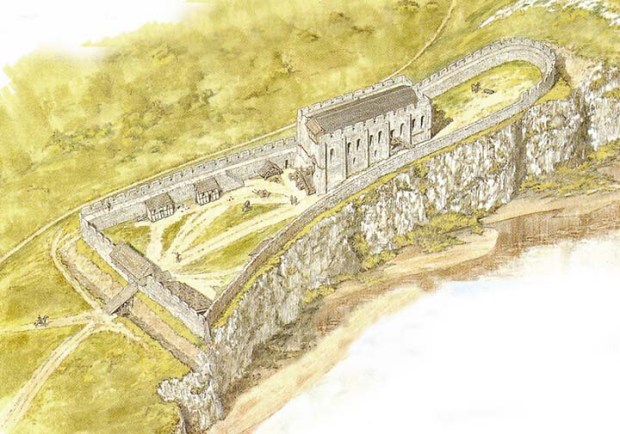
And here’s what it looked like roughly around the 12th century.

Exciting, right? A stone “tower” that looks sort of like a prison building, with a couple wooden huts outside? Okay, I exaggerate a bit. But seeing this castle made me go, Eeesh, not what I was expecting, for my heroine who will be living in something like this.

But then to complicate things further, you are not only supposed to get the time period right, but you should also get the class distinction right. Thankfully—as far as I can tell—Chepstow, as lovely as it is, is a fairly modest castle compared to others built in the 12th century. A King’s castle would be more luxurious. Kings’ castles usually get refurbished and rebuilt more often that other castles, though, which is why many (if not most) of the castle ruins in the UK are remnants of much more contemporary designs.

I’ll tell you that I DID find a castle that will and does inspire me and is from the correct time period, and belongs within the correct financial ranking. But all of this research led me to have a discussion with one of my writer friends, and I’d like to hear your input on it, too. Yes, even if you read this post a few years down the line. I’m curious to what you think! And I’ll probably still be working on the novel then, anyway.

How important is historical accuracy in a novel? Would you rather read a novel that 1) gets its history right or 2) tweaks the facts for the sake of their story?

I recently read Christy English’s The Queen’s Pawn. I don’t recommend it. The whole premise of the book was an inaccuracy, but it turns out, finding historical inaccuracies was the only entertainment I squeezed out of the reading. My conclusion is that if you are going to get history completely wrong, you had better write an engaging story so that I the reader will forgive you. I haven’t forgiven Christy English, because the story was not interesting to me. Rewriting history just so you can write about a middle-aged man fornicating with a pubescent teenager is not my idea of worthwhile literature. Lolita it wasn’t.

Ahem. Anyway, your thoughts on historical accuracy?

Fiction Friday: Newbery Medal Winners in Fiction, 1980-2012

Yes! A day in advance! Again!

You know how I mentioned earlier this week that I started a book club reading and rereading Newbery Award Winners? Well, in preparation for the first meeting, I really wanted a poster of the Newbery Award Winners. And I thought it would be even more nice to have a super short description of the book, to jog our minds if we have already read it, or to make us interested in books we maybe never heard of.

Well, those posters they have in libraries are apparently only available to libraries. I tried to make an account as a homeschool—no dice.

Those nice pretty posters also don’t have a blurb about the books. They have the book name, author, date, and cover. I don’t judge a book by its cover, but I do judge a book by its title. Let’s just say The View from Saturday sounded like a kid version of Divine Secrets of the Ya-Ya Sisterhood, and why read Sarah, Plain and Tall when you can read something like Julie of the Wolves?

I remember really liking Sarah, Plain and Tall. I don’t remember it being about a mail-order bride.

So I made my own posters. And since I love you all dearly, I’m going to share them with you to download, for free. (Note, the link to download the printable version is near the end of the post)

This is a preview image. Click the link at the bottom of the page to download.

I have to admit, though, that I have a couple of confessions to make. 1) I am no longer any good at math. The Newbery Award gave its first medal in 1922. This year is 2012. That means there are 90 books, right? 2012-1922=90. No, there are 91 books. If you just subtract, you aren’t counting the current year. Problem: my layout was 30 books per page. In lieu of creating a new layout (this was my 3rd or 4th), I decided rather to eliminate from my posters the books that were biographies and the books that were collections of poems. While I might be interested in someday reading A Visit to William Blake’s Inn: Poems for Innocent and Experienced Travelers (1989), I can honestly say that I have no desire to pick up Joyful Noise: Poems for Two Voices (1982) after hearing that all of the poems are about insects.

Confession 2) I haven’t read most of these books. Some of them I hadn’t even ever heard of. I think I read mostly Newbery Honors books as a child, with some major exceptions, like The GiverNumber the Stars, and A Wrinkle in Time. So when I went about writing blurbs about the books, I had to read the synopses of the novels from sites like Amazon and Goodreads. I could only fit about 100 characters per novel to keep the posters to a page each. That’s less than a Tweet, and is about 20 words. Try summarizing a book you’ve never read into 20 words or fewer sometime—it’s definitely a head-scratcher.

As much as I enjoyed the challenge (and hope it will help me come up with elevator speeches of my own novels in the future), it is very time-consuming. That’s why I’m going to release one page per week.

So, for today, I give you the Newbery Medal Winners 1980-2012.

A couple other notes:

  • The boxes by the cover images include the date of the award and serve as a check box, so you can keep track of which ones you’ve read.
  • Since I haven’t read some of these books, the blurb may not be the best representation of the novel.
  • I haven’t printed this out myself yet. If the images are a bit fuzzy, it’s because I couldn’t find high-res images of the covers.
  • This is for educational or personal use only. You MAY NOT use these posters for any sort of commercial gain.

See you next week!