[Historical Fiction] Friday

Historical Fiction

I can’t believe that NaNoWriMo is less than a week away! I’ve been trying to prep by doing research, since my novel is set mostly in an alternate 12th century England (I know…I know). My intention was to be historically accurate—as much as possible. But when I started researching castles, I realized that my mental image was going to have to change in some respects. For example, here’s a rough idea of what I was picturing:

But Alas, Conwy Castle was begun in the 13th century. One hundred years later. Keep reading to see a progression showing how difficult it is to date a castle, and how people really have almost no idea what castles looked like in the 12th century.

Here’s a floor plan of Chepstow Castle, showing how many renovations the castle received over a few hundred years.
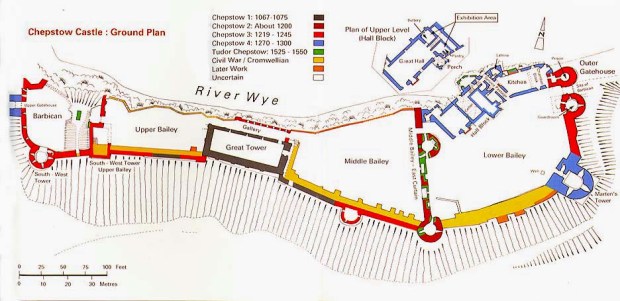
Here’s a model of what the castle looked like in the 1500s, during the Tudor time period which followed the Middle Ages.

And here’s what it looked like roughly around the 12th century.
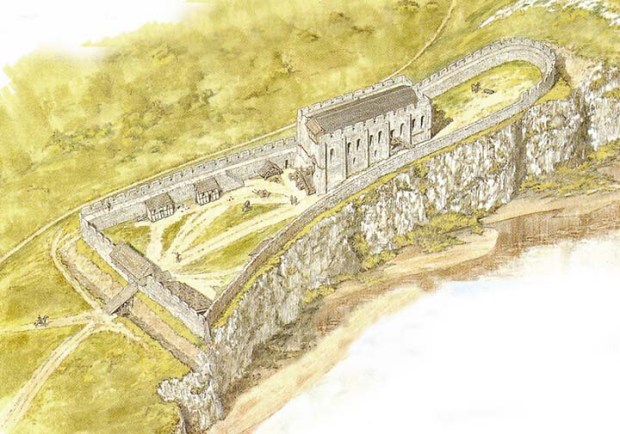
Exciting, right? A stone “tower” that looks sort of like a prison building, with a couple wooden huts outside? Okay, I exaggerate a bit. But seeing this castle made me go, Eeesh, not what I was expecting, for my heroine who will be living in something like this.

But then to complicate things further, you are not only supposed to get the time period right, but you should also get the class distinction right. Thankfully—as far as I can tell—Chepstow, as lovely as it is, is a fairly modest castle compared to others built in the 12th century. A King’s castle would be more luxurious. Kings’ castles usually get refurbished and rebuilt more often that other castles, though, which is why many (if not most) of the castle ruins in the UK are remnants of much more contemporary designs.

I’ll tell you that I DID find a castle that will and does inspire me and is from the correct time period, and belongs within the correct financial ranking. But all of this research led me to have a discussion with one of my writer friends, and I’d like to hear your input on it, too. Yes, even if you read this post a few years down the line. I’m curious to what you think! And I’ll probably still be working on the novel then, anyway.

How important is historical accuracy in a novel? Would you rather read a novel that 1) gets its history right or 2) tweaks the facts for the sake of their story?

I recently read Christy English’s The Queen’s Pawn. I don’t recommend it. The whole premise of the book was an inaccuracy, but it turns out, finding historical inaccuracies was the only entertainment I squeezed out of the reading. My conclusion is that if you are going to get history completely wrong, you had better write an engaging story so that I the reader will forgive you. I haven’t forgiven Christy English, because the story was not interesting to me. Rewriting history just so you can write about a middle-aged man fornicating with a pubescent teenager is not my idea of worthwhile literature. Lolita it wasn’t.

Ahem. Anyway, your thoughts on historical accuracy?

Motivation for NaNoWriMo

NaNoWriMo begins in just 17 days. Not sure of what NaNoWriMo is? Well, it stands for “National Novel Writing Month.” But NaNoWriMo is more than just the title for November…it’s also an event. Hundreds of thousands of writers sign up at NaNoWriMo.org to write a novel in just 30 days. Well, write 50,000 words of a novel. Most novels ought to be longer than that, if you want to be published. (See “Length” in “The Difference between Novels and Short Fiction,” here.)

There are some NaNoWriMo rules, like not working on a work-in-progress. Obviously I have a work in progress, even if it isn’t currently progressing (see word count, right column). But, I’m sort of going to use NaNoWriMo to motivate my writing anyway. Besides, all I’ve really written so far is the prologue, and how many people skip over that, anyway?

So I am spending the next 17 days doing an unhealthy amount of research, outlining, planning, plotting, and taking notes so that by the time November 1st hits, I’ll be ready to write with “literary abandon!”

Will you be participating in NaNoWriMo this year? What do you want to know about writing a novel? Ask your questions in the comments, tweet me anytime, or comment on my Facebook page. That’s right—I just added a link to Facebook so I can connect with you lovely people in another arena. For links to my Twitter, Facebook Page, and RSS feed, check out the icons in the top of the right column.

P.S. I’m mostly kidding about that research link. I have far more reliable resources than the kind editors at Wikipedia. If anybody is interested, I’ll post reviews on some of the more general sources I’ll be using. I assume you aren’t all writing about 12th century England, so I’ll leave the specific ones to myself.

P.P.S. Please, don’t write about 12th century England.

Short Fiction vs Novels AND ALSO…Setting

First, a little bit about my background. Then, the difference between Short Stories and Novels. Last, a word about writing setting, and why it’s more important than I thought. Skip around if you want. I won’t be offended.

my writing background

If you’d asked me as a child what I wanted to be when I grew up, I would have had one of three answers: 1) goalie in the NHL, 2) marine biologist, or 3) actress.

1—I grew up in the desert of Colorado and none of my friends wanted to play street hockey with me.

2—As a child I was deathly afraid of whales. They still totally creep me out.

3—Seemed most viable.

Problem was, this tiny little town I grew up in had very little culture, very few opportunities for me to pursue theater until it was introduced in 8th grade as an elective. Until that point, I read Shakespeare and wrote my own scripts. Writing was a means to an end.

My eighth grade year, my school also finally included a creative writing elective. It wasn’t much, but it was my first real instruction in writing, and it was short stories. I learned that writing could be its own reward.

I continued taking creative writing in high school and decided to major in writing in college (my grandparents, who helped me pay my tuition at this private liberal arts university, forbade me from majoring in the arts. Writing I got away with because I could train as a technical writer). Halfway through my junior year, I changed my major to a combination of writing and graphic design. That choice meant I had to give up some writing classes, and one that I gave up was “Writing of Place.”

I thought it was a good choice at the time. When reading, I usually skimmed or completely skipped paragraphs of exposition, unless I REALLY liked the book and was determined to read every. single. word. Setting seemed secondary to the rest of the novel. Who wants to read twelve paragraphs about how undulating the hilly landscape is? Not I.

Sometimes I just wished that all books were illustrated…

When writing skits or plays, I don’t have to write setting—I can write a line or two and leave the rest to the set designer. Setting was an afterthought.

I have a problem few others share. Most writers write too much and then have to edit, edit, edit, edit to trim the fat. I write a skeleton of a story and then revise and revise to give it some more fat.

So it comes as no surprise that, when I decided to try NaNoWriMo a few year’s back, I got about 3,000 words into my novel and realized that I was about halfway through the plot. That’s not a novel. That’s a pathetic, anemic excuse for a novel. I learned then that a novel is in a completely different league than short stories (not to mention plays).

the difference between novels and short fiction

First, there’s a difference in length.

  • Length—Novels are longest, novellas are shorter, and short stories are shortest. See the numbers below for my recommendations. For more information, check out this post on Novel-Writing-Help.com
    • Novel                  80,000–100K words
    • Novella               20,000–50,000 words
    • Short Fiction    2,500–10,000 words
    • Flash Fiction     fewer than 1,000 words

With all those extra words, novels have more room to explore…more.

There’s a difference in scope.

  • CHARACTERS—Short stories usually focus on one or two characters. Novels often introduce a larger cast of protagonists, antagonists, secondary characters, and minor characters.
  • PLOT—Novels have longer, more complex plots. Short stories have to be simpler than novels because of the length constraint. However, I think there’s more freedom with short stories because they have a selective plot. Making Shapely Fiction is a great resource on the variety of “shapes” short fiction can take.
  • SETTING—Novels take you to more places, switch scenes more often, or stay in one place through more seasons.

And there’s a difference in depth.

  • CHARACTERS—Novels can explore depth of character in more words. But this can be a pitfall, because it tempts writers to spend far too much time in backstory. Feel free to get carried away during the drafting process, but kill, kill, kill! during revision
  • PLOT—Novels have plots, subplots and twists to keep the reader turning pages. Short stories usually focus on one plot line.
  • SETTING—A more generous word count means novels spend more time exploring setting. 

setting

Too much setting, and the reader’s eyes glaze over and they skip a few paragraphs. Too little setting, and you have a novel that no one can connect with because all they can visualize is a bunch of nobodies floating around in nothingness doing nothing. Unless you are Samuel Beckett writing Waiting for Godot, it’s not going to work. In fact, I think that Waiting for Godot is a waste of ink.

You really don’t want to know what I know about writing setting because…I really have no idea what I’m doing yet. But the best resource I have yet found on the subject is “Four Ways to Bring Settings to Life” by Moira Allen. You can read it here. Yes, the website isn’t the prettiest, but the text is what is important.

practice

So here’s your Monday Motivation.

  1. Take a character you know fairly well. Your WIP’s protagonist, your favorite fictional character, yourself, etc.
  2. Choose a mood for your character. Angstful? Annoyed? Embarrassed? Lonely? Something else?
  3. Pick a setting/situation and place your character in it.
  4. What is happening? How does your character react? What does your character notice? Keep his or her mood in mind—how we feel influences what we see and what we do.
  5. Write until you feel satisfied that you learned something or challenged yourself.

Character Profile Worksheets

These character packets will help you organize your characters’ traits in one central location.

Have you ever written a character who had short, lustrous hair in chapter one and frizzy ankle-length hair in chapter fifteen? Okay, maybe not. But perhaps your character had gray eyes in one chapter and green ones in another. Or maybe his or her last name changes halfway through the book.

Collect all of your information together with these worksheets in lieu of scraps of paper and sticky-notes all over your office, kitchen, computer, and sister’s house. Continue reading