In the [Writing] Zone

pinterest

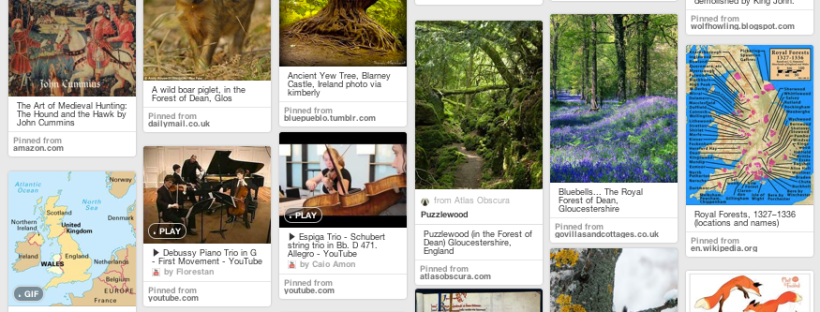
Bridgid Gallagher just tweeted about using Pinterest as a writer. I have a secret board for each of my writing projects, filled with images to inspire me and links to resources.

On her blog, Bridgid shares four more tips on how she gets into the writing zone, including having a writing playlist. I’ve shared my writing playlist for WORLD SONG before, but I’ve also heard good things about SoundFuel, a blog for writing music, and Skye Fairwin’s YouTube channel of music sorted by scene or mood.

All of them are great tips! My only problem is #2—it would take me all day to clean off my desk. Instead I escape to a library to write.

Head on over to Bridgid’s blog to read 5 Tricks for Getting into the Writing Zone.

Becoming a Fan Favorite: Writing Description and Direction

In today’s post, I talk about stage directions in fiction, writing natural descriptions, why some books are constantly reread by readers, and, to an extent, immortality.

Orderly Description

Ever played that “blind drawing” party game? You close your eyes or put a piece of paper on your head and someone gives you direction upon direction to cram into one picture?

Here’s an example for the party planning website Sophie’s World (which, consequently, is the title of one of my favorite books):

“I’d like you to draw the outline of a house. Just a simple little house, right in the middle of the page… Now, beside the house I’d like you to add a tree, a medium sized tree, not too big, not too small… Oh, I forgot! You need a front door on your house. Please draw a front door so that the people can come in and out easily… Oh, did I tell you there are apples in your tree? Draw a few apples, maybe 5 or 6, in your tree now… And don’t forget the windows in the house! I think two would be nice… Did I remind you to draw a chimney? Let’s put a chimney on the house, with some smoke coming out the top… Oh, and look! There’s a dog in the yard… And a picket fence… And of course there’s a family…”

This is the kind of experience a reader has when you describe something in an unnatural order:

blind drawing
It’s also what it’s like when description is given out of order. When describing a scene, consider camera shots.

Zoom in from broad descriptions, ending on one specific detail. Or zoom out, starting on a detail and working your way out to observing the whole. Pan in one direction. Going in an unnatural order gives the nauseating effect of “shaky cam.”

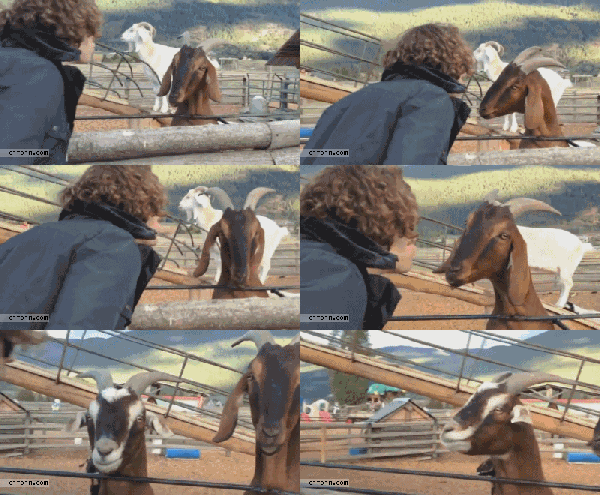
Adding details too late, after the reader has already created the image in his or her mind, gives what I like to call the “awkward goat” effect.

Writer: “I went to give the goat a kiss. Then the other goat—”
Reader: “Wait, there’s another goat?”
Goat: “SURPRISE! I’ve been here the whole time!” (maniacal goat bleating)
surprise-goat
While this is used effectively in visual comedy, redirection doesn’t really work in fiction.

Overcomplicated Stage Directions

Another problem of ineffective description is overcomplicated stage directions. I see sentences like this all the time in unpublished manuscripts:

“Come with me,” Jorge said and turned around while kissing my hand as we ran away together.

Though these are most often found in dialogue tags, I see overcomplicated stage directions all over. That sentence above is just one I made up, but let’s rewrite it so it doesn’t seem like “he” is doing a hundred things at once.

First, find the perps: “and,” “as,” and “while.” The two latter words can often be cut in stage directions. The former is a fine word that sometimes gets overused. Let’s focus on no more than two actions at once.

Said + turned, kissing + ran

“Come with me,” he said, turning around. He kissed my hand, inviting me to run away with him.

Let’s also apply what we just learned about orderly directions, and cut the unnecessary dialogue tag.

Jorge turned around. “Come with me.” He kissed my hand, inviting me to run away with him.

What did I just do? I took advantage of my friend the progressive verb.

A progressive verb is a verb ending in -ing. That ending tells us that the -ing verb is happening while something else is going on, while letting us cut the “while” or “as.”

“While” and “as” aren’t bad words. It’s not about the word, it’s how you use it. By all means, use “as” to make a simile (e.g., “as [adjective] as a [noun]”). “While” is an innocent preposition until proven guilty. The problem is using them to show more than one thing happening concurrently. Show me a manuscript which uses “while” or “as” in the first page in stage directions, and there’s a big chance that same construction will keep showing up over the next ten pages.

Doing a find/replace search for all instances of “as I,” “as we,” “as she,” “as he”  (depending on your POV), repeating the search with “while,” will help you see if you’re going overboard. Also be on the look-out for “then” and “before,” more signs of wordiness and or disorderly directions.

Use them a few times, and that’s fine. Do it a few times per page—or worse, per paragraph—and you’re just being unnecessarily wordy. Gone are the days when novelists are paid by the word.

The Divine Detail

Remember, your novel has to compete with online, in-demand television and movies. You need to keep your reader’s attention. That doesn’t mean your novel needs explosions or murders every other chapter; it means your prose needs to be immediate and precise rather than longwinded and wordy. You want to be Robin Williams giving his Seize the Day speech, not Ben Stein droning about economics. The difference isn’t just subject, it’s diction. Do diction right, and you’ll engage readers that otherwise don’t care one iota about your subject. That is, until they start reading your book.

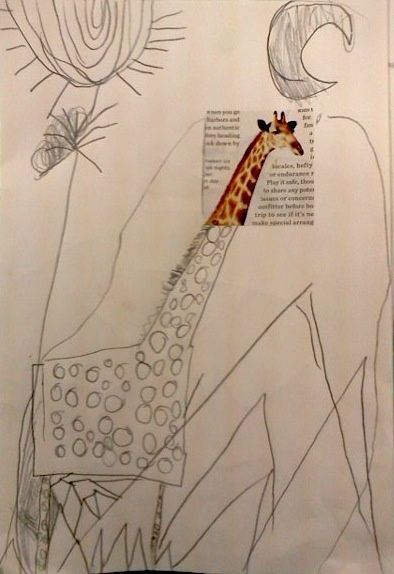
When describing, choose one or two vivid details, referred to by editors as “divine details” that can set the scene or characterize, and let the reader fill in the rest of the image. Compare the chaos of the drawing above (ain’t I an artiste?) with expansion drawings done by children:
expand-drawing

Image via ArtMommie. Click for more images.

When the reader is allowed to contribute, your work takes on a new form. It evolves in the readers’ individual minds. It’s a spark which they build upon to create a conflagration.

Letting the Reader In

It doesn’t matter how brilliant of a writer you are—writing and reading are collaborative efforts, and that collaborative effort will bring more life and beauty to your work than you could hope to do by yourself.

Sometimes we write because we’re control freaks. We are the masters of the universe, and we will plot and plan and tell our characters exactly what they should do. But when we let our characters breathe and give them freedom, when we let the reader have some creative liberty, our work takes on a life of its own.

Maybe that’s a cliche, but if you want your work to live on after you’re gone, you need to let your reader experience your world naturally. You need to let them read between the lines and contribute to the meaning and world of your fiction. When you let them participate, readers will not only want to buy your books, they will want to reread your books over and over again, letting them become part of their life, seeing how their interpretations change over the years.

Year 28 Creative Goals

Jackie Lea Sommers posted twelve creative goals at the beginning of the year and just updated her followers on how she’s been doing on them (Spoiler: She’s killing it). Can you believe 2015 is already a quarter of the way through?

I loved her idea and that she did a visual post.

April is my birthday month, and I have a couple traditions I try to do yearly:

  1. Celebrate both our birthdays by doing something Shakespearean
  2. Visit the zoo to see the baby animals
  3. Create New Year’s Resolutions

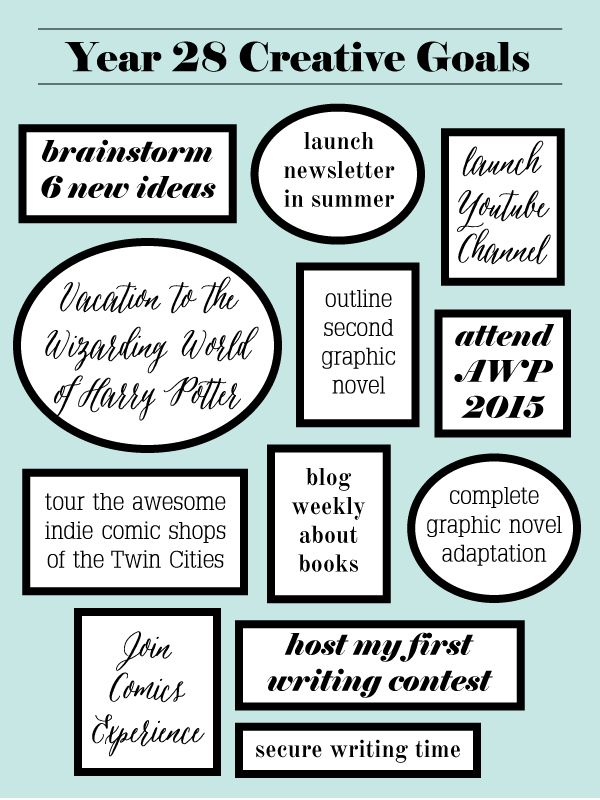
I’m turning 27, so this will be my 28th year. Here are my creative goals:

Creative Goals 28th Year

From top left:

  1. Brainstorm 6 New Ideas—Novel, graphic novel, and picture book ideas that I haven’t already started drafting
  2. Launch Newsletter in Summer—I have so many blogs I had to create a new one just to curate what’s going on each month. When it launches, you can follow that one rather than following me on all the different platforms. Simplicity and organization!
  3. Launch YouTube Channel—I am really excited about this. Frequency of vlogs will be low as long as I have toddlers in the house, but each one will be packed full of goodness and giveaways!
  4. Vacation to the Wizarding World of Harry Potter—Captain and I were going to go for our 5th anniversary last year, but we had to cancel for his brother’s wedding. (Totally worth postponing for!) I’m really hoping we can get away this summer. We haven’t had a break in 4 years.
  5. Outline Second Graphic Novel—This is my Middle Grade novel, which I have to wait to start until I hear back on a writing grant I just applied for.
  6. Attend AWP 2015—I’ll cross this off the list next weekend! Very excited to attend. I’ll be live-tweeting my experience (@larathelark) and tweeting the advice and tips I gather (@laraedits).
  7. Tour the Awesome Indie Comic Shops of the Twin Cities—I need to network with fellow comics geeks. I’ve got a lot of catching up to do!
  8. Blog Weekly About Books—This is an eventual goal I’ll be working up to. Right now it’s monthly.
  9. Complete Graphic Novel Adaptation—I’m adapting a classic novel into a complete graphic novel to keep practicing the form.
  10. Join Comics Experience—This is a community for comics creators. Again, I have to wait to hear back from the grant before I can join (if I want it paid for)
  11. Host my First Writing Contest—Check out 70Pit, coming the first week of July!
  12. Secure Writing Time—In other words, I need to finalize a preschool for my 4-year-old and find regular, reliable part-time childcare for my toddler.

April–July Pitching Opportunities 2015

pitch

This page will be updated as I find contests without entrance fees taking place April–July 2015. This will also be my last seasonal roundup, since I’ve found other contest lists which are updated regularly: Carissa Taylor’s list of contests, updated each year; the contests hosted by Adventures in YA Publishing, open for MG–NA manuscripts; KIDLIT 411’s contests for writers and illustrators of children’s literature; and Sub It Club’s Contest Roundups.

April–July Pitching Opportunities:

  • Nest Pitch (April 1)
  • PitchSlam (April 3)
  • Query Kombat (May 22)
  • PitMad (June 4)
  • SFFpit (June 18)
  • Pitch to Publication (June 29)
  • 70pit (July 1)

Know of any others? Comment below!

Nest Pitch

For: MG-Adult

Submission Date: April 1st

Submission Package: 35-word pitch, Easter Egg question, first 300 words (see blog for specifics)

Entries: More details will be released March 23rd/24th on the Nest Pitch blog.

Winners: 40 will be chosen and mentored.

Twitter: Cheer each other on using the #NestPitch2015 hashtag.

PitchSlam

For: MG-Adult

Submission Date: April 3rd

Submission Package: 35-word pitch, first 250 words (see blog for specifics)

Entries: Unlimited within submission window

Winners: Slush readers provide feedback on the 35-word pitch (round one) and the first 250 (round two). In round three, anyone can enter, and the hosts each pick 8 entries for an agent round.

Twitter: Cheer each other on using the #PitchSlam hashtag.

Query Kombat

For: MG, YA, NA, and Adult genres, excluding erotica

Submission Date: May 22nd

Submission Package: query, first 250 words (see blog for specifics)

Entries: 200

Winners: 64 entries will be chosen to compete, bracket-style. Final four are reviewed by agents.

Twitter: Root for your favorite entries using the #QueryKombat hashtag.

#PitMad Twitter Contest

For: PB, MG, YA, NA, A

Submission Date: June 4

Submission Package: Variety of Twitter Pitches (see my guide here)

Entries: unlimited during submission window

Winners: A “favorite” from a legitimate agent or publisher is a request to query. Each agent participating will give specific instructions for submitting requested material.

Twitter: Pitch party open to all complete manuscripts

#SFFpit

For: PB, MG, YA, NA, A

Submission Date: June 18th

Submission Package: Variety of Twitter Pitches (see my guide here) including sub-genre (see that guide here)

Entries: unlimited during submission window

Winners: A “favorite” from a legitimate agent or publisher is a request to query. Each agent participating will give specific instructions for submitting requested material.

Twitter: Tweet your pitch in 140 characters or fewer on Twitter, during the submission window. Use hashtag #SFFpit and include sub-genre and age (see blog for more info).

#Pitch to Publication

For: MG–A

Submission Date: June 29th–July 3rd

Submission Package: Query, first 5 pages, personality questionnaire, 5 choices of freelance editors

Entries: unlimited during submission window

Winners: Each writer will submit to 5 freelance editors. Each editor (including me!) will choose one manuscript to critique. After the editor critiques the manuscript, it will be submitted for the agent round. Agents can reject or offer representation upon requesting full, critiqued and revised manuscripts. After the agent round, the writer has the option to participate in a small press round, in which publishers can make requests.

Twitter: Cheer each other on or ask questions using #PitchToPublication

#70pit

For: PB, MG, YA, NA, A

Submission Date: July 1st

Submission Package: code name, novel’s intended audience, 7-word character description, 70th page (see blog for more info)

Entries: unlimited

Winners: Top 7 entries from each audience category will be featured HERE, on Write Edit Repeat, for agent perusal. More hosts are possible, and I’m sure there will be giveaways. Contact me if you’d like to be a slush reader!

Twitter: We’ll have a week-long party from July 1st–7th using #70pit.