pg70pit writing contest logo

April 7th on 7th

This is 2016’s second 7th on 7th, where I take a blog subscriber’s seventh page and show you how I’d improve it for the upcoming #pg70pit contest. See the #70pit16 contest schedule here. See more about how to enter the contest here.

Check out the first 7th on 7th, in which I talk about wordiness, breath units, and cleverness.

pg70pit writing contest logo

7th on 7th

THE ORIGINAL PAGE

[Adult Literary Horror]

The backpack’s been emptied every time I shop, but I go through it again, and then the sturdy dressers. Finally I pull the suitcase from underneath the bed. It’s still heavy with stuff that I apparently hadn’t unpacked. Continue reading

Recommended Book Cover Designers

Yesterday I posted 7 Tips for Authors Working with a Book Designer.

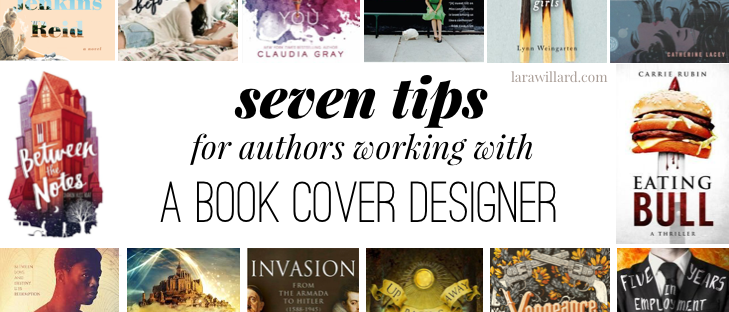
7 Tips for Authors Working with a Book Cover Designer

I also created a new page of recommended book cover designers. You can find it under the “Getting Published” tab in my navigation menu.

Have an illustrator or book publicist you’d like to recommend? Comment below! I’d like to create recommendation pages for these services as well. Please include link to their website.

(Comments are moderated. If yours doesn’t appear right away, it will once I’ve approved it.)

Working with a Book Cover Designer

I don’t believe in judging a person by his or her appearance, but I definitely judge a book by its cover, and so do readers.Just say no to amateurish design. You want readers to take you seriously, don’t you?

If you care about your book, you need to care about your cover. As a former graphic designer, it’s easy for me to tell, based on cover alone, most indie-published books from professionally published ones. Some small presses hire amateur designers, too. Here are some tips to avoid amateur designs and get the best design for your book (or your buck).

7 Tips for Authors Working with a Book Cover Designer

7 Tips for Working with a Book Cover Designer:

  • Unless you’re a trained designer, your design ideas will likely be derivative of visual cliches you’re used to seeing.
  • Saying “do whatever you want” can often be paralyzing to a designer with a thousand ideas.
  • Therefore, give the professional designer direction but not management. Ask for a creative brief, a tool which helps the designer understand what you want. Give the designer a few ideas to get him or her going, and then let the pro do his or her job.
  • It’s often better to say what you don’t like than what you do. “Can we avoid the color orange?” is better than “My favorite color is purple. I want it purple.”
  • If you provide images or ideas, make it clear that they are to inspire, not require the designer to follow them.
  • Create a Pinterest board of your favorite book covers to understand what styles you like. It can also be a useful addition to a creative brief. (Sharing this with your designer will be especially helpful if you hire a newbie designer.)
  • Know your genre. A good book cover gives the reader an expectation of what the pages inside hold.

cover-designs

If you’re working with a traditional publisher, they will have an in-house design team.

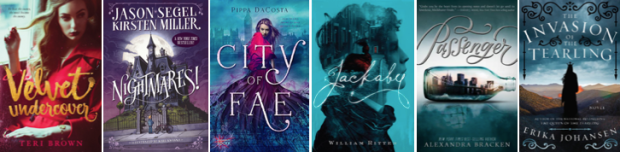
If you’re self-publishing or working with a small press that hires freelancers, here’s a round-up of cover designers.

If you are absolutely confident in your ability to DIY, here’s a tutorial to get you started. However, I strongly recommend researching typography basics before trying to make a cover yourself. Specifically learn hierarchy, legibility, and how to pair fonts. Creative Market has consistently solid typefaces. Stay away from Papyrus, Comic Sans, Impact, Copperplate, and Scriptina. If a display, handwriting, or script font is pre-installed on your computer, you can bet it’s a cliche. I also recommend learning from the good, the bad, and the ugly book covers at The Book Designer’s eBook Cover Design contests.

Click to Tweet: 7 Tips for Authors Working with a Book Cover Designer via @larathelark http://ctt.ec/JWS8T+

“Missing”

I love April. It’s my birthday month and (as far as we can tell) Shakespeare’s birthday, too. It’s also National Poetry Month!
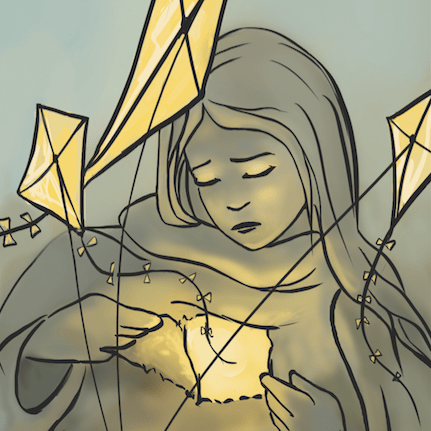
missing-preview

See full illustration below!

I’ve actually had more poems published than fiction, believe it or not, but I haven’t written much poetry since undergrad. Scratch that—I don’t think I’ve written any poetry since undergrad; I’ve been focusing on fiction and comics. I wrote this in 2008, when my now-husband was training at Quantico. Or was it 2009, when he was stationed in North Carolina? (Sheesh, it’s been a long time. This is definitely a throwback!)

“Missing” was originally published in Inkstone and later in The Cedarville Review. This year, Magali Mebsout illustrated it, and I’m excited to share both works with you here.

Click to enlarge. Plain text below.

Missing-Willard-Mebsout

Like the poem or the illustration?

Click to tweet: It’s #NationalPoetryMonth! Read “Missing” by @larathelark, illustrated by @MagaliMebsout.

MISSING

by Lara Willard

Memory is a crazy woman that hoards 
colored rags and throws away food.
—Austin O’Malley 

i’d like to tie
kites to my belt loops
dive off the nicollet
and be carried through partly cloudy skies.
i would hurdle chicago, the piedmont
mountains, free-fall into your backyard.

i’m losing you.
memories thin like brushed hair.
decay comes quickly.

you’ve faded into
souvenirs in a suitcase, patches
torn from a favorite blanket:

naked feet on irish pebbles
and rolling over in the wild grass.
submerging into cold pacific water
lips on mouths of glass soda bottles
fingers turning pages of isaac asimov.

i want to see you and sew things together
but the sky is blue and barren
and the kites on the rooftop are limply
scattered like confetti, thrown
and forgotten.

Read "Missing," a poem by Lara Willard, illustrated by Megali Mebsout #NationalPoetryMonth #Poetry