Which Hogwarts House Do You Belong In?

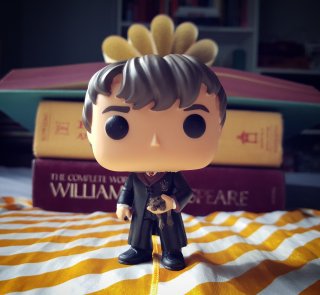
Neville Longbottom Funko


Do you remember when Bustle offered “The ONE Question That Will Determine Which Hogwarts House You Belong In”? This one:

If you could take on huge risk right now, and undo it if it didn’t end up with the result you wanted, what would it be?

It was a horrible question, completely non-canon. Artists kept getting sorted as Slytherin, because our answer involved taking risks for the sake of art, A.K.A. “our career.”

Should we really trust a sorting hat method created by a Slytherpuff anyway? (I’m totally kidding. I’m married to one.)

The Sorting Hat Is All You Need


If Hermione were in charge of sorting students, she’d go to the primary source: The Sorting Hat. Not even Pottermore, which is what caused existential crises in all of us when THAT first came out.

Example: I’m a Gryffindor. If you’d have asked in 2012 which Hogwarts I would be in, I would’ve said Ravenclaw. They’re brilliant, and they live in a tower. (Those conditions were the only aspects I considered. Clearly I’m not as brilliant as I think.)

Then Pottermore sorted me into Gryffindor, triggering an existential crisis.

Now I totally get it. I’m like a hybrid Minerva/Molly/Hermione.

You can view everything the Sorting Hat says sings on the subject of houses here, but read on for the defining characteristics of each.

Images belong to Pottermore. Become a member to take their sorting quiz.

Ravenclaw

Ravenclaws are CLEVER. They might be wise, or they might be “smart” (as in, “Don’t be smart with me!”). They are more concerned with self-betterment than measurable success; they are motivated by improvement, not competition with others. They need to be informed … and to inform others.

The Ravenclaws who kept hiding Luna’s things can show the dark side of Ravenclaw: removing whatever makes oneself look less than best.

Gryffindor

Gryffindors have NERVE. Bravery—maybe. Willingness to talk back to teachers, sure. Standing up to bullies / defending others? Definitely. They aren’t afraid to break the rules for the greater good.

Taking risks isn’t necessarily a defining factor of Gryffindor! You can be a scaredy wormtail and still end up in Gryffindor. You might avoid risks if the stakes are personal (like failure or rejection) but be braver if someone else is at risk. Neville showed a ton of courage in The Deathly Hallows, but do you think he tried out for the Quidditch team? I’m thinking No.

Slytherin

Slytherins have AMBITION. They are the most valuable allies and the most formidable foes because they will fight/sacrifice to achieve their goals. Slytherins get things done.

You don’t have to be a liar or a cheat to be in Slytherin, but if you are, then at least all the other sorting tests based on superficial stereotypes will confirm that you’re in the right house. *shrug*

Hufflepuff

Hufflepuffs are TRUE to self & others. Loyal, kind, and hardworking if they believe in the work. Hufflepuffs are the most altruistic, possibly the most practical, definitely the most fair.

Characters

Why isn’t Harry Potter a Slytherin? He totally could’ve been, except that he was prejudiced against them by the Weasleys, who considered evil, racist Death Eaters as being representative of the Slytherin house. #NotAllSlytherin

Why weren’t Hermione Granger or Minerva McGonagall Ravenclaws? Because they both have a lot of nerve—they’re willing to break rules.

But Hermione wasn’t willing to break the rules when she was first sorted! I think the Sorting Hat is either into divination—it saw how Harry and Ron would rub off on her—or it felt the need to inject some wisdom into Gryffindor to balance out the Weasley brothers.

Why isn’t Neville Longbottom a Hufflepuff? Neville is very loyal, but more than that, he’s willing to lose house points (and their good sides) to stand up to Harry & co. He’s a Gryffindor.

Why wasn’t Snape a Gryffindor? He was brave and sacrificial, but ultimately his actions were motivated by obtaining his goals: becoming Dark Arts professor or (spoiler: [acting out his love for Lily]).

Why wasn’t Luna a Gryffindor or a Hufflepuff? Simply put, she’s the cleverest of all Harry’s friends. You might say she’s a rule-breaker, but she can’t really break rules if she marches to the beat of her own drum.

Do you have any more examples you’d like to add? Based on the defining characteristics above, which house would you be sorted into?

pg70pit writing contest logo

April 7th on 7th

This is 2016’s second 7th on 7th, where I take a blog subscriber’s seventh page and show you how I’d improve it for the upcoming #pg70pit contest. See the #70pit16 contest schedule here. See more about how to enter the contest here.

Check out the first 7th on 7th, in which I talk about wordiness, breath units, and cleverness.

pg70pit writing contest logo

7th on 7th

THE ORIGINAL PAGE

[Adult Literary Horror]

The backpack’s been emptied every time I shop, but I go through it again, and then the sturdy dressers. Finally I pull the suitcase from underneath the bed. It’s still heavy with stuff that I apparently hadn’t unpacked. Continue reading

Recommended Book Cover Designers

Yesterday I posted 7 Tips for Authors Working with a Book Designer.

7 Tips for Authors Working with a Book Cover Designer

I also created a new page of recommended book cover designers. You can find it under the “Getting Published” tab in my navigation menu.

Have an illustrator or book publicist you’d like to recommend? Comment below! I’d like to create recommendation pages for these services as well. Please include link to their website.

(Comments are moderated. If yours doesn’t appear right away, it will once I’ve approved it.)

Working with a Book Cover Designer

I don’t believe in judging a person by his or her appearance, but I definitely judge a book by its cover, and so do readers.Just say no to amateurish design. You want readers to take you seriously, don’t you?

If you care about your book, you need to care about your cover. As a former graphic designer, it’s easy for me to tell, based on cover alone, most indie-published books from professionally published ones. Some small presses hire amateur designers, too. Here are some tips to avoid amateur designs and get the best design for your book (or your buck).

7 Tips for Authors Working with a Book Cover Designer

7 Tips for Working with a Book Cover Designer:

  • Unless you’re a trained designer, your design ideas will likely be derivative of visual cliches you’re used to seeing.
  • Saying “do whatever you want” can often be paralyzing to a designer with a thousand ideas.
  • Therefore, give the professional designer direction but not management. Ask for a creative brief, a tool which helps the designer understand what you want. Give the designer a few ideas to get him or her going, and then let the pro do his or her job.
  • It’s often better to say what you don’t like than what you do. “Can we avoid the color orange?” is better than “My favorite color is purple. I want it purple.”
  • If you provide images or ideas, make it clear that they are to inspire, not require the designer to follow them.
  • Create a Pinterest board of your favorite book covers to understand what styles you like. It can also be a useful addition to a creative brief. (Sharing this with your designer will be especially helpful if you hire a newbie designer.)
  • Know your genre. A good book cover gives the reader an expectation of what the pages inside hold.

cover-designs

If you’re working with a traditional publisher, they will have an in-house design team.

If you’re self-publishing or working with a small press that hires freelancers, here’s a round-up of cover designers.

If you are absolutely confident in your ability to DIY, here’s a tutorial to get you started. However, I strongly recommend researching typography basics before trying to make a cover yourself. Specifically learn hierarchy, legibility, and how to pair fonts. Creative Market has consistently solid typefaces. Stay away from Papyrus, Comic Sans, Impact, Copperplate, and Scriptina. If a display, handwriting, or script font is pre-installed on your computer, you can bet it’s a cliche. I also recommend learning from the good, the bad, and the ugly book covers at The Book Designer’s eBook Cover Design contests.

Click to Tweet: 7 Tips for Authors Working with a Book Cover Designer via @larathelark http://ctt.ec/JWS8T+