ThanksGIVING

Contents

  • 15 Bookish & Writerly Things I’m Thankful For
  • My Gift to You
  • Small Business Saturday–Cyber Monday Editing Deals

15 Bookish & Writerly Things I’m Thankful For

  1. My editing clients! I wouldn’t be able to blog or stay home with my kids if it weren’t for you. I’m daily inspired and encouraged by your creative spirits. You’re THE BEST.
  2. The books patiently waiting by my bedside for me to read them
  3. My local library, for saving me hundreds of dollars a year with all their books and comics and movies.
  4. Librarians, for being insanely helpful and brilliant.
  5. This reminder from Shannon Hale:
    https://twitter.com/haleshannon/status/636907891379736576
  6. This GIF:
    https://twitter.com/larathelark/status/667520389229101056
  7. Indie Booksellers (like Addendum Books) and lit mags (like Revolver) who put on awesome literary events.
  8. The social media accounts which show how hilarious and human book publishers are.
  9. The couple hundred writers who participated in #pg70pit this summer—Thank you! We’ll be doing it again in 2016!
  10. The readers & writers who joined in my first BookDeeply writing seminar / book club. (You can still join! Nominate next spring’s debut author in the comments below.)
  11. My fellow MS Editors—you raise me up so I can stand on mountains. Oh, wait, that’s Josh Groban.
  12. Writing/editing/reading social media—Twitter, for helping me find my tribe, and Bookstagrammers, for making my daily doses of books and design easy and convenient.
  13. The community of comics creators at OA Live.
  14. FREE COMIC BOOK DAY
  15. And YOU, for reading my blog! Thank you!

blowkiss

What literary wonders are you thankful for this year? Share in the comments!

My Gift to You

If you are not of a geeky persuasion and/or have no appreciation for popular culture, you probably won’t appreciate this. But if you know who Pavel Chekov is, then I hope you like and enjoy.

I made a series of geeky to-do/checklists for you. I call them…

wait for it…

the CHEKOV LIST.

I’ve got blue ones with trekkie insignia…

chekovblue

Assorted colors for color-coders:
chekovmulti

and black and white sketchy ones for those trying to save some toner…
chekovblack

They’re free! You can download them by clicking the image below.

If you do download them, and if you enjoy them, do me a favor and rate them on Teachers Pay Teachers, please!

Eventually I’ll add more writing worksheets to that site, so let your writing instructors know about it. 🙂

Have fun with these, print out a bunch for friends, enjoy!

downloadEditing Deals

From now through Cyber Monday, request a quote from me to receive big discounts!

SBSdeal

Note: November is the craziest month for Marine families, so my posting schedule is a bit off! We had the Marine Corps Birthday Ball last weekend and have Thanksgiving tomorrow, so November’s query workshop and the Act Three post will be a bit delayed.

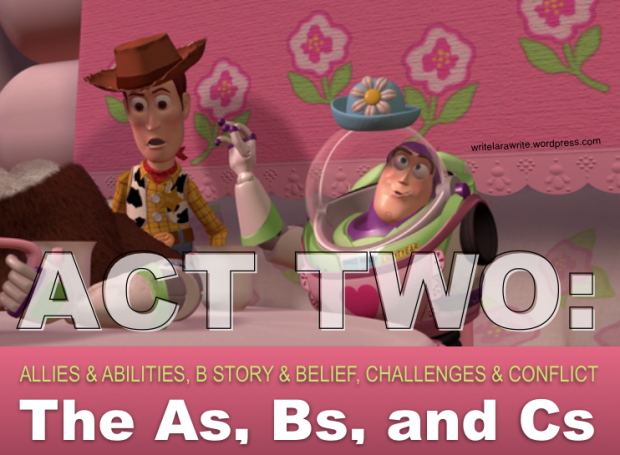
The ABCs of Act Two (NaNoWriMo Week 3)

act_two

Toy Story and its characters are owned by Pixar.

Posts in this series so far:

I talk about the second act in my series on plot. Here I’ll continue examining how these 8 C’s of Plotting combine with Theme in Toy Story‘s second act..

The Ocean

Act One gave us a character with a desire that’s threatened. Woody wants to be the favorite toy, and Buzz’s appearance threatened Woody’s position.

The character’s mistakes (or, in a passive protagonist, his inaction or avoidance) put her into an impossible situation or foreign location. This is the “ocean” of Act Two. (The term “ocean” comes from the Paper Wings Podcast.)

Toy Story’s Act One is character-driven. After the inciting incident (Buzz’s arrival), everything that happens in Act One is a result of Woody’s decisions.

Act Two serves three purposes—ABC:

1) provide the protagonist with Allies and Abilities (or, in a tragedy, Enemies and Flaws)

2) develop the B story or Belief (theme), and

3) Challenge the protagonist with different kinds of Conflict

Complication, the Break into Act Two

When we last left Woody and Buzz:

BUZZ
Sheriff, this is no time to panic.

WOODY
This is the perfect time to panic!
I’m lost, Andy is gone, they’re going
to move from their house in two days,
and it’s all your fault!!

BUZZ
My fault? If you hadn’t pushed me
out of the window in the first place–

Woody and Buzz are stranded at the gas station. Woody nearly got ran over by a semi truck, and he is freaking out. Being lost is the worst possible situation for a toy desperate to be favorite.

Preparation and Problems

The Preparation and Problems section of the plot is the longest section. It’s also the part where most movie trailers gather material from. Blake Snyder calls this section “fun and games”—and that is how the audience will view it, but all of the ABCs listed above need to be introduced and built up during this section. After the Preparation and Problems, the main character should every thing he needs to succeed during the confrontation and the climax.

Note the B story is optional and flexible. When you frame your story with theme, your B story is going to give another opinion or point of view on that theme. If your story is a romance or buddy story, the B story will be the arc of that secondary protagonist.

In Toy Story, here’s the beat sheet:

  1. Introduce Buzz’s delusions as the B Story (He thinks he’s supposed to save the galaxy from Emperor Zurg—Woody knows he’s just a toy)
  2. Woody tricks Buzz into getting on the Pizza Planet delivery truck
  3. W & B sneak into Pizza Planet (obstacle)
  4. Woody finds Andy; Buzz finds a spaceship crane game (conflicting motivations)
  5. Sid gets an alien, Buzz and Woody out of the crane game
  6. Sid takes the toys home, gives the alien to his evil, toy-killing dog Scud (stakes, antagonist)
  7. Sid steals his sister Hannah‘s doll and performs toy surgery on it (new character; stakes)
  8. With Sid gone, his room comes to life. B&W are in toy hell—populated by mutants (situation, new characters)
  9. At Andy’s House, the toys are still looking for Buzz. Andy comes home without Woody. Toys consider it a sign of Woody’s guilt. (pinch point)
  10. Sid tortures Woody with a magnifying glass, starting his forehead on fire (stakes, tool)
  11. Trying to escape, Woody uses Buzz’s karate-chop action to fend off the mutant toys (B story)
  12. Woody and Buzz run into Scud. Woody’s pull-string wakes the dog up. (challenge)
  13. Buzz sees a commercial for a Buzz Lightyear toy (B story midpoint)
  14. Buzz tries to fly (B story elation)
  15. Buzz falls, and his arm pops off, confirming he’s a toy. Hannah picks him up. (challenge, B story collapse)
  16. Woody falls out of the closet entangled in Christmas lights and finds Buzz at a tea party with Hannah. Woody imitates Hannah’s mom’s voice to get her to leave (tool, obstacle, belief)
  17. Buzz is Mrs. Nesbit (B story gloom); gives Woody idea to fly out window (obstacle)

Through this section, Woody gains allies (Buzz, the mutant toys) and abilities (the magnifying glass, talking to humans). Buzz’s B story, which was suggested in Act One, gets its own arc here. Woody’s beliefs start changing—earlier he’d be destroyed by truck or magnifying glass before breaking his “toy” character. Woody and Buzz are both challenged, revealing their weaknesses. We also get a “pinch point” reminder of the antagonists Woody will have to face next:his fellow toys at Andy’s house.

Confrontation, Elation, Collapse

Woody throws the Christmas lights to Andy’s toys, and some are happy to see him (elation), but Mr. Potato Head still doesn’t trust him, and reminds the other toys what he did to Buzz. Woody tries to get Buzz to prove to the toys that he’s okay, but Buzz, still depressed, throws his arm at Woody. Woody pretends to be Buzz with just his hand. The toys might just believe him … until he slips up and shows them the severed arm. Now they’re positive he’s a toy killer, and they close the window.

Gloom

Pixar movies tend to have lengthy gloom periods because they follow big, emotional collapses. Compare this to Dreamworks movies, which tend to have less intense gloom periods. In many stories, especially visual fantasies, the environment or weather conditions will reflect the gloom period.

Here’s a beat sheet for Toy Story‘s gloom:

  1. Woody tries to save Buzz from the Mutants, who actually mend Buzz’s arm (allies)
  2. Sid is coming back, and Woody tries to drag Buzz out of the way, but Buzz is still depressed (B story)
  3. Woody hides, gets trapped; Sid decides to blow up Buzz, but he has to wait until the thunderstorm is gone (obstacle, stakes)
  4. Andy really misses Woody; he’s moving tomorrow (hope, stakes)
  5. Woody asks Buzz for help, but Buzz is still depressed.
  6. Woody explains why being a toy is great. He says Buzz deserves to be the favorite.

Midpoint

As I’ve said before, the Midpoint can happen any time between the Confrontation and the Comprehension. The Midpoint occurs at about 50% and is a shift in thinking or purpose. In Toy Story, Woody’s Confrontation and Collapse happen in the same scene, right after Buzz’s. The Midpoint often occurs during a sequel—when the character has a moment to think. For Buzz, the midpoint is when he’s lying on the ground. He’s not going to keep trying to get back to Star Command anymore—his motivation has changed. For Woody, the plot midpoint starts when Slinky drops the blinds. Woody isn’t going to be the favorite among toys anymore. But Woody’s emotional, character midpoint starts when he says this:

WOODY
Oh, come on, Buzz. I…Buzz, I
can’t do this without you. I need
your help.

and ends when he says this:

WOODY
Why would Andy ever want to play
with me, when he’s got you?
I’m the one that should be strapped
to that rocket.

Listen Buzz, forget about me. You
should get out of here while you can.

Woody stops focusing on himself being Andy’s favorite toy and starts to realize that he needs others to help him. He starts thinking of Buzz and Andy rather than his own position.

The plot midpoint is the scene, and the emotional midpoint is the sequel. All together, you’ve got a big Scene at the middle of the story that shows a change in direction or motivation.

Comprehension

The comprehension is whatever drags the character out of the gloom.

BUZZ
Come on, Sheriff. There’s a kid
over in that house who needs us.
Now let’s get you out of this thing.

WOODY
Yes Sir!

Once out of the gloom, the character needs to make a new plan, which starts Act Three.

Writing Act Two

Have you figured out what your character’s deepest, unconscious desire is?

What does your character believe in Act One? How will that belief change or evolve? What shift will your character experience during the midpoint?

What kind of people, places, and obstacles will help your character arrive at the midpoint?

Remember the 12 different types of antagonists. Brainstorm problems your character might face while en route to the midpoint.

I’m donating some edits for an auction benefitting Summer Heacock. The top 5 bidders will win their choice of a full plot critique or an intense line edit of their first ten pages. Bid here before Monday November 23rd.

Next: Act Three

Overused Words You Should and Shouldn’t Delete

overused-words

If you spend some time in writer critique circles, I’m sure you’ve heard the well-intended advice to delete words “that” or “was” from your writing. I’m here to clarify when you should, and when you SHOULDN’T, delete these words.

Once you’ve read the lesson, I’ve got a master list of commonly overused words for you to refer to while revising.

Delete “that”

Sometimes a sentence needs the word “that” in order to be read correctly. For example:

He knew from the way I carried myself and the name tag I had been
wearing my father is mayor.

The sentence above reads like a run-on without the word “that.” It reads better like this:

He knew from the way I carried myself and the name tag I had been
wearing that my father is mayor.

Don’t delete “that” from sentences which use a “from” or “by” to describe how a person learns something. The “by” or “from” signifies how, and the “that” signifies what was learned.

If you delete the “that,” use punctuation to allow the reader time to switch from how to what:

You can tell by the way I use my walk,
I’m a woman’s man: no time to talk.

In most cases, I agree that “that” should be removed from sentences. 😉

But before deleting all instances, consider readability and meaning of the sentence with and without the word. “That” can be a symptom of wordiness, but it isn’t the problem. Sometimes clarity requires more words.

Delete “was” or “is”

The being words aren’t the problem. The problems are passive voice and incorrectly using “-ing” words. First, passive voice.

How to find passive voice

Passive voice is a verb with a “to be” helper verb (is/am/are/was/were/have been) in front of it and an -ed or -en ending. Here are some examples:

  • is forbidden
  • am bitten
  • are captured
  • was eaten
  • were smooched
  • have been made

How to fix passive voice

To fix passive voice, you need to find the true subject. Read the sentence and ask “by whom or what?” The answer to that question is the true subject.

  • Peanut butter is forbidden [by the PTA] —> THE PTA forbids peanut butter.
  • I am bitten [by my vampire boyfriend] —> MY VAMPIRE BOYFRIEND bit me.
  • Rebels are captured by the Empire —> THE EMPIRE captured rebels.
  • Spaghetti was eaten [by all] —> WE ALL ate the spaghetti.
  • Our cheeks were smooched by Great Aunt Millie —> GREAT AUNT MILLIE smooched our cheeks.
  • Mistakes have been made [by the administration] —> THE ADMINISTRATION made mistakes.

Should you fix passive voice?

Generally yes. Active verbs are stronger than passive verbs. Passivity is considered negative and weak.

However, sometimes passive voice is necessary. Sometimes the true subject needs to stay hidden (for suspense) or is unknown. Sometimes the object is more important than the true subject. This is especially true when the subject is a victim.

Do search for passive voice, but understand when to make it active and when to keep it positive.

What isn’t passive voice? Tricky -ed Adjectives

Being verbs are used as auxiliary verbs—helpers to other verbs, as in the case of passive or perfect voice—or as linking verbs, when they link the subject to a noun or adjective.

“He is happy” is pretty obviously not passive voice because “happy” isn’t a verb. But what about “He is excited”? Sure, you can ask “by whom or what” here, because you can be excited by something. Excite is a verb. But excited is also an adjective. So are pleased, confused, thrilled, delighted, flattered

Check the dictionary to see if the word is an adjective, and remember the rule about passive voice: Sometimes the object is more important than the true subject. In the case of linking verbs and adjectives, the character whom the adjective describes is usually more important than whatever is causing the effect.

Read more about linking verbs below, and the problems people have with them, too.

Delete “was” (also “-ing” verbs or “gerunds”)

Nearly every time I see someone online advising writers to cut “ing verbs,” that person doesn’t understand what a progressive verb is. And if those bloggers don’t know what a progressive verb is, they certainly don’t know what gerunds or active participial phrases are.

gerund is an “ing” word used as a noun. For example, Singing annoys Kristina—”Singing” there is a noun, because you could replace it with “Steve” or “fish” or “politics” and it would still make grammatical sense.

progressive verb is a verb with an -ing ending and a “to be” helper verb (is/am/are/was/were/has been/have been/will be/would be/will have been/would have been…) in front of it. The girl was singing— “was singing” is a progressive verb.

An active participial phrase is an “ing” word used as an adjective, often as part of a larger adjectival phrase. Singing loudly, the girl was annoying Kristina—”singing loudly” is an adjectival phrase talking about the girl, and “was annoying” is the verb, the action she is performing.

Getting -ing Verbs Right

Progressive verbs are sometimes used incorrectly. The key word is “progressive.” A progressive verb shows an action happening continually or at the same time as something else:

I was washing my face when Harold burst into the bathroom.

This sentence shows a progressive action. Changing that to this…

I washed my face when Harold burst into the bathroom.

…changes the meaning of the sentence. (Why did his bursting into the room cause me to wash my face?)

Progressive verbs often are used correctly.

However, if you’re throwing in progressive verbs for no reason, you can cut the “is/am/are/was/were” and “-ing” to create a simpler, less wordy verb. Chances are, that verb could be stronger, and in some works, that word count could be better spent elsewhere.

Barbara is eating a sandwich when Doug takes the dog for a walk.

Rather than put the focus on the act of Barbara’s continual eating, focus on something more important, like what about the sandwich was so remarkable it had to be included in the story.

Barbara savors her cheesesteak as if it were her last meal. Nauseated by the stench of her onions, Doug takes the dog for a walk.

Getting -ing Adjectives and Adjective Phrases Right

First, make sure the adjective is attached to the right noun.

Considering Nigel’s allergies, the cat needed to find another home.

That’s a misplaced modifier. The cat isn’t considering Nigel’s allergies; the narrator is. This is correct:

Considering Nigel’s allergies, I needed to find the cat another home.

So what’s wrong with -ing words? Not knowing how and when to use them.

Now you know.

Bonus: Linking Verbs = Telling

You’ll see below that linking verbs (e.g. am, are, be, is, was, were, will) are included on the overused words list.

Again, linking verbs are fine in moderation.

A linking verb creates an equation, telling you more about a subject. This = This.

Ronald is mad.

Eliza is a gravedigger.

These sentences aren’t bad. Sometimes less is more, and sometimes summary is necessary. Showing isn’t always better than telling—you should only show that which is remarkable enough to be remarked upon. If Eliza’s a background character, and her occupation doesn’t affect the plot of your story, then I don’t want a scene of her digging up graves. Actually, I could see that being thrown in for comedic effect or foreshadowing, but that’s beside the point. Showing too much can be just as much of a problem as telling too much. Use linking verbs sparingly and intentionally.

Bonus: Expletive sentences are passive.

Grammatically, “expletives” are filler words. Expletive sentences are ones that start with “it” or “there” and a linking verb. In expletive sentences, the “it” and “there” are abstract and veil the true subject. The second sentence here is not an expletive: “The tiger’s ears twitched. It was listening.” We know what “it” is—it’s the tiger.

This is an expletive:

It was scary to think about his mother dying.

Compare that with this:

His mother dying was scary to think about.

Both use linking verbs to tell us something. The latter is stronger because it has a concrete subject. You can get rid of the linking verb entirely if you’re willing to change subjects:

Thinking about his mother dying scared him.
(telling)

Whenever Yuri thought about his mother, his eye twitched involuntarily.
(showing)

Janet reached for Yuri’s hand. “That was Mercy Hospital. Your mother is ill.”
Yuri tensed. How did she get this number?
“I have some P.T.O. saved up. We could—”
“Save it for the funeral.” Yuri pulled his cuffs down to his wrist. “Let’s go catch a movie.”
(showing through internal dialogue and subtext. The reader has to interpret this scene. Is Yuri scared here? Maybe not. Maybe apprehensive, nervous… the reader will provide a complex emotion based on their own experiences.)

Expletive sentences are fine in moderation. We use them all the time in natural conversation. You’ll find plenty reading my blog. You’ll find them in literary and commercial fiction.

But do be aware of what they are and how to revise them. Ask “What was/is?” at the end of each expletive to find a clearer subject. Consider how you can show rather than tell. Remember, showing in fiction isn’t just visual, it’s experiential. How can you show by movement, touch, taste, smell, texture, sound, temperature, body language, weather, or appearance?

Note that expletives might use the following instead of a “to be” verb:

  • does
  • did
  • feel
  • seem

For example: “There seems to have been a misunderstanding.” or “It doesn’t take a rocket scientist to understand.”

The point of an expletive is that “it” or “there” is hiding, rather than referring to, the subject of the sentence.


 Commonly Overused Words

These are words I see repeated in manuscripts pretty frequently, combined with Lana’s Watch Word list. Check out her guest post to see how she uses her list to revise her own works.

You are free to use and share this list for educational, non-profit purposes! You must, however, give credit and the link to this post. You may not use this list for commercial gain.

Note: look for different forms of the words below. Tense (past, present, perfect, progressive) and person (first, second, third) will affect the word endings. The most common variations are -ing, -s, and -ed suffixes.

Adverbs / Prepositions—Adverbs are FINE. But these adverbs and prepositions are frequent pet words in manuscripts. Use in moderation.

-ly, A lot, Again, Almost, At least, Back, Even, Instead, Just, Like, Of Course, Over, Really, So, Then, Toward, Very, Which

Signs of Weak Verbs—can you make the verb stronger or more specific? Do you want to?

Be, Is, Had, Has, Make, Was, Were, Would,
It does/is/was/will/would/had,
There are/do/does/is/was/were/will/would/had

Signs of Wordiness—cut if you can, or split up the sentence. 

And, As, Began/Begin, Going, Start, That, Try/Tried

Repeated Descriptions / Actions—use in moderation. Authors tend to overuse one of these and ignore other possible descriptions or actions.

Breath, Brow/Eyebrow, Eye, Gasp, Hair, Head, Laugh, Shake/Shook, Shrug, Sit/Sat down, Smile, Smirk, Sneer, Stand/Stood, Stomach, Turn

Repeated Pronouns—make sure the antecedent (the word these refer to) is clear

It, One, of Them, of Us, There, They

Filtering Language—Removing will allow the reader to experience firsthand rather than secondhand (Read more)

Feel/Felt, Glance, Hear, Know, Look, Realize, Recognize, Remember, Saw, See, Seem, Think/Thought

Overused by Characters / Narrator—Again, fine in moderation but distracting when used frequently. Watch sentence beginnings, especially

And, But, Like, OK/Okay, So, Well, [Other Characters’ Names]

Full List

-ly
A lot
Again
Almost
And
As
At least
Back
Be
Began/Begin
Breath(e)
Brow/eyebrow
. But
Even

Eye
Feel/Felt
Gasp
Glance

Going
Had
Hair
Has
Head

Hear
Instead
Is

It
It is (does/was/will/would/had)

Just
Know
Laugh
Like
Look
Of Course
Of them
OK/okay
One
Over
Really
Realize
Recognize
Remember

Saw/See
Seem
Shake/Shook
Shrug
Sit down/Sat down

Smile
Smirk
Sneer

So

Stand/Stood up
Start

Stomach
That
Then
There is (are/do/does/was/were/will be/would/had)

Think/Thought
Toward
Try/Tried
Turn
Very
Was
Well
Were

Which
Would


Act One: Threatened Characters Make Mistakes (NaNoWriMo Week 2)

Act_One

Toy Story and its characters are owned by Pixar

Two weeks ago I shared my tips for Speed-Writing Your First Draft. Last week I talked about the five building blocks of a story as well as the three elements of scene. In the weeks to follow, I’ll give you some benchmarks and plot ideas to keep you from getting stuck.

If you haven’t read last week’s post about goals, conflict, the 12 types of antagonists, and sequels, go do so now. Today I’ll build upon those, so even if you have read it, you might want to skim through it again.

Overarching Goal = Passion or Fear

Another way to think of your character’s overarching goal is to consider what they’re passionate about. Remember, a character’s goal is what drives them. Something they only feel lukewarm about isn’t going to compel them to keep going to the end of the story.

This passion needs to be established early on.

If you’re not sure what your character is passionate about, consider what they’re most afraid of.

Consider Toy Story. Woody is afraid of being replaced as Andy’s favorite toy. But he’s not just passionate about being Andy’s toy, he’s passionate about his position as Head Toy. When Woody is Andy’s favorite toy, all the other toys look to him for guidance and reassurance.

Enter Buzz Lightyear, the coolest toy ever. Now Woody has a story, he has conflict, he has something that will change his current life and force him to make decisions.

The inciting incident is a Change which introduces fear or risks passion. 

Reaction

When your main character experiences this initial change, he or she is going to react. In my 8 C’s of plotting, I go into more detail about the reaction, so I’ll stick to the Toy Story example here.

Buzz arrives in Woody’s spot, and Woody tells him so. Buzz meets all the other toys, who are very impressed by him and compare him to Woody:

BUZZ pushes his button. “Buzz Lightyear to the rescue!”

The toys all GASP IN AWE.

SLINKY
Hey, Woody’s got something like that.
His is a pullstring, only it—

MR. POTATO HEAD
Only it sounds like a car ran over it.

Buzz is delusional and thinks he’s not a toy but an actual space ranger. Woody is the only one who seems to notice this, driving a further wedge between him and the other toys. Even Woody’s girlfriend wants Buzz to be her “moving buddy.”

A montage shows Andy favoring Buzz and replacing all his cowboy-themed (Woody) decor with space-themed (Buzz) decor. Another montage shows all of the toys who once idolized Woody now enamored with Buzz.

Then Andy has to choose between the two toys, and he picks Buzz. Woody has been replaced.

Woody has had it. He confronts Buzz, calling him a phony and shoving him. Their altercation is interrupted by Sid blowing up a toy in the yard next door. (Now this scene is a Chekhov’s Gun. If you’ve planned your story ahead of time, you will include all the factors at play during the ending within your first act. If you discover your story as you write, you’ll go back during revisions and plant foreshadowing.) After Sid shows us the worst possible outcome for a toy, Bo Peep reminds everyone that they are moving away (more foreshadowing).

Complication/Campaign

Next we have the Complication/Campaign. This step has a two-part name because it often starts with a complication and ends with the need for a new campaign or journey, which leads into Act Two. In a character-driven story like this, the complication:

  • is a bad decision, mistake, or accident
  • which grows out of the Reaction
  • and ends unfortunately,
  • resulting in the need to make new plans—the “campaign” of Act Two.

(See my 8 C’s post for other types and examples of reaction and complication, using the examples of The Fugitive, The Lion King, and The Hunger Games.)

In Toy Story, Woody actively but inadvertently causes his complication, which has its own mini-plot:

  1. Inciting incident: Andy’s Mom tells him he can bring one toy to the pizza restaurant—only one.
  2. Beginning: Woody is hopeful. He shakes the Magic 8 Ball asking if he’ll be picked. The 8 Ball says “Don’t count on it.” Woody throws the ball, which falls down behind the desk.
  3. Middle Part 1: Woody tells Buzz there’s a toy in trouble. He drives an RC car into Buzz to knock him behind the desk, but Buzz dives out of the way. There’s a chain reaction of bumps and knocks, which gets all the other toys’ attention, and
  4. Midpoint: Buzz is knocked out the window.
  5. Middle Part 2: Everyone reacts, including Woody, who didn’t mean for Buzz to fall out the window. The RC car tells the toys Woody did it on purpose, and the toys turn on him. Andy comes in, finding only Woody, and brings him into the van to the pizza restaurant.
  6. Ending: Buzz jumps out of a bush and onto the van. At the gas station, he confronts Woody. They fight, flying out of the car. They’re still fighting when Andy and his mom get back into the van. The van drives off, leaving Woody and Buzz at the gas station.

The Complication ends Act One and introduces the campaign or “ocean” of Act Two, which I’ll talk about next week! If you can’t wait that long, listen to this Paperwings Podcast on the subject.

Writing Act One

Ask yourself what your character’s immediate desire and greatest fear are.

In Tangled, Rapunzel’s passion is to see the floating lanterns. Her greatest fear is abandonment. If abandonment is her greatest fear, then her ultimate goal is to feel like she belongs in a loving family. See the 8 C’s of Tangled here.

Write your character’s fear and desire on a note and post it in your writing space. Refer to it every time you start writing. If you already know your character’s greatest desire or ultimate goal, write that down, too. Otherwise write it down as soon as you discover it.

Ask “What if…?”

Remember the 12 different types of antagonists. What kind of antagonist will introduce your character’s fear to the audience or reader during the inciting incident?

How can other types of antagonists drive your character to make the mistake that causes the Complication?

What impossible situation will your character find himself in—the “Ocean” of Act Two? How can you get your character there?

Moving On

Chances are, you have an idea of your character’s campaign or “ocean” when you write the Change.

The Change, or “inciting incident,” is what gives you a story. A character starts off with a sense of stability, something rocks the normalcy boat, and the protagonist is thrown into a sea of chaos. The boat gets shattered by a giant squid, the protagonist can’t swim, there are sharks in the water, and your guy floats on flotsam and jetsam until he gets to shore, where he finds a new stability. He kisses the sand, and the camera fades to black. —The 8 C’s of Plotting (underlined section suggests the “ocean” of Act Two)

If you’re already writing the ocean, consider what Preparation your character needs in order to survive the ocean and overcome her fear to achieve her greatest desire. What Problems will come her way? How can she win a small victory?

Next post: Act Two.