Editor Interview

#PitchtoPublication is Samantha Fountain’s new contest which pairs writers with freelance editors before an agent round. I’ll be participating as an editor, and Samantha interviewed me on her blog. To find out more about the Pitch to Publication contest, check out sfountain.com.

Interview originally appeared on sfountain.com, along with interviews of the other participating editors.

Q. How did you become a freelance editor?

I was an English Department TA in high school and throughout college. Grammar has always interested me. In high school, everyone figured I’d either become a teacher or be an editor at a publishing house. As a writing coach and freelance editor, I get the best parts of both—teaching receptive, determined writers and editing without having to worry about sales.

I was one of the acquiring editors at my university literary magazine and loved it. Some of my peers went on to work in publishing, but I liked the flexibility of freelancing because I have two small children at home. 

Q. Do you have a general philosophy for how you approach your editing work?

I’m more of a literary editor than a commercial one. I don’t do it for the money, I do it because I love literature and writing. (Enough to pay a private university thousands of dollars to give me reading and writing assignments for four years!) Of course, this is my job, so I need to be paid for my work. I never overcharge or undercharge, and I base my rates on the EFA standards.

Editing is a collaboration between writer and editor. It’s a mutual partnership. It’s a conversation. I encourage my current and potential clients to ask questions and voice concerns. Some writers need more nurturing. Others want to improve at any cost. Either way, I give honest, encouraging feedback. I’m never harsh, but I do respectfully snark sometimes. Editors and agents are snarky creatures. It keeps us sane in the slush.

Q. What are the most common mistakes you see in new writers work?

Cliches: If you’ve seen a phrase on someone else’s page, it’s probably a cliche. If you’ve heard it in a movie trailer, it’s definitely a cliche. If you have body parts moving of their own accord—eyes shooting open, for example—it’s not only a cliche, it’s an awkward visual.

Telling rather than showing: Telling does have its place. For example, you can tell me that a character shut the door without describing her movement across the room, the sound of the door creaking. Unless shutting the door is somehow a plot device, it’s not important and can be summarized. Novels do require some telling, otherwise they’d be scripts. But readers want to experience the story, so include feelings and sensations to incorporate the reader.

Over description and underestimation of the reader: Pick a “divine detail” to set the scene. Describe that, then let the reader fill in the rest. Readers don’t want to be lectured; they want to participate in the story.

Q. What’s the one thing most novelists don’t understand about the art of revision?

The first draft is about exploration and expression. It’s about the writer. Revision is about creating experiences for the reader.

Most writers write for themselves. There’s nothing wrong with that. But if writers want to work with agents and acquisition editors, if they want their work read by thousands of people, they need to recognize that literature is collaborative. Just read the acknowledgements at the back of a novel! Writing is a solitary effort, but success and publishing are both team efforts.

Q. What’s one easy thing every writer can do right now to make themselves a better writer?

Nothing about writing is easy! But writers who are easy to work with will become better writers. Read a lot, be a good listener, be professional, respect your readers, and remember that agents and editors are readers, too.

Q. What kind of entries are you looking for in your Pitch to Publication query box?

I’m a very omnivorous reader, so genre doesn’t matter. I want a story I can escape into, with characters who are uniquely human, not underdeveloped stereotypes. I want subverted tropes. I want something that isn’t cookie-cutter. What makes your story different from everything else out there?

Note: I’m not going to assume that anyone has read the same books I have, so I’ll give TV and movie examples to illustrate. If you haven’t seen them, it only takes an hour or two to rectify.

Writers with a graphic novel script, good gracious, send that baby to ME. For novels, I want all the genre-illusive pieces (Princess Bride, Doctor Who, Galavant). All the bromances (Sherlock, Psych). All the will-they-won’t-they spy and crime-fighting duos (Chuck, Castle). Anything depressing yet hilarious or with a happy-for-now ending (500 Days of Summer, Casablanca). Adventure stories that pass the Mako Mori test (Firefly, Pacific Rim). Character-focused historical fiction with an interesting plot (Indiana Jones). And possibly guilty-pleasure thrillers (Pretty Little Liars).

I do have a couple rules: no erotica, sexual violence, violence against children, or misogynist or racist POVs. Those stories are not for me.

Q. What’s your favorite ice cream flavor?

Minneapolis has too many creameries for me to ever just pick ONE favorite ice cream flavor. But I tend to gravitate toward complex flavors which combine textures. I like salted caramel pretzel. Grand Ole Creamery has Cookie Monster flavor, which is butter pecan with Oreo and cookie dough pieces and maybe M&Ms?—it’s amazing.

Q. How do you take your caffeine?

Chai Tea Latte, usually. Before 8pm or else I’m up all night! Also the chocolate I sneak while my kids are napping.

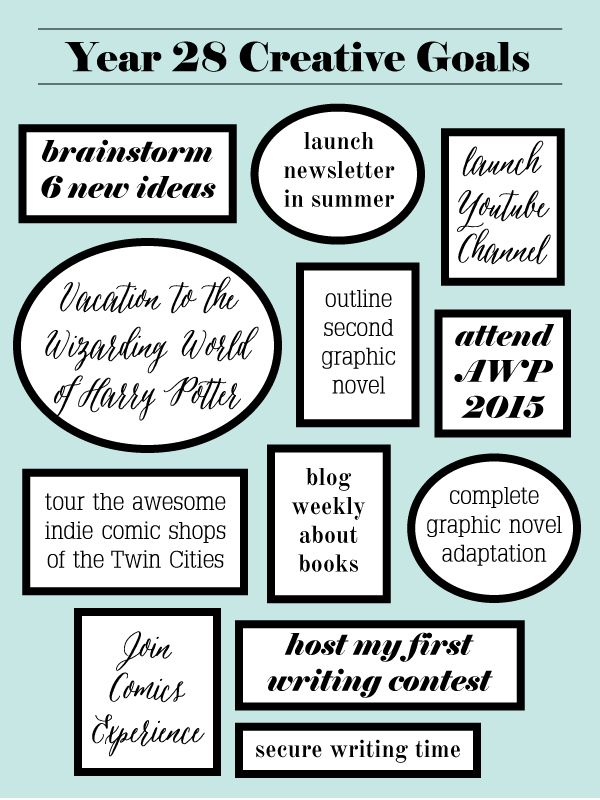
Year 28 Creative Goals

Jackie Lea Sommers posted twelve creative goals at the beginning of the year and just updated her followers on how she’s been doing on them (Spoiler: She’s killing it). Can you believe 2015 is already a quarter of the way through?

I loved her idea and that she did a visual post.

April is my birthday month, and I have a couple traditions I try to do yearly:

  1. Celebrate both our birthdays by doing something Shakespearean
  2. Visit the zoo to see the baby animals
  3. Create New Year’s Resolutions

I’m turning 27, so this will be my 28th year. Here are my creative goals:

Creative Goals 28th Year

From top left:

  1. Brainstorm 6 New Ideas—Novel, graphic novel, and picture book ideas that I haven’t already started drafting
  2. Launch Newsletter in Summer—I have so many blogs I had to create a new one just to curate what’s going on each month. When it launches, you can follow that one rather than following me on all the different platforms. Simplicity and organization!
  3. Launch YouTube Channel—I am really excited about this. Frequency of vlogs will be low as long as I have toddlers in the house, but each one will be packed full of goodness and giveaways!
  4. Vacation to the Wizarding World of Harry Potter—Captain and I were going to go for our 5th anniversary last year, but we had to cancel for his brother’s wedding. (Totally worth postponing for!) I’m really hoping we can get away this summer. We haven’t had a break in 4 years.
  5. Outline Second Graphic Novel—This is my Middle Grade novel, which I have to wait to start until I hear back on a writing grant I just applied for.
  6. Attend AWP 2015—I’ll cross this off the list next weekend! Very excited to attend. I’ll be live-tweeting my experience (@larathelark) and tweeting the advice and tips I gather (@laraedits).
  7. Tour the Awesome Indie Comic Shops of the Twin Cities—I need to network with fellow comics geeks. I’ve got a lot of catching up to do!
  8. Blog Weekly About Books—This is an eventual goal I’ll be working up to. Right now it’s monthly.
  9. Complete Graphic Novel Adaptation—I’m adapting a classic novel into a complete graphic novel to keep practicing the form.
  10. Join Comics Experience—This is a community for comics creators. Again, I have to wait to hear back from the grant before I can join (if I want it paid for)
  11. Host my First Writing Contest—Check out 70Pit, coming the first week of July!
  12. Secure Writing Time—In other words, I need to finalize a preschool for my 4-year-old and find regular, reliable part-time childcare for my toddler.

Now Accepting Summer Clients!

I’ve been on a short sabbatical from manuscript editing to get my household ready for the big move, but I’ll be open for business again in June, with the possibility of some openings in May! I’ve been missing all my clients and am very happy to get off the bench.

Seven Reasons to Make Me Your Editor

I’m taking reservations for the following services:

Manuscript Critiques

What you need to know:

  • This type of editing fills up the fastest, so don’t delay in reserving your spot!
  • I read the entire MS or short story and give overall comments and suggestions
  • I do not make in-text comments, but may highlight sections
  • Average cost is $8 per 1,000 words (a 75K manuscript = 75 x $8 = $600)

For more information, see my services page.

Substantive Line Edits or Copyedits

What you need to know:

  • Depending on the level of editing you need, I edit on the sentence level and give thorough feedback which has been praised by established literary agents, authors, and colleagues.
  • I use track changes for objective copyediting and leave comments for anything subjective.
  • Average cost for line edits is $27 per 1,000 words (I have a $40 special for the first 2,500 words and $160 special for the first 10,000 words)
  • Average cost for copyedits is $11 per 1,000 words ($7 for experienced authors)

For more information, see my services page.

Query Letter and Synopsis Edits

What you need to know:

  • I’m nearly always available for these edits, but they are done on a first-come, first-served basis. As soon as you pay, you get put on the waiting list, and I get to you as soon as I can. (I’ll let you know if the wait times exceed 3 business days in our first email.)
  • You get unlimited passes on these, but priority for full edits goes to new clients, who will need more attention. If you have a quick question, though, I often reply the same day!
  • For examples of my editing style, see my query workshops.
  • Cost is $35 for either, $60 for both.

For more information, see my query workshops.


I list my exceptions (the genres and content I will not edit) here and mention my favorite genres and subjects here.

If you think we’d be a good fit, send me your 1,000-word sample. I’ll read your sample, give you feedback, and quote you a price. To reserve a spot, you’ll need to pay a 20% deposit or $40—whichever is greater.

The deposit is refundable if you cancel before our scheduled date. If you cancel after that, I’ll keep the deposit.

For example, say that you want the first 10,000 words of your work-in-progress professionally edited. You pay $40 and we schedule you for the first two weeks of July. If you cancel before July 1, I’ll refund your $40. If you cancel after July 1, and I haven’t begun editing, I keep the $40 for loss of business. If I edited 5,000 words before you cancelled, I’ll keep your $40 but give you feedback on the first 2,500 words. You’d then have the option of paying for any feedback beyond that, using the price-per-word quote we agreed on.

Does that make sense? If you have any questions, please don’t hesitate to ask.

I look forward to reading your stories and pushing you toward publication!

Beta Readers vs. Manuscript Critiques

MS Editor Elizabeth talks about the difference between Beta Readers and professional MS critiques. I’ll add that strangers can be Beta Readers, but it’s best to pick acquaintances—they are objective, yet you can get a hold of them IRL if they drop off the planet or steal your work (FYI, this happens way less often than writers think). I had twelve friends read my novel and give feedback anonymously using a Google form—it worked well!

Elizabeth B.'s avatarMS Editors

You just finished writing the last page of your story—congratulations! Whether you pumped out a NaNoWriMo victory or spent the last five years agonizing over your dream book, you now have a full manuscript sitting in front of you. Give yourself a pat on the back; you deserve it for making it to the end. Now what? You want to make your story better, but you’re still too close to see its weaknesses and discern whether readers would enjoy it. It’s time to get an outside opinion.

If you take your work seriously, you should show your story to someone other than your mother or best friend. Run far away from anyone who has an obligation to tell you that your story is great as is! No book will be ready for publication without major revisions, so you need to hook up with someone who can give you informed feedback…

View original post 765 more words