Becoming a Fan Favorite: Writing Description and Direction

In today’s post, I talk about stage directions in fiction, writing natural descriptions, why some books are constantly reread by readers, and, to an extent, immortality.

Orderly Description

Ever played that “blind drawing” party game? You close your eyes or put a piece of paper on your head and someone gives you direction upon direction to cram into one picture?

Here’s an example for the party planning website Sophie’s World (which, consequently, is the title of one of my favorite books):

“I’d like you to draw the outline of a house. Just a simple little house, right in the middle of the page… Now, beside the house I’d like you to add a tree, a medium sized tree, not too big, not too small… Oh, I forgot! You need a front door on your house. Please draw a front door so that the people can come in and out easily… Oh, did I tell you there are apples in your tree? Draw a few apples, maybe 5 or 6, in your tree now… And don’t forget the windows in the house! I think two would be nice… Did I remind you to draw a chimney? Let’s put a chimney on the house, with some smoke coming out the top… Oh, and look! There’s a dog in the yard… And a picket fence… And of course there’s a family…”

This is the kind of experience a reader has when you describe something in an unnatural order:

blind drawing
It’s also what it’s like when description is given out of order. When describing a scene, consider camera shots.

Zoom in from broad descriptions, ending on one specific detail. Or zoom out, starting on a detail and working your way out to observing the whole. Pan in one direction. Going in an unnatural order gives the nauseating effect of “shaky cam.”

Adding details too late, after the reader has already created the image in his or her mind, gives what I like to call the “awkward goat” effect.

Writer: “I went to give the goat a kiss. Then the other goat—”
Reader: “Wait, there’s another goat?”
Goat: “SURPRISE! I’ve been here the whole time!” (maniacal goat bleating)
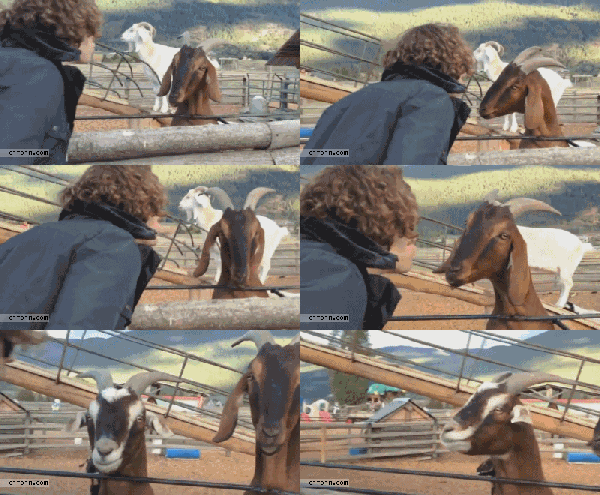
surprise-goat
While this is used effectively in visual comedy, redirection doesn’t really work in fiction.

Overcomplicated Stage Directions

Another problem of ineffective description is overcomplicated stage directions. I see sentences like this all the time in unpublished manuscripts:

“Come with me,” Jorge said and turned around while kissing my hand as we ran away together.

Though these are most often found in dialogue tags, I see overcomplicated stage directions all over. That sentence above is just one I made up, but let’s rewrite it so it doesn’t seem like “he” is doing a hundred things at once.

First, find the perps: “and,” “as,” and “while.” The two latter words can often be cut in stage directions. The former is a fine word that sometimes gets overused. Let’s focus on no more than two actions at once.

Said + turned, kissing + ran

“Come with me,” he said, turning around. He kissed my hand, inviting me to run away with him.

Let’s also apply what we just learned about orderly directions, and cut the unnecessary dialogue tag.

Jorge turned around. “Come with me.” He kissed my hand, inviting me to run away with him.

What did I just do? I took advantage of my friend the progressive verb.

A progressive verb is a verb ending in -ing. That ending tells us that the -ing verb is happening while something else is going on, while letting us cut the “while” or “as.”

“While” and “as” aren’t bad words. It’s not about the word, it’s how you use it. By all means, use “as” to make a simile (e.g., “as [adjective] as a [noun]”). “While” is an innocent preposition until proven guilty. The problem is using them to show more than one thing happening concurrently. Show me a manuscript which uses “while” or “as” in the first page in stage directions, and there’s a big chance that same construction will keep showing up over the next ten pages.

Doing a find/replace search for all instances of “as I,” “as we,” “as she,” “as he”  (depending on your POV), repeating the search with “while,” will help you see if you’re going overboard. Also be on the look-out for “then” and “before,” more signs of wordiness and or disorderly directions.

Use them a few times, and that’s fine. Do it a few times per page—or worse, per paragraph—and you’re just being unnecessarily wordy. Gone are the days when novelists are paid by the word.

The Divine Detail

Remember, your novel has to compete with online, in-demand television and movies. You need to keep your reader’s attention. That doesn’t mean your novel needs explosions or murders every other chapter; it means your prose needs to be immediate and precise rather than longwinded and wordy. You want to be Robin Williams giving his Seize the Day speech, not Ben Stein droning about economics. The difference isn’t just subject, it’s diction. Do diction right, and you’ll engage readers that otherwise don’t care one iota about your subject. That is, until they start reading your book.

When describing, choose one or two vivid details, referred to by editors as “divine details” that can set the scene or characterize, and let the reader fill in the rest of the image. Compare the chaos of the drawing above (ain’t I an artiste?) with expansion drawings done by children:
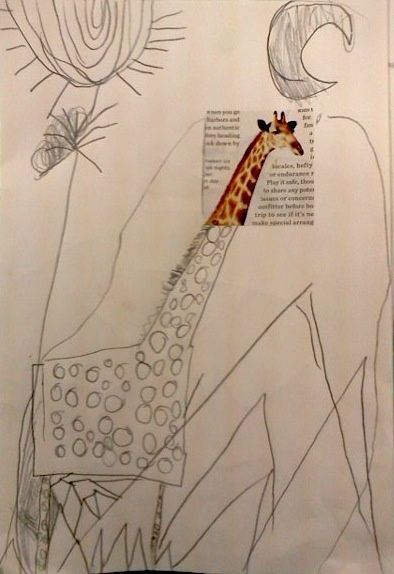
expand-drawing

Image via ArtMommie. Click for more images.

When the reader is allowed to contribute, your work takes on a new form. It evolves in the readers’ individual minds. It’s a spark which they build upon to create a conflagration.

Letting the Reader In

It doesn’t matter how brilliant of a writer you are—writing and reading are collaborative efforts, and that collaborative effort will bring more life and beauty to your work than you could hope to do by yourself.

Sometimes we write because we’re control freaks. We are the masters of the universe, and we will plot and plan and tell our characters exactly what they should do. But when we let our characters breathe and give them freedom, when we let the reader have some creative liberty, our work takes on a life of its own.

Maybe that’s a cliche, but if you want your work to live on after you’re gone, you need to let your reader experience your world naturally. You need to let them read between the lines and contribute to the meaning and world of your fiction. When you let them participate, readers will not only want to buy your books, they will want to reread your books over and over again, letting them become part of their life, seeing how their interpretations change over the years.

Friday Reads: SMILE by Raina Telgemeier

We bought a house! Posts will be pretty sporadic while we clean and pack and move, but this summer will be full of goodness. I’ll be participating in #PitchToPublication as one of the freelance editors, and I’ll be hosting #70pit the first week of July. So get those manuscripts ready for some full requests! For now, here’s a quick review of Smile, a middle-grade graphic novel memoir by Raina Telgemeier.

smile

Everyone in my family adored this graphic memoir.

I was reading it in my hammock outside and kept laughing. Soon my husband came over (he’s the one with orthodontic experience) and began reading with me, laughing and reading his favorite quotes aloud. Then our son came and joined us, reading along.

The toddler wasn’t particularly interested, though. I’m thankful, because the hammock was already dragging on the ground at that point.

As for the actual content, Raina (the main character) goes through middle and high school, relaying her dental and social dramas. Telgemeier (the author/illustrator/adult) managed to fit a lot into a single volume graphic novel. Secondary characters were drawn in the 2D cartoony style but weren’t flat caricatures of people.

smile-inside

Click to view sample pages on Amazon.

Telgemeier can pack so much emotion into one facial expression—she’s insanely talented as an illustrator! But her storytelling is also finely crafted. We’ve got subplots, conflicts, friends and foes, self reflection. Life lessons aren’t a prerequisite for me in juvenile literature. Smile does have them, but Telgemeier never lectures her audience. Teen Raina is conversational, assuring and inspiring.

Recommended for 5th and 6th graders, and for anyone who’s survived middle school and/or orthodontia.

Query #11 April 2015

Below is the eleventh public query critique I’m offering up on the blog. To enter, see the rules here. If you want a guaranteed critique (plus line edit) of your query or synopsis, private ones cost $35 each.

My comments are in blue below. To read the original query first, simply read only the black text.

Dear Agent,

If being shy around girls were a serious disease, sixteen-year-old Jason Martyr would be on the terminal list.  ha! It turns out girls are the least of his worries when a secret government agency abducts him, claiming he has a rare genetic ability to travel through time. I’m not a fan of the phrase “it turns out” because 1) I see it a lot in queries and 2) it’s a passive, abstract phrase. I’d suggest cutting it, but this premise has me excited, so I’m not that bugged by it.  The agency threatens Jason’s family and friends to ensure his cooperation. Let’s swap this to give it more immediacy. Always end on the strongest point: “To ensure his cooperation, the agency threatens Jason’s family and friends.” Later you mention the “perfect girl.” Does he have a particular crush? Is she threatened as well? If so, this would be a great place to put it, putting a name and personalizing the threat.


His Jason’s mission is to go back in time to and stop a ruthless group called the Masters of Infinity[comma] from altering history and taking control of the future. This was a long sentence. Break it up and rework the second half to give specifics about the Masters of Infinity. With the sentence as it was, we lose that awesome name in the middle. You could rewrite this as “…Masters of Infinity, a group of ___ wanting to take control of the future by altering history,” but that’s a bit blah, so I’ll leave the rewrite to you. Their next attack is a 1937 coup attempt aimed at deposing FDR and installing a fascist dictator in his place.  If the Masters succeed, the U.S. may never take part in World War II, setting off a catastrophic domino effect through the rest of the timeline. Ooooooh. Honestly, at this point, I’m assuming you’ve already snagged an agent since you sent this to me 3 weeks ago. Granted, I don’t read a lot of YA time travel, so an idea like this could have already sold, in which case the problem is timing. I hope the timing is on your side!

P.S. Find/Replace those double spaces after each period. That’s carried over from typewriters. I assume you won’t be sending agents a manuscript printed with a dot-matrix printer. Double spaces should only be used if typing in a monospace font, like Courier.

All Jason wants is to return to his normal life and the quest for the perfect girl. This is where the query starts to falter. Hopefully your premise will get you far enough that the agent will look at your pages. Otherwise these stakes aren’t personal or intense enough. The only thing keeping him from saving the world is laziness and hormones? Make it personal. Again, if there was one girl in particular, does he feel like he needs to prove himself to her? Is he up against crippling self-doubt? Before that can happen he This is a bit wordy. “First he” easily cuts three words. must survive martial arts training from the most dangerous fighter in the world, and then prevent the Masters’ henchmen from carrying out the coup. Since you stated that this was his mission already, this is redundant. His enemies know he is coming, and have some lethal surprises in store for him. I think you could cut everything in this paragraph except for this line, and you’d have a tighter query. But I would like to get a stronger, deeper reason for what he does what he does. Jason will go home when he completes the mission – if he survives.

[Fun title in ALL-CAPS], a work of speculative fiction for the YA market, is complete at 82,000 words.  It features action sequences similar to the television series Chuck, and light science fiction aspects similar to Roland Smith’s Cryptid Hunters series.  It is a stand-alone novel with series potential. While Chuck is one of my favorite television series of all time, it’s difficult to compare a written action sequence to a visual one. I’d cut the “action sequences” part and mention that it’s similar to the TV series Chuck and Roland Smith’s Cryptid Hunters series.

I can definitely see the Chuck similarity. Remember that when we meet Chuck, he’s a failed genius working a dead-end job and has been betrayed by both his best friend and his girlfriend. He’s pathetic, but we know he has potential. What Jason is lacking is Chuck’s motivation. Chuck wants to figure out what happened to him, he wants to feel successful, and he wants to feel like less of a loser. Incorporating the emotional stakes into your query will help sell it.

I have a bachelor’s degree in journalism and MBA with emphasis in marketing, both from the University of Missouri.

Thank you so much for your time and consideration.

PLEASE let me know when this book comes out.

Oh, and…er…if you want to send me a revised query, I’ll look at it.

querylara

Editor Interview

#PitchtoPublication is Samantha Fountain’s new contest which pairs writers with freelance editors before an agent round. I’ll be participating as an editor, and Samantha interviewed me on her blog. To find out more about the Pitch to Publication contest, check out sfountain.com.

Interview originally appeared on sfountain.com, along with interviews of the other participating editors.

Q. How did you become a freelance editor?

I was an English Department TA in high school and throughout college. Grammar has always interested me. In high school, everyone figured I’d either become a teacher or be an editor at a publishing house. As a writing coach and freelance editor, I get the best parts of both—teaching receptive, determined writers and editing without having to worry about sales.

I was one of the acquiring editors at my university literary magazine and loved it. Some of my peers went on to work in publishing, but I liked the flexibility of freelancing because I have two small children at home. 

Q. Do you have a general philosophy for how you approach your editing work?

I’m more of a literary editor than a commercial one. I don’t do it for the money, I do it because I love literature and writing. (Enough to pay a private university thousands of dollars to give me reading and writing assignments for four years!) Of course, this is my job, so I need to be paid for my work. I never overcharge or undercharge, and I base my rates on the EFA standards.

Editing is a collaboration between writer and editor. It’s a mutual partnership. It’s a conversation. I encourage my current and potential clients to ask questions and voice concerns. Some writers need more nurturing. Others want to improve at any cost. Either way, I give honest, encouraging feedback. I’m never harsh, but I do respectfully snark sometimes. Editors and agents are snarky creatures. It keeps us sane in the slush.

Q. What are the most common mistakes you see in new writers work?

Cliches: If you’ve seen a phrase on someone else’s page, it’s probably a cliche. If you’ve heard it in a movie trailer, it’s definitely a cliche. If you have body parts moving of their own accord—eyes shooting open, for example—it’s not only a cliche, it’s an awkward visual.

Telling rather than showing: Telling does have its place. For example, you can tell me that a character shut the door without describing her movement across the room, the sound of the door creaking. Unless shutting the door is somehow a plot device, it’s not important and can be summarized. Novels do require some telling, otherwise they’d be scripts. But readers want to experience the story, so include feelings and sensations to incorporate the reader.

Over description and underestimation of the reader: Pick a “divine detail” to set the scene. Describe that, then let the reader fill in the rest. Readers don’t want to be lectured; they want to participate in the story.

Q. What’s the one thing most novelists don’t understand about the art of revision?

The first draft is about exploration and expression. It’s about the writer. Revision is about creating experiences for the reader.

Most writers write for themselves. There’s nothing wrong with that. But if writers want to work with agents and acquisition editors, if they want their work read by thousands of people, they need to recognize that literature is collaborative. Just read the acknowledgements at the back of a novel! Writing is a solitary effort, but success and publishing are both team efforts.

Q. What’s one easy thing every writer can do right now to make themselves a better writer?

Nothing about writing is easy! But writers who are easy to work with will become better writers. Read a lot, be a good listener, be professional, respect your readers, and remember that agents and editors are readers, too.

Q. What kind of entries are you looking for in your Pitch to Publication query box?

I’m a very omnivorous reader, so genre doesn’t matter. I want a story I can escape into, with characters who are uniquely human, not underdeveloped stereotypes. I want subverted tropes. I want something that isn’t cookie-cutter. What makes your story different from everything else out there?

Note: I’m not going to assume that anyone has read the same books I have, so I’ll give TV and movie examples to illustrate. If you haven’t seen them, it only takes an hour or two to rectify.

Writers with a graphic novel script, good gracious, send that baby to ME. For novels, I want all the genre-illusive pieces (Princess Bride, Doctor Who, Galavant). All the bromances (Sherlock, Psych). All the will-they-won’t-they spy and crime-fighting duos (Chuck, Castle). Anything depressing yet hilarious or with a happy-for-now ending (500 Days of Summer, Casablanca). Adventure stories that pass the Mako Mori test (Firefly, Pacific Rim). Character-focused historical fiction with an interesting plot (Indiana Jones). And possibly guilty-pleasure thrillers (Pretty Little Liars).

I do have a couple rules: no erotica, sexual violence, violence against children, or misogynist or racist POVs. Those stories are not for me.

Q. What’s your favorite ice cream flavor?

Minneapolis has too many creameries for me to ever just pick ONE favorite ice cream flavor. But I tend to gravitate toward complex flavors which combine textures. I like salted caramel pretzel. Grand Ole Creamery has Cookie Monster flavor, which is butter pecan with Oreo and cookie dough pieces and maybe M&Ms?—it’s amazing.

Q. How do you take your caffeine?

Chai Tea Latte, usually. Before 8pm or else I’m up all night! Also the chocolate I sneak while my kids are napping.