Friday Reads: MS. MARVEL, Vol. 1: NO NORMAL

Regarding Graphic Novels

Read my introduction below, or skip ahead to the review.

I’m going to preface this with the disclaimer that I’ve always loved superheroes, but comics were not easily available to me as a child. I didn’t know anyone at school who was into comics, and on the rare occasion I was far enough away from my rural upbringing that I could get my hands on comics, I’d grab a single issue. I was often disappointed in the lack of variety, the women without agency treated more like scantily clad objects of desire or killing rather than heroes. I watched Batman and Spiderman cartoons and loved Supergirl.

Pre-internet, I grew up thinking that geek girls were an endangered species.

Now I have immediate access to comics thanks to the internet. I live in a city with comic book stores and a huge interlibrary loan system.

I’m a small-town girl late to the game, but I have every intention of catching up. And let me tell you, there’s never been a better time to get into comics, especially if you’re a woman or a child.

More female characters are being given agency—they are treated as individuals, not objects. More are fronting their own series. Women comic creators are generating a ton of amazing content online and in print.

Our library separates the adult graphic novels from the teen ones, and the teen ones from the children’s ones, a division I’m very thankful for as a mother.

Go to your library, browse the spines, judge them by their covers, and take a stack home. This week I picked up Saga vol 1 (Mature: contains very graphic sex in chapter/issue 4), A Boy & A Girl (pg-13 for brief nudity and language), This One Summer (pg-13 for language and sexual references), Ms. Marvel vol 1, Misfits of Avalon, and a stack of Star Wars ones for the Captain.

I’ll likely be reading and reviewing newer releases, ones that are either stand-alones or the first in a new series. This isn’t a comic or graphic novel review blog—it’s a blog about writing and editing—so I’ll be reviewing ones with a broad audience, ones that should be available at local libraries or bookstores.

But do comment below with your favorite graphic novels! It’s no secret I’m a fan of The Dreamer, but I won’t be reviewing it, since Vol. 3 is out in stores now.

Ms. Marvel Vol. 1: No Normal

msmarvel

This is a very mild origin story (think Peter Parker without Uncle Ben dying), so whether you’ll like it or not depends on how well you connect with Kamala.

Kamala Khan is the kind of superhero I craved as a preteen. She’s geeky and spunky and relatable. (Again, a lot like early Spider-Man.) I can see why some might consider her a Mary Sue character, but in #5, when she had her first “victory,” I was hooked. If the conflict and stakes don’t keep intensifying, then I’ll probably walk away, but for now, I’m so in.

kamala-khan

If you have daughters that want to get into comics, I’d recommend Kamala for 8+

Writing Exercise

Pick up a copy of Ms. Marvel Volume 1 from a library or bookstore (you could read the whole thing just standing in between stacks). Then write a 15-blinker origin story.*

*It doesn’t have to be a superhero story. It could be about your origin as a writer.

And don’t forget to comment with your favorite graphic novels, comics, or webcomics below, if you’ve got some!

Query #9 February 2015

querylara

Below is the ninth public query critique I’m offering up on the blog. This will happen once a month (as long as I get a response). I choose one query per month. If your query is not selected one month, it will be in the drawing for the next month. Please do not resubmit unless you’ve made significant edits. To enter, see the rules here. If you want a guaranteed critique (plus line edit) of your query or synopsis, private ones cost $35 each.

My comments are in blue below. To read the original query first, simply read only the black text.

Greetings…,
Her life is a lie but Fiona doesn’t know it, until a chance encounter and a brush with death blows the lid off her neatly packaged world. These are all cliches. “Blows the lid off” is a cliche, too, but you’ve made it fresh with “neatly packaged world.” Still, this hook doesn’t tell me what makes your book unique.
Fiona’s in the spotlight cliche again, and this time it’s a little more serious than a step from the closet. Is this a reference to her coming out of the closet? Because that’s not clear. A mysterious girl, created in a lab as an eternal sixteen-year-old, plops beside her on a park bench, and instantly ensnares her mind. Now, she’s smack in the middle of a deadly pursuit.
Cut the cliches and the set up of these two paragraphs and get to what’s important: “When a lab-created girl plops beside her on a park bench and ensnares her mind, __teen-year-old Fiona is about to get even more unwanted attention than when she came out of the closet.”
A black ops team is on the hunt; their project’s running loose, and if she becomes active, the entire world will suffer. I’m not sure what’s going on here. Is the girl who sat next to Fiona and ensnared her mind this “project”? What is that girl’s name? I want to know more about her, even if it’s just a sentence, so that I’m really concerned when I read that a black ops team is looking for her. And how will the world suffer? Give us a precise idea of what could happen. The squad of government-trained assassins will stop at nothing cliche, especially in queries. to keep their secrets from surfacing, but Fiona’s determined to safeguard this long desired sense of belonging, which stems from her new friend’s presenceThis is a bit awkward and needs to be its own sentence. Flip it to make it less awkward: But Fiona has long desired the sense of belonging which stems from her new friend’s presence, and she’s determined not to lose either.
On the run, confused, and desperate, Fiona turns to the strongest person she knows, her girlfriend/martial arts instructor, Isoko. With the help of the woman she loves, Fiona fights to uncover the truth behind Project Snowfall. However, the more she digs, the more her own existence begins to unravelI don’t know what this means. I know what the words mean, but I don’t know what it means in the context of the story. It’s too vague. What kind of things come into question? How can someone’s existence unravel? When I hear that, I picture the melting Nazis in Raiders of the Lost Ark.
Your title is stellar. If you want to share it in the comments, feel free, but I need to keep the workshops anonymous. [GREAT TITLE], a YA techno-thriller, is complete at 53,000 words. Told in an omniscient third, this LGBT themed novel is geared toward general suspense lovers, literary action seekers, and those with a flair for the romantic. This is pretty much akin to saying “everyone will like my book.” Again, be specific. Marketers can’t sell books to everyone—they need a direct audience to target. That’s why agents and readers like comp titles. Try “my book will appeal to fans of ___ and ____.” While [TITLE] works as a stand-alone, it has series potential; comma, not a semicolon. and would appeal to mature teen readers through adults.
Thank-You Just “Thank you,” no hyphen. for the time you took in considering my query.
This is a great start, and your concept alone should garner some requests, but I’d like to see fewer-to-no cliches and some more specifics. Feel free to revise and resubmit to continue the workshop.
Still from cafeteria scene in film NEVER BEEN KISSED, of protagonist Julia dressed in outrageous clothes, wondering with whom she should sit at lunch.

Literary? Mainstream? Commercial? What Genre Is This Anyway?

What’s the difference between commercial and literary and mainstream fiction? What do those words mean, anyway? What about “upmarket”? Where does my book fit in?

Sometimes it’s really obvious where your novel fits in with others.

Other times, you show up querying your book and have no idea where to put it. It’s awkwardly similar to high school (at least the movie version of high school). Everybody else seems so neatly sorted into groups.

A group of skater-pothead high schoolers from the film CLUELESS.

And then there’s you…

Still from cafeteria scene in film NEVER BEEN KISSED, of protagonist Julia dressed in outrageous clothes, wondering with whom she should sit at lunch.

But you want your book to find readers, which means your book needs to find something in common with other books (ones that have readers). Hey, you know which books have the most readers? Commercial fiction. Let’s start there.

Commercial Fiction

Commercial fiction is any fiction that has ONE of the following characteristics:

  • It sells a lot of copies, OR
  • It has a tight, fresh premise that’s easy to pitch (like a logline), OR
  • It has a very specific, established audience.

So genre fiction is considered commercial fiction, because genres can sell a lot of books to their target readers. Children’s books can often be considered commercial because all kids are encouraged to read, but children’s books are categorized by age first, genre second. Commercial writers are often prolific ones, churning out book after book after book for their very happy fan base, regardless of their genre.

BOTTOM LINE: Don’t call your own work “commercial fiction”—that’s a term defined by sales. Know the difference between age categories (adult, young adult, middle grade, etc.) and genres (what this post is about).

Genre Fiction

Genre fiction adheres to specific tropes. For example, if you’re writing a romance, your story must have a happily ever after. If it doesn’t, it’s not a romance.

Read heavily in your genre. What do you expect when reading that genre? That’s what readers will expect from your book if it’s put on that shelf.

Established genre families, often with their own shelves in stores or libraries:

  • Mystery
  • Romance
  • Suspense / Thriller
  • Speculative Fiction (includes fantasy, science fiction, horror)
  • Western
  • Adventure (sometimes grouped with thrillers)

Did you write speculative fiction? Read about my guide to Science Fiction and Fantasy Sub-Genres.

Cross-Genre

A cross-genre novel or story is one that borrows tropes from two or more genres. If your book is about an elf and an ogre falling in love and living happily ever after, you’re borrowing from the Romance and Fantasy families.

take-on-me

But do you call it Fantasy Romance or Romantic Fantasy? The first word in a genre pairing is the adjective qualifying the second, more prominent genre. In other words, a fantasy romance is primarily a romance with some fantasy elements. A romantic fantasy borrows more from the fantasy genre than the romance genre, but it still should have a happily ever after, or you can’t call it “romantic.”

Many stories have romantic elements. That doesn’t mean they are romances.

If your story has romantic elements, then say it’s “______ with romantic elements” if you must. But the romantic elements should be evident from your pitch.

A lot of colors have blue in them, but when we add a bit of it to yellow and mix it throughout, we call the result “green,” or maybe “yellow-green,” not “yellow with blue elements.”

BOTTOM LINE: If you think your book fits in one or more genres, look up the tropes for each genre. Read multiple authors of those genres to see where your book fits best. 

mean-girls

Your book doesn’t fit in with any of those genres? Don’t give up yet.

Mainstream or General Fiction

If your book wouldn’t sit on one of the five “shelves” listed above, it will likely be placed in a section called “General Fiction” or simply “Fiction.”

Historical fiction will likely be shelved here, along with contemporary fiction. Women’s fiction is general fiction promoted mainly to female readers. If your book is one of these genres, call it by one of those names. It’s better to be specific than vague, and it shows that you know your audience.

Mainstream fiction might appeal to a broader audience, but it can be more difficult to market. Marketers need to know where to direct their efforts.

Without a specified audience, your book will be a much harder sell.
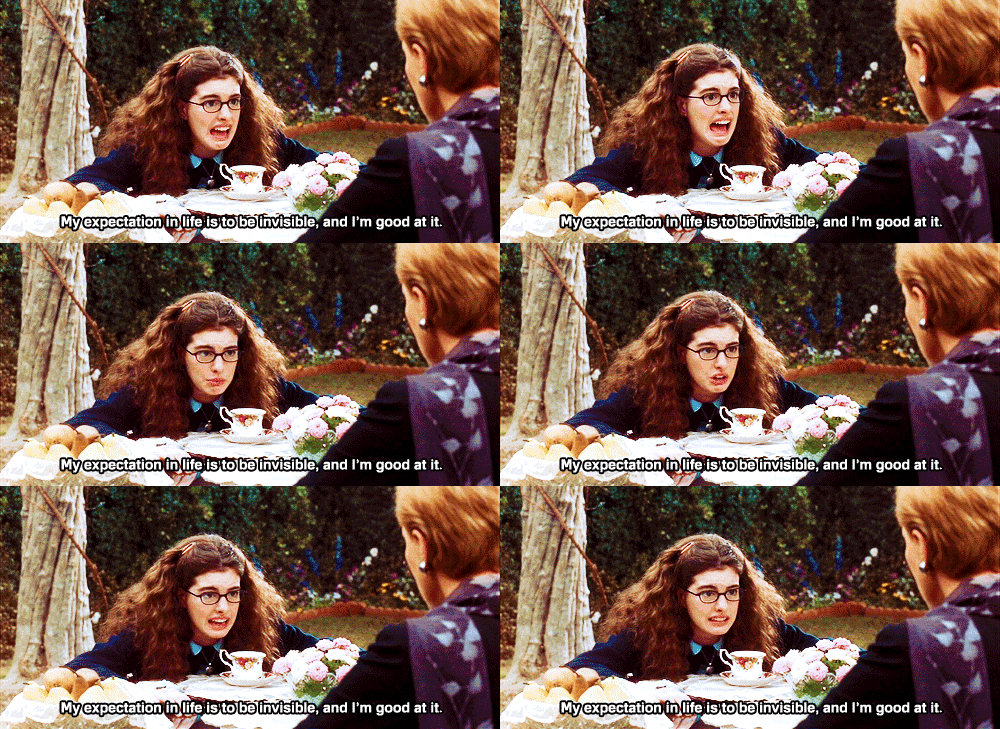
GIF from The Princess Diaries: "My expectation in life is to be invisible, and I'm good at it."

Literary Fiction

Literary fiction has its own audience—one who has high expectations for prose and subtext.

If literary fiction gets its own shelf, that shelf is often called “literature,” though many readers are rightly annoyed at the suggestion that genre fiction can’t be considered literature. We won’t get into what constitutes a work of fiction being considered “literature” here. As far as I’m considered, that’s the same as debating the definition or worth of “art.”

What we will talk about is what constitutes literary fiction.

Elements of literary fiction:

  • The language is vivid and fresh. Frequently in literary fiction, how an element is presented is more important than what is presented. The words are like visible brushstrokes in a painting.
  • It might be more concerned with subtext, theme, or atmosphere than action.
  • It’s more likely to subvert tropes than genre fiction, which upholds tropes (to the satisfaction of its expectant readers).
  • Literary fiction is more likely to allude or respond to other forms of art, especially classical poetry and literature.
  • The structure might be experimental, playing with timelines, points of view, or different forms (incorporating poetry or illustrations or other forms of media).
  • It might be more concerned with a character’s internal struggle than external conflict.
  • It might play with what defines a “novel” or “story” or “literature” (see Metafiction)
  • It might be delivered to a select few (like the first collection from Facsimile Press, which publishes fiction only via fax).
  • Some readers might not consider it accessible because it attempts the unexpected.

Read more: Literary and Commercial Fiction as Paintings

Like “commercial,” the term “literary” is subjective and is doubted by readers when self-applied. Some readers might not agree with your label.

GIF of a man throwing a book out the window in frustration

If you’ve studied or discussed literature at length, or if your writing has been recognized or published by a literary community, then you might be fine calling your work literary. Show that you understand what literary means in a query letter by including a statement in your bio paragraph, like “I majored in literature at Such-and-Such University” or “my fiction has won [recognizable literary accolades not based on commercial genre].”

BOTTOM LINE: Err on the side of calling your work contemporary or historical (whichever fits) until an authority in the literary sphere—an agent, reviewer, award-winning author, or publisher—assigns the “Literary” qualifier to your work. 

Upmarket Fiction or “Book Club Books”

Upmarket Fiction is mainstream fiction with both literary and commercial elements. These are often books read by book clubs, because not only are the books entertaining and accessible, but they also have finely crafted prose, universal themes, or head-scratching concepts that beg to be discussed with other readers.

You can call your work upmarket, but there’s no shelf for upmarket books. “Upmarket” is an adjective. Use it paired with another genre or category label, for example, “upmarket fantasy” or “upmarket contemporary novel.”

BOTTOM LINE: Upmarket fiction is approachable, but beneath its fresh, commercial premise lie layers of subtext.

pretty-in-pink

Conclusion

When pitching your book, you need to show how it’s both different from and similar to books on the market.

From The Breakfast Club: a popular boy makes a really weird sandwich, eliciting looks from his peers.

To be a success, your book needs to fit in with others while having unique qualities of its own.

In a query letter, the main content of the pitch should show how your story is unique. The informational paragraph with word count, genre, and age category should show where it fits in. This is where you can include comp titles: books or related media that might share a specific audience with your readership. “[MY TITLE IN ALL CAPS] would appeal to fans of [two or three recently published books, still-writing authors, or related media].”

What's the difference between literary, mainstream, commercial, and upmarket fiction?Click to save on Pinterest

Friday Reads: THE BASEBALL PLAYER AND THE WALRUS

I received an ARC of The Baseball Player and the Walrus and am excited to share this picture book with all of you!

Image links to Amazon Smile. With Amazon Smile, every purchase helps the charity of your choice!

Short Version

A sweet, surprisingly deep*, story about balancing responsibilities with pursuing dreams. Children will empathize with the characters, and adults will enjoy the details and theme.

*This isn’t to say I’m surprised that any picture book would be deep, since most have a lesson or takeaway element (that, and the illustrations, are why I love picture books!)—I just expected this to be a fun, silly story, and I was pleasantly surprised that it was much more than that.

Illustrations

Alex Latimer’s illustrations are packed with amusing details that demand encore reads. My favorite are the suitcases overflowing with bills and fish, and the trophies scattered haphazardly on the bedroom floor.

Story

Ben Loory has written a crafty tale about the unfortunate choice between work and passion. While the recommended age for this book is 5-8 year olds, I (mother, writer, artist) read it to my four-year-old son. He enjoyed it and was emotionally attached to both the baseball player and the walrus. I don’t want to give spoilers, but when I asked him what he didn’t like and what he liked about the book, his answers were dependent on the emotional state of the characters, rather than, like, a dragon or explosion or something “cool.” I can’t recall him empathizing with a picture book character before now, so that’s something I’m really pleased about. That’s why I advocate all people read—reading makes us empathetic humans. Every online troll should read picture books with empathetic characters. Maybe they’d learn something.

Oh, the preschooler also said he liked the walrus’ tusks. So there’s that.

Recommended for

Besides trolls who need a lesson, I’d recommend this book to elementary teachers during read-aloud time, since some of the words might be difficult for early readers. But I’d also recommend it to high school seniors and adults. The subtext and some of the humor will be appreciated by adults who live the dilemma posed in the book, asking themselves whether it’s more important to have “lots and lots and lots of money” and a job they succeed at, like the baseball player, or to invest time and energy into something more fulfilling.

On our first read through, the theme spoke to me as a mom trying to decide between working full time and staying at home. But on the second read, it spoke more to me as a creative, one who is constantly deciding between good paying jobs and really exciting ones.

Have you ever heard the quote “You can never step into the same book twice, because you are different each time you read it”? It’s attributed to John Barton. I think it only applies to books with relatable, human experiences. With theme and subtext.

It applies to this book.

Buy Links

Benefit a local, independent bookstore by preordering via IndieBound.

Benefit a charity by pre-ordering online via Amazon Smile.

The Baseball Player and the Walrus will be available for purchase on February 24, 2015.

Writing Exercise

Write a 15-blinker about a choice between passion and responsibility.