Using Spreadsheets to Track Your Revision

I use spreadsheets to track my editing progress as I work my way through a manuscript. It shows me very clearly how much progress I’ve made and how much left I still have to do.

I tweaked the spreadsheet I created for myself to make it into a template anyone can use (in theory—let me know if you’re unable to save a copy for yourself!).

Here’s the spreadsheet in Google Sheets. Go to File > Save a Copy to save and modify your own.


(The Google Sheets version also has formulae if you don’t want to work chronologically!)

Spreadsheet tracking revision or editing progress

If that doesn’t work, I’ll walk you through the steps to make your own.

First open up a new spreadsheet and include the column headers (Project, Project Name) and row headers (Total Pages, # Complete, Section 1, 2, etc.) as seen above. If you have more than one project, create more rows for that.

Each project is three columns, with its first two rows each merged into one cell, which is why Project Name and the number of total pages are both centered. So merge B1+C1+D1 into one cell and repeat for B2+C2+D2.

Then in B2, enter the total number of pages for your project. In this example, I’ll use 300 since it’s a nice round number.
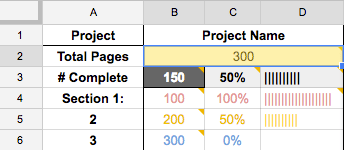
total number of pages to revise or edit

I filled B3 with a dark gray and turned the text white to remind me that when this template is all set up, that’s the only cell I need to update. I also set C3 and D3 with bold text and a very light gray fill, to set that progress apart as the total progress.

Decide how many sections you want to divide your project into. We’ll do three for this example, but you can add as many as you’d like.

Find the page number that Section 1 ends on. That’s the number you’ll put into B4. For example, if Section 2 starts on page 109, then Section 1 ends on 108, so enter 108 here.

Repeat for the remaining sections. Your last section (Section 3, or B6 here) should have the same number as your total pages (B2).

The total percentage completed (C3) is easy enough: it’s the number complete divided by the total number of pages. So in C3, enter

=B3/B2

This is where the formulae get a little tricky. We want to make sure that the numbers in column C stay between 0% and 100%.

The percentage finished in section 1 (C4) is the number of pages complete divided by the total pages, maxing out at 100%. So in C4, enter

=MIN(B3/B4,1)

The percentage finished in section 2 (C5) is the number of pages complete (B3), minus the number of pages in Section 1 (B4) divided by the total pages (B2), with a minimum of 0% and maxing out at 100%. So in C5, enter

=MAX(MIN((B$3B4)/(B5B4),1),0)

(Yeah, I definitely had to do some digging to figure that one out!)

For C6, you can copy and paste C5. Thanks to the trick Leigh suggested in the comments (adding the $), that first cell will stay B3 even when you copy and paste.

You can continue copying and pasting, but make sure that the formulae in the percentage column always start with the total number of pages. In my template, those cells are shaded dark gray.

Now for column D, the bar graphs. This is something else I had to look up and modify to fit my needs.

All we’re doing is taking the percentages in column C and turning them into graphs, with one vertical line (shift + the key under “backspace” or “delete”). We want 1 line for each 5%.

editing or revision progress graph with spreadsheet

Start with D3:

=REPT(“|”,(C3*20))

Then copy and paste down the column. The C3 will adapt for each cell, changing to C4, C5, etc.

One last thing: quickly enter the total number of pages into B3 so you can see how much 100% is, then rescale the D column to fit. Otherwise 100% won’t look like 100% 🙂

If you save a copy of the template I created, you can copy and paste the H–J columns to create more projects.

Now that you’ve got your spreadsheet all set up, update B3 with how many pages you’ve completed, and watch the bars fill up!


xo Lara

How Improv Can Improve Your Writing

Wednesday on the MS Editors blog, I applied Tina Fey’s rules of improv to writing first drafts. Check it out!

You can't be that kid standing at the top of the water slide overthinking it. You have to go down the chute_Tina Fey

Lara's avatarMS Editors

I’ve mentioned before (in 7 Tips for Writing Realistic Dialogue) that trying improv (the art of performed improvisation) can improve your writing.

Well, currently I’m reading Bossypants by Tina Fey, and in it she gives the rules of improv and describes how these rules have changed her life. The rules are as follows:

  1. Say “YES”
  2. Say “YES, AND…”
  3. Make statements
  4. There are no mistakes, only opportunities

Applying these rules to your writing will help you soldier through a crummy first draft by shutting up your internal editor. The trick is to improv against yourself.

Say “YES”

Stop arguing with yourself and start writing. Stop saying you can’t do it, or it’s too hard, or you need to learn more before you can start. Just start. Your improv partner (you) might be crazy, but go with it. In fact, craziness usually translates into energy, so embrace the crazy and hammer out that…

View original post 653 more words

Which Hogwarts House Do You Belong In?

Neville Longbottom Funko


Do you remember when Bustle offered “The ONE Question That Will Determine Which Hogwarts House You Belong In”? This one:

If you could take on huge risk right now, and undo it if it didn’t end up with the result you wanted, what would it be?

It was a horrible question, completely non-canon. Artists kept getting sorted as Slytherin, because our answer involved taking risks for the sake of art, A.K.A. “our career.”

Should we really trust a sorting hat method created by a Slytherpuff anyway? (I’m totally kidding. I’m married to one.)

The Sorting Hat Is All You Need


If Hermione were in charge of sorting students, she’d go to the primary source: The Sorting Hat. Not even Pottermore, which is what caused existential crises in all of us when THAT first came out.

Example: I’m a Gryffindor. If you’d have asked in 2012 which Hogwarts I would be in, I would’ve said Ravenclaw. They’re brilliant, and they live in a tower. (Those conditions were the only aspects I considered. Clearly I’m not as brilliant as I think.)

Then Pottermore sorted me into Gryffindor, triggering an existential crisis.

Now I totally get it. I’m like a hybrid Minerva/Molly/Hermione.

You can view everything the Sorting Hat says sings on the subject of houses here, but read on for the defining characteristics of each.

Images belong to Pottermore. Become a member to take their sorting quiz.

Ravenclaw

Ravenclaws are CLEVER. They might be wise, or they might be “smart” (as in, “Don’t be smart with me!”). They are more concerned with self-betterment than measurable success; they are motivated by improvement, not competition with others. They need to be informed … and to inform others.

The Ravenclaws who kept hiding Luna’s things can show the dark side of Ravenclaw: removing whatever makes oneself look less than best.

Gryffindor

Gryffindors have NERVE. Bravery—maybe. Willingness to talk back to teachers, sure. Standing up to bullies / defending others? Definitely. They aren’t afraid to break the rules for the greater good.

Taking risks isn’t necessarily a defining factor of Gryffindor! You can be a scaredy wormtail and still end up in Gryffindor. You might avoid risks if the stakes are personal (like failure or rejection) but be braver if someone else is at risk. Neville showed a ton of courage in The Deathly Hallows, but do you think he tried out for the Quidditch team? I’m thinking No.

Slytherin

Slytherins have AMBITION. They are the most valuable allies and the most formidable foes because they will fight/sacrifice to achieve their goals. Slytherins get things done.

You don’t have to be a liar or a cheat to be in Slytherin, but if you are, then at least all the other sorting tests based on superficial stereotypes will confirm that you’re in the right house. *shrug*

Hufflepuff

Hufflepuffs are TRUE to self & others. Loyal, kind, and hardworking if they believe in the work. Hufflepuffs are the most altruistic, possibly the most practical, definitely the most fair.

Characters

Why isn’t Harry Potter a Slytherin? He totally could’ve been, except that he was prejudiced against them by the Weasleys, who considered evil, racist Death Eaters as being representative of the Slytherin house. #NotAllSlytherin

Why weren’t Hermione Granger or Minerva McGonagall Ravenclaws? Because they both have a lot of nerve—they’re willing to break rules.

But Hermione wasn’t willing to break the rules when she was first sorted! I think the Sorting Hat is either into divination—it saw how Harry and Ron would rub off on her—or it felt the need to inject some wisdom into Gryffindor to balance out the Weasley brothers.

Why isn’t Neville Longbottom a Hufflepuff? Neville is very loyal, but more than that, he’s willing to lose house points (and their good sides) to stand up to Harry & co. He’s a Gryffindor.

Why wasn’t Snape a Gryffindor? He was brave and sacrificial, but ultimately his actions were motivated by obtaining his goals: becoming Dark Arts professor or (spoiler: [acting out his love for Lily]).

Why wasn’t Luna a Gryffindor or a Hufflepuff? Simply put, she’s the cleverest of all Harry’s friends. You might say she’s a rule-breaker, but she can’t really break rules if she marches to the beat of her own drum.

Do you have any more examples you’d like to add? Based on the defining characteristics above, which house would you be sorted into?

pg70pit writing contest logo

April 7th on 7th

This is 2016’s second 7th on 7th, where I take a blog subscriber’s seventh page and show you how I’d improve it for the upcoming #pg70pit contest. See the #70pit16 contest schedule here. See more about how to enter the contest here.

Check out the first 7th on 7th, in which I talk about wordiness, breath units, and cleverness.

pg70pit writing contest logo

7th on 7th

THE ORIGINAL PAGE

[Adult Literary Horror]

The backpack’s been emptied every time I shop, but I go through it again, and then the sturdy dressers. Finally I pull the suitcase from underneath the bed. It’s still heavy with stuff that I apparently hadn’t unpacked. Continue reading