What’s the one thing that makes us write slowly or stop writing completely?
Fear.
Fear of inexperience, fear of failure, fear of imperfection. Yet we know that to get better, we have to write.
To get a perfect draft, we need to edit, and you can’t edit a blank page!
How do you get past the fear and write quickly? Follow these five tips.
1. Get rid of distractions.
Turn off the TV and your internet (I use Anti-Social to block distracting websites).
Go somewhere where you can be either alone or undisturbed.
Be conscious about other distractions. If easily stimulated, write uncomfortably. You’ll write quickly to get it over with! I’ve written pages in the garage, crammed into the passenger seat of my car with my laptop.
Consider writing your first draft longhand! Writing by hand forces you to focus on the pen and the page. To write faster than Bilbo, however, read on.
Go for speed rather than going for “good.” Writing quickly is about quantity, not quality. Save the slow, quality writing for revision. Pull a Buzz Lightyear—sure, this first draft won’t fly, but it can fall with style!
4. Don’t edit!
Major editing before knowing your three acts and your theme is a waste of time—you won’t know what to cut, what to keep, and what to change.
If you have to, darken/invert the screen, type in white or pale gray, or type across the room with a wireless keyboard so you can’t read what you’re typing.
If you MUST fix errors, don’t dare edit until your scene is done! After you’ve finished the scene/chapter/book, you can go back and fix problems.
5. Just. Keep. Writing.
Write past the typos, the weirdness, the words-to-look-up.
Sure, switch tenses or points of view while drafting. Doing so helps you find your novel’s most natural voice! Revise later, once you’ve decided what works best for the whole story.
Make notes and comments in-text so you don’t lose your train of thought. I use three slashes (///) before and after these notes so I can find them easily while revising. Example:
(The fact that I didn’t fix “comepletely” is a true testament to my strong will.)
If you don’t know a word or fact, type TK—it means “to come,” but the “TK” combination isn’t found in common English words, so your find/replace function will filter out other words.
Do you have any other tips for writing quickly or recklessly? Share them in the comments!
Did you find this post useful? Consider sharing it on social media 🙂
One of my goals for October is to get more organized and be better at time management. The problem with being a work-at-home mom is that I’m always working and I’m always a mom! I’m all for being holistic, but nobody should be working all the time!
I’ll start with my calendar management, and then I’ll share the app I use to schedule my days.
Calendar Management
I took a class at my university called Writing for Organizations, and during that, I was taught how to use Gantt Charts to map out projects. I’m a visual person, so I really enjoyed it. But I haven’t applied that chart since! I created a template in Excel so that I can start using it to plan out individual months.
I also created a quarterly calendar, originally for our family so we could see the whole year at a glance, but then I decided it would work really well for planning out my projects, too. In fact, you could use highlighters to create Gantt Charts on your calendar.
First I downloaded a Pomodoro app. The Pomodoro Technique is to set a timer for 25 minutes, work that entire time, take a 5-minute break, and then repeat two more times. After three or four “pomodoros” you get a longer break.
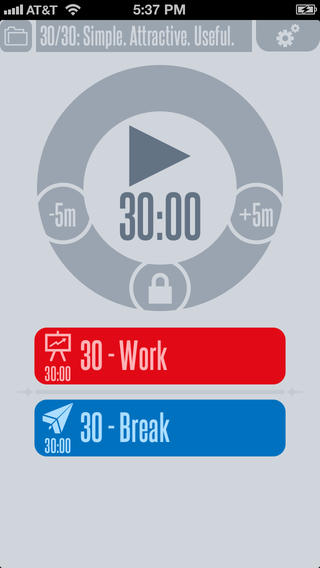
I picked 30/30 because I liked the graphics and the ability to color code.
You can modify your ratios between work and break. I generally split the hours up this way: 40 minutes doing something I like (like editing). 5-minute break, 10 minutes doing something I dread (like answering emails or doing dishes), and another 5-minute break.
I also schedule in leisure time, food prep, and play time with my kids. Having the day mapped out with this app helps me to see that I DO have time for everything. 30/30 is especially recommended for people with ADD/ADHD.
Motivation
If you’re struggling with motivation, I recommend the Coach.Me app. You can also try Habitica for an RPG-inspired app.
What are your favorite methods for time management? Share in the comments.
A breathtaking debut brings us the unforgettable story of a small-town love, big dreams, and family drama.
Silas Hart has seriously shaken up Westlin Beck’s small-town life. Brand-new to town, Silas is different from the guys in Green Lake. He’s curious, poetic, philosophical, maddening—and really, really cute. But Silas has a sister—and she has a secret. And West has a boyfriend. And life in Green Lake is about to change forever.
Truest is a stunning, addictive debut. Romantic, fun, tender, and satisfying, it asks as many questions as it answers. Perfect for fans of The Fault in Our Stars and Ten Things We Did (and Probably Shouldn’t Have).
Hi Jackie, thanks for agreeing to do this interview!
Your debut novel, Truest, is coming out in just a few DAYS(!!) Do you care to talk about your publishing journey?
2013 was a whirlwind! I queried literary agents and signed with one, won the Katherine Paterson Prize for Young Adult Writing, and was offered my book deal with HarperCollins all within a period of a few months. It was exciting and rewarding and terrifying. I celebrated by having my first panic attack and getting a prescription for Ativan. (But really.)
Querying was an emotional rollercoaster. I spent months perfecting my query letter and researching literary agents who seemed like a good fit with Truest. All told, I had about a dozen agents request full or partials, and in the end, I signed with Steven Chudney, who really resonated with my characters and my writing style.
Truest is your debut novel, but it isn’t the first novel you’ve written. How did you know when to shelve your first book, and how did you know Truest was “the one”?
Back in 2012, I queried about forty literary agents and only heard back from one. It was pretty clear to me that it was time to shelve the novel I was working on and tackle something else. That first novel was written for adults; this time, I wanted to try my hand at writing for teens. The entire process felt so different. I had learned so much in the previous four years of writing that first novel, and all of it was put to use in writing Truest. I spent about six months writing a first draft, then handed the manuscript out to a couple beta readers. They and I both knew that this novel was different, that this one was going to be my debut novel. How long did it take you to write Truest? Any idea how many revisions you went through? Any darlings you had to murder?
All told, there were over twenty drafts. I spent six months on a first draft, another year on revisions, one round of revisions with my agent, and another year on revisions with my editor at Harper. I murdered darlings like it was my job—even right up to the very last draft!
Are you a plotter or a “pantser”?
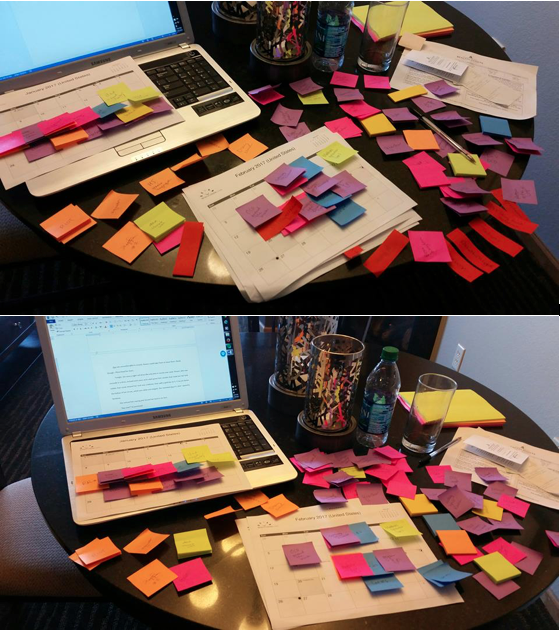
That’s a good question—and the answer differs depending on what stage I’m in. In general—and especially at the beginning of a project—I’m a pantser. I don’t know the ending when I start writing the novel. In fact, I might not even know the ending until several drafts in. But once I’m in the middle of the project, there is a lot of planning and organizing that has to be done.
See: after pantsing all the freewriting, I had to get them all in the right order. This project looks more like a plotter’s work, doesn’t it?
But, if I had to choose only one, I’d say I’m a pantser. If I plot prior to the first draft, the project dies a sad death and I can’t find any energy in the project anymore.
I’d plotted out an entire other novel (for my next book), and once I did, I didn’t want to write it. I returned to my pantsing ways and wrote a different story.
And then I wrote yet another one. That story will be my second novel. How long have you been writing?
I’ve been a storyteller my entire life. I’ve wanted to write books since second grade.
I love the sixty-nine test—where you gauge whether you’ll really like a book by flipping to its 69th page and reading it. (It is an easy number to remember.) Would you care to share yours?
“Yup,” he said. “Afraid so. You know my secret … well, one of them.”
“One of them?” I raised an eyebrow. “You don’t have any other siblings, do you?”
“I’m for real, West.” He shoved my shoulder with his own. “Let’s be good to each other.”
“Friendship doesn’t work like that, Silas. You don’t just decide to be friends.”
“I just did.”
“Well, I didn’t.”
He looked me in the eye. “My girlfriend is in Alaska, and my sister is messed up. Your boyfriend lives on a tractor, and your best friend ditched you for summer camp.”
“Hey!” His choice of words stung. “She—”
“Let’s be good to each other,” he repeated, and his eyes were so sad and serious and intense.
“Starting when?” I said, trying to mask the panic in my voice.
“Starting now.”
What’s the best / worst writing advice you’ve ever gotten?
Best: Write “shitty first drafts” and give yourself short assignments. Thank you, Anne Lamott.
Worst: Wait to write till you’re inspired. As Stephen King wrote, “Amateurs sit and wait for inspiration, the rest of us just get up and go to work.” I’m sure all of your characters are your brain children, but if you had to pick a favorite, who might it be?
I adore Silas Hart, one of the characters in Truest. But I’m also enchanted by Asa Bertrand, the main character of my next novel. Rowen Lucas, Asa’s best friend and the girl he’s in love with, is a strong, artistic badass. I want to be her.
Your gorgeous blog has posts about faith and OCD. How do either of these affect your writing? Will we see these themes in Truest? In your next book?
My faith affects everything in my life, and especially my writing. God and I wrote Truest together, and God had all the best ideas.
My OCD doesn’t affect my writing in the same way, but having a nearly life-long battle with clinical anxiety has affected my writing life.
The main character in Truest—Westlin Beck—is a pastor’s daughter, and faith is a big theme throughout the novel. I think (and hope) it’s addressed in such a way that anyone can enter into the conversation though.
OCD/anxiety is something I’m tackling in my next novel, Mill City Heroes.
When my blog readers finish Truest and are anxiously awaiting your second book (working title: “Mill City Heroes”), what should they read?
If you could have any superhero power, what would it be?
Flying!!! Or running so fast that it’s nearly flying. I can do these things in my dreams. Which Hogwarts house would you be sorted into?
I’m a proud Ravenclaw.
Last question. Favorite Billy Joel song. Go.
“She’s Got a Way”
Are you an author that has been (or will soon be) traditionally published? I’d love to interview you and turn you into your own adorable 8-bit sprite! Contact me on Twitter or e-mail me: query lara at gmail dot com.
Join me in counting down the final weeks till Truest’s publication! Every Tuesday, I’ll be posting something Truest-related. Please feel free to re-blog, pin, tweet, share on Facebook, etc.– I’d love to get the word out! And, of course, you can pre-order your own copy here!
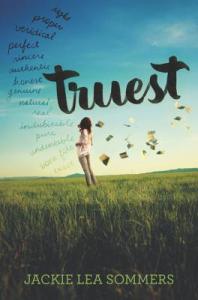
Today I’m excited to share with you how Truest‘s book cover came to be. (And please excuse the weird formatting toward the end– once I started inserting pictures, it all went haywire!)
At the end of April 2014, Laurel, an editor at Katherine Tegen Books, sent me this email:
While Jill is still working on gathering notes for you on the latest revision, I have another exciting step in the publication process. We get to start thinking about your cover! Jill and I will fill out a form to share with our designers—who work serious magic and make the best…







 Lara Willard