Tips and Tricks for Writing Successful Twitter Pitches

Or, general tips and tricks for pitching on Twitter, and how pitching SFF is different from pitching other genres.

twitch

This is going to be a long one, folks. Skip around as needed!

Update from 2021We Need Diverse Books no longer uses the #ownvoices hashtag or label. Read why.

Update from 2018—I wrote this post in 2014, and it’s been so cool seeing these practices put to work in Twitter pitches over the last four years. It’s been unreal knowing that some are now books I own or can pre-order! Some things have changed (like contest rules and the character limit on tweets), and I’ve added clarification where I felt it was needed, but much of the advice I gave then I’d still give now.

Update from PitchMAS—when pitching in a general pitch party, your hashtags matter so much more. Make it easy for an agent to find you, or they never will. I tried searching for different genres during the party so I could retweet—I couldn’t find them because people weren’t using effective search terms. Use age category tags and genre tags, plus relevant and appropriate keywords (like “Bechdel” or “WNDB”—see my notes on references below).

Contents

  1. Well-Known Twitter Pitch Events
  2. Tips for Pitching on Twitter
  3. The Importance of Hashtags
  4. After the Pitch Party
  5. My Personal SFFpit Results
  6. Analysis of my Personal SFFpit Results
    1. Analysis of Timing
    2. Analysis of Focus
    3. On Voice
    4. On Comp Titles and Culture References
    5. On Fresh Premises and Trendy Topics
    6. On Hashtags, Again
  7. Final Thoughts

Well-Known Twitter Pitch Events

  • PitMad, for pretty much everybody, 4x/yr* Now retired
  • PitchMAS, for pretty much everybody, 2x/yr** Now retired
  • SFFpit, for Science Fiction and Fantasy works, 2x/yr
  • DVPit, for pitches from marginalized voices that have been historically underrepresented in publishing, each April***

*(see PitMad’s new rules! Only 3 pitches total, not twice per hour. Make sure you are tweeting what will catch your genre’s agents’ attention, and use hashtags!)
**Looking at my winning pitches from PitchMAS, hashtags and keywords mattered most, then other references, then stakes.
***Read DVPit’s about page before deciding whether you qualify.

Tips for Pitching on Twitter

Favorite Resources for Twitter Pitching:

The following advice stems from a series of Tweets published December 8th, 2014. Follow me on Twitter! @LaraEdits is devoted to writing and editing tips. If you aren’t on Twitter, you can still bookmark my feed.

A hook can be interesting MC, conflict, stakes, fresh premise, or voice. Pitch whichever is strongest in your novel.

It’s impossible to convey how unique your MC, setting, conflict, premise, or voice is all at once, in one tweet. Which is the MOST different compared to other novels?

If your pitches are falling flat, adjust your selling point. You might be trying to pass a swan story off as a duck one.

Twitter pitches are so short, you have to pick your focus. Character, stakes, conflict, premise, voice…pick two per pitch.

That way, if an agent goes to your feed, they don’t see the same pitch repeated, and they see that 1) your novel is complex, 2) you can pitch in a variety of ways (i.e. you’re a skilled writer), 3) you are open to variance in writing (i.e. you’d be willing to do necessary rewrites)

During these Twitter Pitch Parties, you can usually pitch once or twice per hour. That’s 12 to 24 different opportunities to pitch! Vary them by focus and by hashtags, but only use relevant hashtags. (This rule has now changed for PitMad)

I use the free version of Buffer to 1) schedule my pitches beforehand and 2) see their effectiveness afterward.

I’d recommend at least 6 different pitches, with different focuses, repeated with different hashtags (if more than two are applicable). And out of those 6-12 differently focused, no-words-wasted, intriguing pitches, tweet your most fantastic ones at peak times. That is, as soon as the pitch party starts, and at lunch time EST, lunch time PST, and after-work hours. There will be more tweets then, and that’s likely when agents will do the most browsing, so your tweets then matter most.

There will be too many tweets for each agent to read. That’s why you need to use hashtags effectively (see below). You can always query those you think are a good fit for your novel (check #MSWL).

The Importance of Hashtags

The reason you need to use genre or age category hashtags in Twitter pitch parties is because that’s how agents filter through the feed. They can’t see every tweet! One agent was looking for Adult Fantasy works. She searched “#SFFpit #A #Fa” and that’s how she found my tweet.

KNOW THY GENRE. If you write speculative fiction, read my Straightforward Guide to Science Fiction and Fantasy Sub-Genres.

There are two deciding factors in assigning an age category. One is the age of the protagonist. One is the age of the audience, based on the age of protagonist and the content of the novel. If your protagonist is an adult, you can’t pitch it for kids. If your content is too mature for kids, it needs to be pitched at a higher age category. If the tone is too simple or cutesy for the intended audience, that needs to be fixed. Agents will reject YA novels if it “sounds MG.” (See When Voice and Genre Don’t Match)

What is New Adult? New Adult is a contemporary construct that stems from the post-adolescent phenomenon. If your novel contains an 1) 18-to-20-something protagonist with a 2) contemporary mindset 3) transitioning between adolescent and adult life, then you can pitch it as #NA. Note, though, that this started as a subcategory of romance, and some agents and publishers still consider it “YA romance + more sex” OR “adult romance with younger MCs.” NA is all about navigating the world as a newly-released-into-the-wild adult. It concerns itself with firsts: first job, first home, first “serious” relationship.

NA is new, because historically, people were children, and then, after they hit puberty, they were adults. In the 20th century, more people attended school past puberty, and eventually (post WWII), people were divided into children, teenagers, and adults. Now, people aren’t considered adults until 25, which leaves us with a 19-to-25-year-old category: new adults.

Calls for Diversity: #WNDB, #OWN, and #DVpit

If you qualify, you can use the #WNDB hashtag, which stands for the #WeNeedDiverseBooks hashtag but gives you considerably more characters to work with.

Update from 2021We Need Diverse Books no longer uses the #ownvoices hashtag or label. Read why.

(2018 update, since I absolutely needed additional clarification here: 

  • Remember that diversity is NOT a trend. It is not a label you “add in” as an afterthought to sell more books. If you are wanting to write characters who are marginalized in a way you are not, invest your time in researching setting, culture, attitudes, worldview, and language, and invest your money in sensitivity reads.
  • If you aren’t a marginalized author writing about a character sharing that marginalization, do not use #own or #ownvoices. Secondhand experience is not enough. Read DVpit’s notes on marginalization here.
  • Some voices are not yours to borrow, and some stories are not yours to tell. Do we need another LGBT coming-out story written by a cishet person? Should another white American write from a slave’s perspective? Do not profit off another’s pain, especially if your ancestors or your greater community were the ones who caused the pain.

)

After the Pitch Party

What to do after Twitter pitch parties: STOP. Celebrate agent interest and newfound friends, analyze which pitches worked best, research agents.

DON’T:
Jump into querying too soon.
Query more than 1 agent per agency.
Query agents / presses that seem shady.

DO:
Query only agents / presses you’d trust your MS (& career!) with.
Take time to research agents and tailor your query for each. Try to send within the week.

If you sit at the bar and keep using the same line over and over again, it’s not going to be very successful unless you’re Ryan Gosling. You need to tailor your pitches based on the type of agent you want to represent you.

SFFpit Results

For the sake of this post, all times given are in CST Central Time.

Remember, #SFFpit is for writers and agents of speculative fiction. Agents looking for other genres might act differently. In fact, I expect they will. Be sure to read my analysis below.

Dan Koboldt, host of SFFpit, posted his results of the 2014 Twitter Party. A quick look:

  • 641 authors tweeted 6,000 pitches
  • 32 literary agents made 355 requests
  • 11 small presses also participated
  • 32% of authors received at least one request from an agent
  • 14% of authors got requests from 2 or more agents

My results

  • I tweeted 24 times, once every half hour from 7am–7pm.
  • I pitched 22 completely different pitches for the same manuscript. I re-pitched two.
  • During those 12 hours, I received 143 RTs and 17 requests—10 from agents, 6 from small presses (one small press requested twice).

While I will certainly be looking into the small presses, this specific blog post is going to consider what the agents were looking for.

37.5% (9/24) of my pitches received requests from both agents and small presses.

25% received requests from literary agents. Here are the 6 winning pitches:

7:47 am, pinned to the top of my page, 26 RTs and 5 agent requests

Tagged: Premise, Voice, Reference

9:47 am, 9 RTs and 1 agent request

Tagged: Premise, Reference

12:47 am, 1 RT, 1 agent request, 1 press request

Tagged: Premise, Stakes

1:17 pm, 1 RT and 1 agent request

Tagged: Character, Premise, Reference

2:17 pm, 4 RTs, 1 agent request, 1 press request

Tagged: Premise, Stakes, Reference

3:17 pm, 1 RT, 1 agent request, 1 press request

Tagged: Voice, Premise, Reference

Audience Choice—Three pitches received 10 or more RTs but yielded no agent response:

Tagged: Stakes, Voice

Tagged: Stakes, Premise, Reference

Tagged: Stakes, Voice

The tweet that received the most RTs was actually the first and third “Audience Choice.” It was the clear winner in critique groups, and I thought for sure it would be my most successful pitch. 29 total RTs … zero agent response.

SFFpit Analysis

For the sake of this post, I will only be analyzing the requests from agents, not small presses. Realize that this is an extremely small sample and is particular to my genre and premise. To make this really scientific, I’d need to analyze every agent favorite per category. If anybody wants to go ahead and do that, please do! If you want to do the same analysis I’m doing here, blog about it and comment below with a link so readers can see your responses as well.

Analysis of Timing

I started off the day with what I thought were some of my strongest pitches. My second post did better than my first, so I immediately pinned that to the top of my page. It went on to be my most successful pitch of the day, likely because it was pinned to the top of my page.

If you post great ones at the beginning of the day, they will be retweeted throughout the day, getting your pitch in front of more people.

The chart below shows the time the number of RTs and Requests (both agent and small press) by time posted.

Time Posted

I don’t know how to see when the agents were online, but I vaguely remember a surge of notifications at around 10 am CST, and in the afternoon, around 3 pm CST.

Analysis of Focus

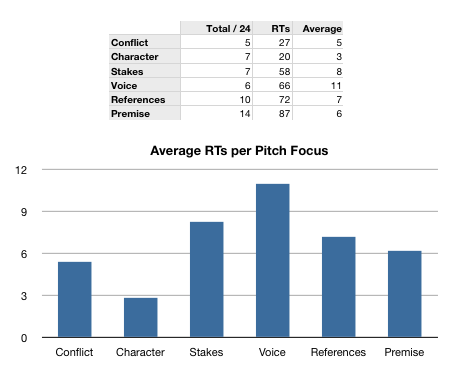
I tagged my 22 different pitches by their focus:

  • Conflict
  • Character
  • Stakes
  • Voice
  • References (comp titles, pop culture references, social references, keywords from manuscript wishlists)
  • Premise

As you can see, the audience favorites were definitely those pitches with clear stakes and a strong voice.
audience

While most advice I see regarding pitching focuses on conflict and stakes, the success rate of my pitches suggests that isn’t necessarily what agents are looking for, at least in SFF, at least in my genres.

Two guesses.

One: Because the past decade has given us multimillion dollar Science Fiction and Fantasy franchises, agents who represent these genres receive more derivative work than manuscripts from other genres. That’s why, today, in SFF, a fresh premise is important.

Two: Speculative fiction often features a clear antagonist. Whether it’s good vs evil, humanity vs aliens, or one girl against the world, it’s generally assumed that conflict and stakes are a given.

So if you aren’t writing SFF, don’t think that your pitches don’t need stakes!

Granted, my tweets that focused on stakes didn’t do bad at all, but they certainly didn’t do as well as ones with other focuses, as you can see:

All ten agents who requested on one of my tweets selected one tagged “premise.” Nine selected one with a reference of some sort, six chose one with strong voice.

Agents Selection

However however however!

Not all of my “premise” tweets were successful. Let’s look at the success rate of each focus based on my 24 tweets.

Out of all six tags, the tweets with references (I’ll go through the references below) had the highest success rate at 50%. Of my 10 tweets with references, 5 got requests.

Those are pretty great odds.

The odds get even better when I start combining tags.

success-rate

Now, here my sample size is showing, but of the 2 tweets that had both strong voice and a culture reference, 100% got a request.

And I’m thinking that the 0 requests for my Stakes + Voice pitches is more proof that pitching SFF just isn’t the same as pitching other genres. Those poor little babies. Maybe they’ll do better during PitchMAS.

At bigger sample sizes, the results might not be the same, but one thing’s for certain:

No matter your genre, your pitches with strong voice and apt pop culture references are most likely to get noticed.

On Voice

It takes practice to have a natural voice to your writing. Voice = diction = word choice. Use specific nouns, verbs, and adjectives. See my posts on diction here.

On Comp Titles and Pop Culture References

I’ve spent months trying to find the best comparative titles for my novel. Here’s how to do it.

HOW TO CHOOSE COMP TITLES

1—Choose a novel that matches your novel in at least 2 of the following categories: genre, premise/plot, time, place, protagonist type, conflict, tone, audience, event.

2—Find another work that matches both your book and your first comp title in two or more of those categories.

My most successful pitch was The Princess Bride + Lost in Austen. While it isn’t a novel (I’d love to read it!), Lost in Austen matches my novel in genre (literary fantasy) and premise/plot (contemporary MC goes to a historical, fictional world, tries to get home, falls in love reluctantly with a local). The Princess Bride matches my novel and Lost in Austen in genre, and it matches my novel in tone (the irreverent humor), audience, time and place (medieval Europe-ish), and event (the wedding crashing).

Remember that when you are pitching a book to an agent, you are pitching a book to a reader. A reader that reads professionally. You’re also pitching to a professional. A professional that needs to make a living.

With that in mind, here are my 7 tips for including references in Twitter pitches:

  1. Be relevant—references to classical literature and old books aren’t as successful as ones published in the last two–three years. Show that you’re aware of what’s in the market today.
  2. Be literary—make at least one of your comparative titles a novel, if possible. Show that you read your genre.
  3. Be realistic—your references need to work for your novel. See “How to Choose Comp Titles” above.
  4. Be humble—Don’t claim to be the next [Insert Famous Author Here]. Instead, use one of their recent books as a comparative title.
  5. Be specific—compare your characters to well-known characters (I picked Taylor Swift and Chuck Bartowski)
  6. Be savvy—if you can make a reference to a still-current movement that affects publishing, do, but only if it applies to you or your manuscript (Examples: WNDB, LGBTQ, Bechdel and Mako Mori feminism tests. Read my note on calls for diversity in the hashtag section.)
  7. Be awesome—refer to something geeky or a cult classic that hasn’t been mentioned for a while and will stir up nostalgia. Everybody mentions Black Panther and Buffy and recent blockbusters. Give me more Veronica Mars, Donnie Darko, more 80s and 90s and 00s references.

On Fresh Premises and Trendy Topics

By “fresh premise” I mean pitching something that the market isn’t currently saturated in. Pay attention to agents who tweet their responses to queries (#tenqueries, #querylunch, #500queries), and you’ll see what they are receiving a lot of. Right now, winter 2014, they are receiving a lot of paranormal, dystopians, fairy tale retellings, and urban fantasy. Ghosts, angels, demons, werewolves, mermaids, psychics, empaths.

So if you’re pitching something trendy, focus on what makes your novel different, what makes yours unique, not on what makes it trendy.

The good news about publishing is that it’s cyclical. So you can try to grab the readers now, while they are hungry, by self-publishing, or you can wait a couple of years until the big publishers come back to it. Remember that anything that is trendy now, won’t be in two years when the books being written now are being put out on bookshelves. You either have to be a year or two ahead of the market, or a couple years behind. I heard one editor at a big 5 publisher say she was ready to start looking at vampire books again. Give it time. (And please don’t ask me which editor. I don’t remember because it wasn’t applicable to me personally. If you have an agent, s/he should know.)

(Note: In April 2018, agents were aflutter on Twitter actively looking for more vampires. See?!)

On Hashtags, Again

Use them. Of the agents who requested from my pitches, here are the total number of requests they made during the SFFpit event, in descending order:

40, 34, 33, 33, 7, 6, 5, 3, 3, 3

If you take into consideration all the favorites and the 32 agents who participated, a single agent, on average, chose only 11 pitches. Out of six thousand.

Final thoughts

Research what agents are looking for. See which Wish Lists are compatible with your novel, and then try to guess what that agent might search for during a pitch party. If one of your favorite agents is looking for space opera, use that hashtag, or if there isn’t a designated hashtag list, use those words in one of your pitches. That way when an agent searches “#SFFpit space opera,” your pitch will pop up.

Guide to SFF (Science Fiction and Fantasy) Sub-genres

Lara Willard answers genre questions: What's Magical Realism? What's the difference between Science-Fiction and Fantasy? What genre is my novel?

Find out the closest fitting sub-genre for your speculative fiction, or troubleshoot your genre in this guide for writers.

Contents

  1. Major Genres
  2. SFF Sub-genres Used in #SFFpit
  3. The Difference between Science Fiction and Fantasy
  4. What’s the Difference between…
  5. Setting-Based Sub-genres
  6. Literary Fantasy
  7. Fantasy Romance or Romance Fantasy (Order Matters!)

Major Genres

This post is about the sub-genres of science fiction and fantasy. If you don’t think your story falls into speculative fiction, see my post on commercial, literary, and “general fiction” categorization, or watch my seminar on understanding age categories and genres (>1 hr).

SFF Sub-genres Used in #SFFpit

If you are writing speculative fiction and plan on pitching via #SFFpit, or if you are researching #MSWL, you need to know your sub-genres. The total list, as of December 2014, is below. I’ve divided them based on the requirements of the sub-genre.

This list is what what used for #SFFpit in 2014. For current lists or other contests, please visit the contest host’s website or blog.

By Subject (Genre Depends on Specific Tropes)

  • #FA – fantasy
  • #DF – dark fantasy
  • #EF – epic or high fantasy
  • #MYF – mythic fantasy
  • #PN – paranormal
  • #SF – science fiction
  • #DS – dystopian
  • #ML – military science fiction
  • #PA – post-apocalyptic SF
  • #SP – steampunk

By Setting (Genre Depends on Time or Place)

  • #CF – contemporary fantasy
  • #HF – historical fantasy
  • #SO – space opera
  • #TT – time travel
  • #UF – urban fantasy
  • #WW – weird west

Crossovers

  • #FR – fantasy romance
  • #HF – historical fantasy
  • #AH – alternate history
  • #LF – literary fantasy
  • #MR – magical realism
  • #SFR – sci-fi romance
  • #SFT – sci-fi thriller
  • #SO – space opera
  • #TT – time travel

The Difference between Science Fiction and Fantasy

If the not-in-our-reality elements stem from technology, it’s Science Fiction. If they stem from magic or unknown forces, it’s Fantasy. There is crossover. The Force in Star Wars tied the series to fantasy until the Midi-chlorians debacle of the prequels, which tried to sever any ties with the fantasy genre by explaining the Force with science.

The umbrella term for Science Fiction and Fantasy is Speculative Fiction, which is fiction not limited by real-world settings or physics.

What’s the Difference between…

Contemporary Fantasy & Urban Fantasy?

Answer:  If the urban setting is so experiential that it becomes a living, breathing thing, then it’s Urban Fantasy. You could have a historical UF set in 1930s NYC or a futuristic UF. Contemporary Fantasy is contemporary. Internet age. The fraternal twin of urban fantasy is rural fantasy, but “rural fantasy” is better categorized by its setting in time, not place.

Contemporary = Internet age.

Historical = set in the past.

Contemporary Fantasy & Magical Realism?

In Magical Realism (#MR), the fantastic elements aren’t described as extraordinary. “It is what it is.” Examples of #MR would be One Hundred Years of Solitude, The Curious Case of Benjamin Button, and the film Big Fish. The setting is the “real world.” The difference between magical realism (#MR) and contemporary fantasy (#CF) is that CF treats the fantastic as being weird or extraordinary. It explains the magic or calls it magic (or something similar). Disney loves contemporary fantasy. It’s always calling stuff magic.

In a Magical Realism world, magic is real and ordinary. When something falls at a party, we don’t explain gravity to the whole room. It’s just a part of our reality. We accept it.

Genres with Gods and Goddesses—Paranormal, Mythic, Dark, or…?

These can have some overlap.

If the gods are based off classical or pre-established mythology, it’s a mythical fantasy. If they are interacting with the real world, it’s paranormal (specifically supernatural). If it’s set in an imaginary world (Narnia, Middle Earth, Westeros), then I’d just call it fantasy (#FA). If the tone is dark or evil, it would be dark fantasy.

High Fantasy & Space Opera?

They are quite similar. Epic/High fantasy entails a journey, often with a “fellowship.” Think Lord of the Rings, swords & sorcery. An epic fantasy is epic in characters, in setting, and in scope. Journeys span countries, take time. Space Opera is an epic tale, like epic or high fantasy, except the travel is between worlds, and the travel is usually done via space ship. Space Opera, if it contains spaceships, is Science Fiction. The setting is the main difference.

Post-Apocalyptic or Dystopian?

dystopian novel is about a protagonist in a futuristic setting fighting a corrupt state.

If your “dystopian” lacks technology as part of the setting or corruption, it’s probably epic fantasy. It’s the difference between Big Brother (dystopian) and Dark Lord (epic fantasy).

post-apocalyptic novel is about human survival. The story takes place after some major disaster has affected the world. Usually the disaster is a natural disaster (think Day After Tomorrow and other world-disaster movies), a zombie apocalypse (Warm Bodies, World War Z), World War III, an alien or monster invasion (The Book of Eli), or a disease outbreak (Contagion, Station Eleven). A post-apocalyptic novel may also be science-fiction thriller. Warm Bodies crosses over into paranormal romance. Station Eleven is often considered literary fiction.

Post-apocalyptic = after civilization—humanity vs natural disaster, invasion, or aftermath

Dystopian = against uncivilization—humans vs a corrupt State

PA and DS novels have an interesting cause-and-effect relationship. Take current day, add an apocalypse, have people survive, they end up creating a new government which becomes corrupt. That’s the beginning of The Hunger Games. Take a corrupt government, overthrow it in a major war, and you’ve got people trying to rebuild and survive. That’s Mockingjay.

Dark or Paranormal Fantasy?

To be grievously simplistic, paranormal means “monsters.” If your novel contains ghosts, vampires, were-animals, zombies, Big Foot, or any kind of “spooky” type of creature, it’s paranormal. Paranormal can be romance, adventure, or comedy. Generally it is placed under fantasy, but it could be post-apocalyptic (see Warm Bodies, above). If it’s a romance novel with a paranormal love interest, it’s paranormal romance.

dark fantasy has a dark, ominous tone. It might concern death or criminal behavior. Usually a dark fantasy is considered a fantasy / horror crossover.

Not all paranormal fiction is dark. Twilight isn’t a horror novel, it’s a romance. Shaun of the Dead is more of a comedy adventure than a horror movie. I’d probably call it paranormal comedy. If it weren’t funny, but not particularly dark or ominous, just a paranormal adventure, I’d call it paranormal fantasy.

Setting-Based Sub-genres

If your novel prominently features historical settings or characters, it’s Historical Fantasy, Alternate History, or Time Travel.

  • Historical Fantasy (#HF) is set in the past but contains fantastic elements. It’s the fraternal twin of contemporary fantasy.
  • Alternate History #AH asks “What would happen if [historical event] had a different outcome?” While HF focuses on the past, AH focuses on a new present or future.
  • Time travel is either Science Fiction (if it uses tech or science to travel through time), or it’s a portal fantasy (if it uses a magic portal to travel through time).

If your novel primarily features the geography or heavens of a fantasy world (like Narnia, Middle Earth, Westeros, or Mount Olympus), it’s fantasy or one of its subgenres.

If your novel takes place in outer space or has interplanetary settings (it goes from one planet to the other), then it’s more likely science fiction.

The other setting-based genres, as sorted in the list above, should be pretty straightforward.

Literary Fantasy

Literary Fantasy #LF is a new addition to the #SFFpit hashtags. In LF, more emphasis is placed on theme, the human condition, or the prose. If book stores wouldn’t know whether to shelve you with SFF or with “Fiction” (aka General Fiction aka Literature), you may have written LF. Recent examples of Literary Fantasy—The Ocean at the End of the Lane (also Magical Realism), Jonathan Strange and Mr. Norrell (Historical Fantasy), The Magicians.

Genre isn’t about labels, it’s about finding readers. SFF readers look for imagination and adventure that isn’t 100% ground in reality. Literary readers want excellent prose, or to be emotionally or mentally invested in a character or theme. Of course there’s crossover!

For more about the “literary” classification, read my post Literary? Mainstream? Commercial? What Genre Is This Anyway?

Fantasy Romance or Romance Fantasy (Order Matters!)

A Fantasy Romance is a Romance novel with fantastic elements. It takes more after the romance genre than the fantasy genre. That means the novel is primarily about getting two love interests into a relationship.

It’s like the difference between yellow-orange and orange-yellow. Put an “ish” after the first word, and you can tell that yellow(ish) orange is more orange, and orange(ish) yellow is more yellow. If your novel couldn’t stand its own among other romance novels, it’s more likely a romantic fantasy.

Whenever you combine two genres together, the second one is the prominent genre, and the first is the modifying adjective. Which genre readers would be more likely to enjoy your book? That’s your prominent genre.

If you still aren’t sure about genre, leave a question below or tweet your question to @LaraEdits.

Appendix: Am I a reputable resource on this subject?

Well, I think so. I’m a published literature essayist of Sigma Tau Delta, the International English Society. I graduated summa cum laude with an interdisciplinary degree in literature, writing, and English (among other things). Since then, I’ve traded in my academic writing for a conversational tone. As a writing coach, freelance editor, and writer, I have experience in the field and have been reading on the subject of speculative fiction genres for years. I’ve taken into account the opinions of literary agents, librarians, publishers, and readers. Collaborative opinions aren’t something you can cite easily, so don’t look for a works cited page or list of references here. If you’re writing a literature paper on the subject of sub-genres, you can cite me using the following information, based on your style guide: C. Lara Willard / “Guide to SFF (Science Fiction and Fantasy) Sub-genres” / Write Edit Repeat / [link to this post].

Update: Connor Goldsmith, literary agent at Fuse Literary, has shared his definitions on sub-genres, with a section devoted to horror, here.

Query #6 November 2014

querylara

Below is the sixth public query critique I’m offering up on the blog. This will happen once a month (as long as I get a response). I choose one query per month. If your query is not selected one month, it will be in the drawing for the next month. Please do not resubmit unless you’ve made significant edits. To enter, see the rules here. If you want a guaranteed critique (plus line edit) of your query or synopsis, private ones cost $35 each.

My comments are in blue below. To read the original query first, simply read only the black text.

Dear –,

To seventeen-year-old Zéphyrine, the minds of others are playgrounds.

I wasn’t in love with this, but I still liked it. It was just bogged down with sticky words—short, common words that slow the eye down and distract from the important parts. Now it’s tight and snappy.

P.S. Watch your spaces. Some of these paragraphs had extra ones between them.

As a mind witch, she can manipulate thoughts, rewrite events and erase memories. She’s the Ravager’s most useful asset, but after so many years at his service, she’s tired of using her powers to hurt others. Those underlined words I’d usually trim down, but I think here it works in your favor, giving that annoyed, tired voice. If Zeph isn’t annoyed and tired of working with the Ravager, then you’ll want to cut “so many.” You were also missing a space here. The one time she tried to walk away, her father—the Ravager and immune to her powers—burned her half to death, and Zéph fears what will happen if she ever tries to say no again. I feel thrown under the bus here. Telling us that the guy she’s enslaved to is her father shouldn’t be a throwaway statement. That needs its own sentence, or it needs to be the most emphasized part of the sentence. The last few words of any sentence are the most important. So you could say something like “she’s tired of using her powers to hurt others, and she’s tired of the Ravager using her. It didn’t exactly make for the best father/daughter relationship.” Then mention her trying to walk away and what she fears, cutting the immunity part.

Other than that awkward bit, this is a great paragraph. We know what makes her special, what her problem is, and what she wants.

As her father’s hunger for power grows, Zéph is sent deep into the heart of the enemy territory of Almar—the neighboring country her father intends to conquer. Cut the cliches. Her task is straightforward: infiltrate the castle and manipulate the King’s thoughts. Following orders, she compels Her straightforward task/orders didn’t mention the king’s son, so this is confusing. And “compels” is a common enough verb that I didn’t get that she was using mind control. She could have just been nice to him, for all I knew. Agents skim, so you need to be as precise and concise as possible. I suggest “manipulate the thoughts of the royal family. As a result,”  Jasen, the king’s only son, to think thinks of her as a friend and confidente confidant. (Don’t be repetitive; choose the more specific word.), but the respect he has for her intelligence is all his own. delete extra space When Iriae, a mad girl as powerful as the Ravager, asks Zéph to join her in defeating him Wait, who’s “him” here? I read this as defeating Jasen, you know, because Iriae is mad, so why not, and she happens to be as powerful as the Ravager. Is Iriae wanting to defeat Ravager? This is the problem with parentheticals—they can be eliminated from the sentence. Eliminate this one, and Iriae wants to defeat Zeph’s new friend., it’s time to no, cut this. make a choice: shatter the illusion she has with Jasen and ask for his help and his father’s army, or carry on being the Ravager’s mind witch. This seems like a false dilemma. Why does she have to ask Jasen’s help if she can team up with Iriae to defeat her father? If Iriae wants to defeat the prince, then this dilemma makes a bit more sense, because Zeph either has to cancel her mission to save Jasen, or she has to let Iriae win and become just as bad as any of these crazy powerful people.


Zéph makes no commitments, but when her mother, who she thought long-dead, turns up very much alive and on Iriae’s side, Now you’re going to give another reveal in the query, and another dilemma? Do we need this extra information? I don’t think so. she gives in to temptation and risks everything to finally break free of her slave-like existence. Three cliches here. Break free is fine, since you’re using it literally, but the others need to go. But if they fail, Jasen will lose his kingdom, Huh? Is this implying he’s the king now? Iriae and Zéph’s mother What? They’re sisters? will be killed, and Zéph will be condemned to eternal torture at the hands of her father. I’m sure that this is all built up steadily in your manuscript, but all of this thrown into a sentence makes this seem like a melodrama. I expect a radio voice to come in and say, “Will she survive? Come back next time for the next installment of . . .”

MIND WITCH is a YA dark fantasy novel complete at 75,000 words that will appeal to readers of Ubik and A Girl of Fire and Thorns. Why aren’t these titles in all caps? How is this like Ubik? Try to keep any comp titles fairly recent. Within 5 years is best, 10 is okay. Ubik was published the same year as the first moon landing. Like Clive Barker’s ABARAT, it’s an illustrated novel, . . . Arabat is? I’m not seeing any illustrations in any of the Amazon previews. And reading reviews, the revised versions of the novel don’t include any illustrations. Can you think of another, more recent or accessible illustrated novel?  . . . and my portfolio can be found at [redacted]

Your hook and first paragraph are solid, or they will be when you cut the excess. The second one is confusing, and the third is overly complicated. Show us who the character is (check) what she wants at the beginning (check) what stands in her way (check) what the stakes are (check). If you want a third paragraph there, then I want to know what her secondary goal is. Sure, she wants to be free from her father, but what else does she want? Friendship with Jasen? Then tell me that and what gets in her way. Does she want to be reunited with her true family? Then hint at that, without spoilers, and tell me what gets in her way.

Slushproofing your Query pt. 2: Getting all the Blocks

Max Wirestone gives great query advice. Don’t forget, agents and assistants skim queries. They’ve got to! They read hundreds per week!

Max Wirestone's avatarMax Wirestone

Let me engineer a made-up query that has an element I saw in several entries.

Emily was worried. She knew that meeting Nick’s parents would be a minefield. She couldn’t ski, she couldn’t ice skate. She was going to be completely out of place– from the sounds of it, Christmas with the Millers was nothing but a sequence of winter sports. But she really started to lose it when she discovered that Nick’s mom was in the Daughters of the Confederacy.

I ran into a query like this (that was actually probably more subtle) and I read it three times before I got the subtext. Which is here is: Nick is white, Emily is black. The book is an interracial romance.

The author doesn’t state that, though. They imply it. They artfully suggest it. But they don’t state it out right.  Instead, it’s hinted at it in a single, important…

View original post 117 more words