Still from cafeteria scene in film NEVER BEEN KISSED, of protagonist Julia dressed in outrageous clothes, wondering with whom she should sit at lunch.

Literary? Mainstream? Commercial? What Genre Is This Anyway?

What’s the difference between commercial and literary and mainstream fiction? What do those words mean, anyway? What about “upmarket”? Where does my book fit in?

Sometimes it’s really obvious where your novel fits in with others.

Other times, you show up querying your book and have no idea where to put it. It’s awkwardly similar to high school (at least the movie version of high school). Everybody else seems so neatly sorted into groups.

A group of skater-pothead high schoolers from the film CLUELESS.

And then there’s you…

Still from cafeteria scene in film NEVER BEEN KISSED, of protagonist Julia dressed in outrageous clothes, wondering with whom she should sit at lunch.

But you want your book to find readers, which means your book needs to find something in common with other books (ones that have readers). Hey, you know which books have the most readers? Commercial fiction. Let’s start there.

Commercial Fiction

Commercial fiction is any fiction that has ONE of the following characteristics:

  • It sells a lot of copies, OR
  • It has a tight, fresh premise that’s easy to pitch (like a logline), OR
  • It has a very specific, established audience.

So genre fiction is considered commercial fiction, because genres can sell a lot of books to their target readers. Children’s books can often be considered commercial because all kids are encouraged to read, but children’s books are categorized by age first, genre second. Commercial writers are often prolific ones, churning out book after book after book for their very happy fan base, regardless of their genre.

BOTTOM LINE: Don’t call your own work “commercial fiction”—that’s a term defined by sales. Know the difference between age categories (adult, young adult, middle grade, etc.) and genres (what this post is about).

Genre Fiction

Genre fiction adheres to specific tropes. For example, if you’re writing a romance, your story must have a happily ever after. If it doesn’t, it’s not a romance.

Read heavily in your genre. What do you expect when reading that genre? That’s what readers will expect from your book if it’s put on that shelf.

Established genre families, often with their own shelves in stores or libraries:

  • Mystery
  • Romance
  • Suspense / Thriller
  • Speculative Fiction (includes fantasy, science fiction, horror)
  • Western
  • Adventure (sometimes grouped with thrillers)

Did you write speculative fiction? Read about my guide to Science Fiction and Fantasy Sub-Genres.

Cross-Genre

A cross-genre novel or story is one that borrows tropes from two or more genres. If your book is about an elf and an ogre falling in love and living happily ever after, you’re borrowing from the Romance and Fantasy families.

take-on-me

But do you call it Fantasy Romance or Romantic Fantasy? The first word in a genre pairing is the adjective qualifying the second, more prominent genre. In other words, a fantasy romance is primarily a romance with some fantasy elements. A romantic fantasy borrows more from the fantasy genre than the romance genre, but it still should have a happily ever after, or you can’t call it “romantic.”

Many stories have romantic elements. That doesn’t mean they are romances.

If your story has romantic elements, then say it’s “______ with romantic elements” if you must. But the romantic elements should be evident from your pitch.

A lot of colors have blue in them, but when we add a bit of it to yellow and mix it throughout, we call the result “green,” or maybe “yellow-green,” not “yellow with blue elements.”

BOTTOM LINE: If you think your book fits in one or more genres, look up the tropes for each genre. Read multiple authors of those genres to see where your book fits best. 

mean-girls

Your book doesn’t fit in with any of those genres? Don’t give up yet.

Mainstream or General Fiction

If your book wouldn’t sit on one of the five “shelves” listed above, it will likely be placed in a section called “General Fiction” or simply “Fiction.”

Historical fiction will likely be shelved here, along with contemporary fiction. Women’s fiction is general fiction promoted mainly to female readers. If your book is one of these genres, call it by one of those names. It’s better to be specific than vague, and it shows that you know your audience.

Mainstream fiction might appeal to a broader audience, but it can be more difficult to market. Marketers need to know where to direct their efforts.

Without a specified audience, your book will be a much harder sell.
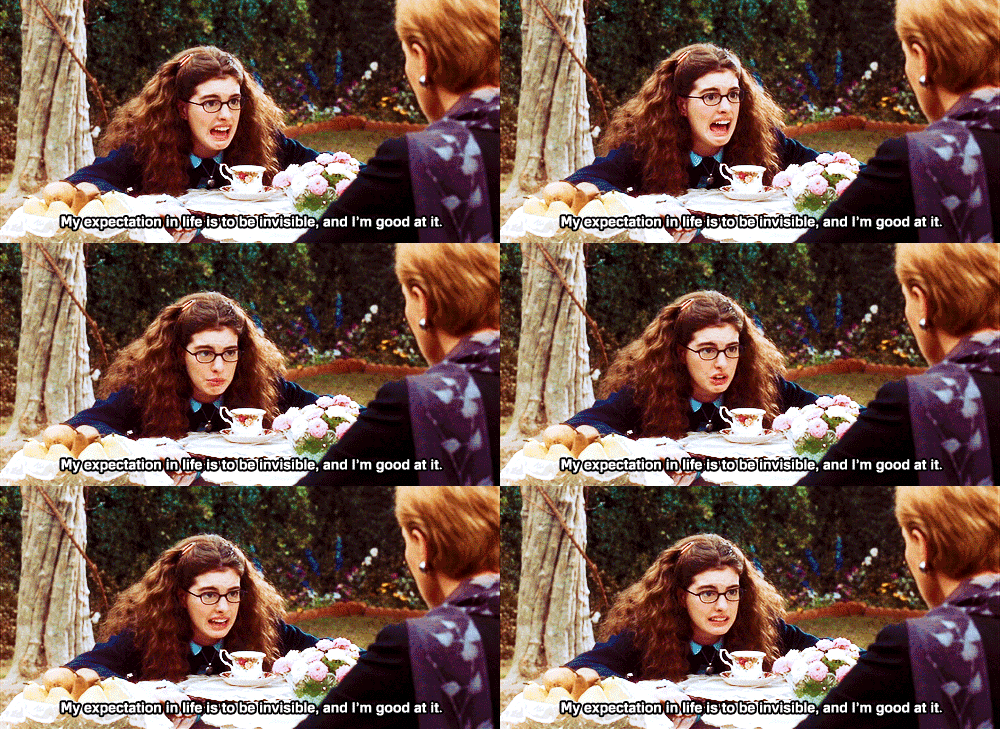
GIF from The Princess Diaries: "My expectation in life is to be invisible, and I'm good at it."

Literary Fiction

Literary fiction has its own audience—one who has high expectations for prose and subtext.

If literary fiction gets its own shelf, that shelf is often called “literature,” though many readers are rightly annoyed at the suggestion that genre fiction can’t be considered literature. We won’t get into what constitutes a work of fiction being considered “literature” here. As far as I’m considered, that’s the same as debating the definition or worth of “art.”

What we will talk about is what constitutes literary fiction.

Elements of literary fiction:

  • The language is vivid and fresh. Frequently in literary fiction, how an element is presented is more important than what is presented. The words are like visible brushstrokes in a painting.
  • It might be more concerned with subtext, theme, or atmosphere than action.
  • It’s more likely to subvert tropes than genre fiction, which upholds tropes (to the satisfaction of its expectant readers).
  • Literary fiction is more likely to allude or respond to other forms of art, especially classical poetry and literature.
  • The structure might be experimental, playing with timelines, points of view, or different forms (incorporating poetry or illustrations or other forms of media).
  • It might be more concerned with a character’s internal struggle than external conflict.
  • It might play with what defines a “novel” or “story” or “literature” (see Metafiction)
  • It might be delivered to a select few (like the first collection from Facsimile Press, which publishes fiction only via fax).
  • Some readers might not consider it accessible because it attempts the unexpected.

Read more: Literary and Commercial Fiction as Paintings

Like “commercial,” the term “literary” is subjective and is doubted by readers when self-applied. Some readers might not agree with your label.

GIF of a man throwing a book out the window in frustration

If you’ve studied or discussed literature at length, or if your writing has been recognized or published by a literary community, then you might be fine calling your work literary. Show that you understand what literary means in a query letter by including a statement in your bio paragraph, like “I majored in literature at Such-and-Such University” or “my fiction has won [recognizable literary accolades not based on commercial genre].”

BOTTOM LINE: Err on the side of calling your work contemporary or historical (whichever fits) until an authority in the literary sphere—an agent, reviewer, award-winning author, or publisher—assigns the “Literary” qualifier to your work. 

Upmarket Fiction or “Book Club Books”

Upmarket Fiction is mainstream fiction with both literary and commercial elements. These are often books read by book clubs, because not only are the books entertaining and accessible, but they also have finely crafted prose, universal themes, or head-scratching concepts that beg to be discussed with other readers.

You can call your work upmarket, but there’s no shelf for upmarket books. “Upmarket” is an adjective. Use it paired with another genre or category label, for example, “upmarket fantasy” or “upmarket contemporary novel.”

BOTTOM LINE: Upmarket fiction is approachable, but beneath its fresh, commercial premise lie layers of subtext.

pretty-in-pink

Conclusion

When pitching your book, you need to show how it’s both different from and similar to books on the market.

From The Breakfast Club: a popular boy makes a really weird sandwich, eliciting looks from his peers.

To be a success, your book needs to fit in with others while having unique qualities of its own.

In a query letter, the main content of the pitch should show how your story is unique. The informational paragraph with word count, genre, and age category should show where it fits in. This is where you can include comp titles: books or related media that might share a specific audience with your readership. “[MY TITLE IN ALL CAPS] would appeal to fans of [two or three recently published books, still-writing authors, or related media].”

What's the difference between literary, mainstream, commercial, and upmarket fiction?Click to save on Pinterest

Friday Reads: THE BASEBALL PLAYER AND THE WALRUS

I received an ARC of The Baseball Player and the Walrus and am excited to share this picture book with all of you!

Image links to Amazon Smile. With Amazon Smile, every purchase helps the charity of your choice!

Short Version

A sweet, surprisingly deep*, story about balancing responsibilities with pursuing dreams. Children will empathize with the characters, and adults will enjoy the details and theme.

*This isn’t to say I’m surprised that any picture book would be deep, since most have a lesson or takeaway element (that, and the illustrations, are why I love picture books!)—I just expected this to be a fun, silly story, and I was pleasantly surprised that it was much more than that.

Illustrations

Alex Latimer’s illustrations are packed with amusing details that demand encore reads. My favorite are the suitcases overflowing with bills and fish, and the trophies scattered haphazardly on the bedroom floor.

Story

Ben Loory has written a crafty tale about the unfortunate choice between work and passion. While the recommended age for this book is 5-8 year olds, I (mother, writer, artist) read it to my four-year-old son. He enjoyed it and was emotionally attached to both the baseball player and the walrus. I don’t want to give spoilers, but when I asked him what he didn’t like and what he liked about the book, his answers were dependent on the emotional state of the characters, rather than, like, a dragon or explosion or something “cool.” I can’t recall him empathizing with a picture book character before now, so that’s something I’m really pleased about. That’s why I advocate all people read—reading makes us empathetic humans. Every online troll should read picture books with empathetic characters. Maybe they’d learn something.

Oh, the preschooler also said he liked the walrus’ tusks. So there’s that.

Recommended for

Besides trolls who need a lesson, I’d recommend this book to elementary teachers during read-aloud time, since some of the words might be difficult for early readers. But I’d also recommend it to high school seniors and adults. The subtext and some of the humor will be appreciated by adults who live the dilemma posed in the book, asking themselves whether it’s more important to have “lots and lots and lots of money” and a job they succeed at, like the baseball player, or to invest time and energy into something more fulfilling.

On our first read through, the theme spoke to me as a mom trying to decide between working full time and staying at home. But on the second read, it spoke more to me as a creative, one who is constantly deciding between good paying jobs and really exciting ones.

Have you ever heard the quote “You can never step into the same book twice, because you are different each time you read it”? It’s attributed to John Barton. I think it only applies to books with relatable, human experiences. With theme and subtext.

It applies to this book.

Buy Links

Benefit a local, independent bookstore by preordering via IndieBound.

Benefit a charity by pre-ordering online via Amazon Smile.

The Baseball Player and the Walrus will be available for purchase on February 24, 2015.

Writing Exercise

Write a 15-blinker about a choice between passion and responsibility.

Friday Reads: AFTER I DO by Taylor Jenkins Reid

I’m starting a new series on the blog! I haven’t blogged about books in forever, so the hope is one per week. I’ll only be blogging about my favorites (no room for negativity here), and I’ll end with a writing prompt. Ideally I’ll post ever Friday, but life happens! So be sure to subscribe if you haven’t already, and then you can be sure to not miss out. Adult fiction, YA fiction, MG, graphic novels, picture books—I’ll cycle through them all.

Starting off, After I Do by Taylor Jenkins Reid. I’d heard so much about this novel on Twitter, I had to pick it up, even if Women’s Fiction isn’t usually my bag.

First Impressions

The Title

“After I Do” is a great title. Immediately we know it’s about what happens after a wedding, rather than before, regarding a married couple.

The Cover

The color, the illustration that leans on the doodle side, the tagline—these tell me this is women’s fiction, possibly bordering on “chick lit.” The hip, handwritten typeface tells me this is a contemporary novel.

The illustration itself, with the knocked over champagne glass, tells me the celebration—the honeymoon—is over. This isn’t a romance after the wedding, this is about a broken marriage.

The Blurb

From the publisher:

From the author of Forever, Interrupted—hailed by Sarah Jio as “moving, gorgeous, and at times heart-wrenching”—comes a breathtaking new novel about modern marriage, the depth of family ties, and the year that one remarkable heroine spends exploring both.

When Lauren and Ryan’s marriage reaches the breaking point, they come up with an unconventional plan. They decide to take a year off in the hopes of finding a way to fall in love again. One year apart, and only one rule: they cannot contact each other. Aside from that, anything goes.

Lauren embarks on a journey of self-discovery, quickly finding that her friends and family have their own ideas about the meaning of marriage. These influences, as well as her own healing process and the challenges of living apart from Ryan, begin to change Lauren’s ideas about monogamy and marriage. She starts to question: When you can have romance without loyalty and commitment without marriage, when love and lust are no longer tied together, what do you value? What are you willing to fight for?

This is a love story about what happens when the love fades. It’s about staying in love, seizing love, forsaking love, and committing to love with everything you’ve got. And above all, After I Do is the story of a couple caught up in an old game—and searching for a new road to happily ever after.

Let’s break this down.

“They decide to take a year off … anything goes.” Already I think this is a stupid idea, that if two people want to fix their marriage, they should learn how to communicate, not take a break and do whatever falls under “anything goes.” But I’m intrigued. I’m just expecting some dumb choices from the characters.

“Lauren embarks on a journey of self-discovery …” This tells me that this book will be an emotional journey, with plenty of introspection, and probably not much action. It also tells me that this book is primarily about Lauren, not about Lauren and Ryan.

“This is a love story about what happens when the love fades.” This is what really sold me on reading the book. It’s a love story but not a romance. I’m not a fan of romances—the tropes, the miscommunications, the lies. But I love love stories.

Reading

This is a character-driven, theme-driven novel. It’s not plot- or action-driven. So if you start reading and don’t like Lauren, or if you aren’t interested in exploring marriage from all different points of view (in the book, the opinions come from the surrounding cast of characters), then this isn’t the book for you.

I like Lauren’s voice. The tone is depressing but funny, and I really enjoy that contrast. It’s like grief. Sad one moment, funny the next.

The way Reid can characterize through her characters’ dialogue makes me excited about any future movie deals. All of the characters are three-dimensional, even if they only make cameos. Even if I didn’t agree with their opinions or decisions, I felt like they were complex, real people, and not just that, but they were all sympathetic characters. Reading is an exercise in empathy, and I think I’m a more empathetic person after reading After I Do.

I really enjoyed this book. I even marked the letters in the book to have my husband read them (don’t tell his fellow Marines he enjoyed it). It sparked a great discussion. Reading it was almost like preventative couple’s therapy. I’d recommend this book to anyone who’s married or who plans on becoming married—it’s definitely a cautionary tale.

Author Chat

Taylor Jenkins Reid talks about After I Do in this interview from USA Today.

Recommendations

If you like After I Do, you might like books by Emily Giffin or Amy Hatvany.

If you’d like a personalized book recommendation from Penguin Random House, check out The Penguin Hotline.

Writing Prompt

One of the plot devices this novel employs involves letters written between characters. Choose two people at odds with each other, whether fictional or real, and have one write a letter to the other. Let the writer assume that the reader will never receive the letter, so he or she can be completely honest and uncensored.

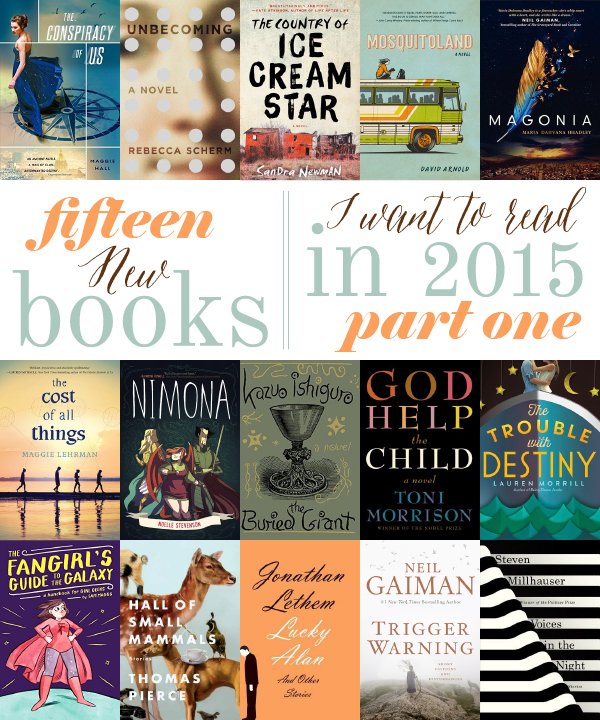
15 New Books I Want to Read in 2015, Part One

15 New Books in 2015 (January–June) | Write Lara Write

These are fifteen books coming out the first half of 2015 that I’d love to read! It’s a weird mix of adult literary and YA of all sorts of genres. Later I’ll post my top 15 of the second half of 2015, but I’m waiting on some cover reveals, first 🙂

Quotes either come from the Goodreads summary of the book or the recommendation from The Millions’ Most Anticipated: The Great 2015 Book Preview

Debut Authors

The Conspiracy of Us by Maggie Hall, 1/13/15

“Forbidden love and code-breaking, masked balls and explosions, destiny and dark secrets collide in this romantic thriller, in the vein of a YA Da Vinci Code.”

Unbecoming by Rebecca Scherm, 1/22/15

“A major debut novel of psychological suspense about a daring art heist, a cat-and-mouse waiting game, and a small-town girl’s mesmerizing transformation.”

The Country of Ice Cream Star by Sandra Newman, 2/10/15

“In the aftermath of a devastating plague, a fearless young heroine embarks on a dangerous and surprising journey to save her world in this brilliantly inventive dystopian thriller, told in bold and fierce language, from a remarkable literary talent.”

Mosquitoland by David Arnold, 3/3/15

“Told in an unforgettable, kaleidoscopic voice, “Mosquitoland” is a modern American odyssey, as hilarious as it is heartbreaking.”

Magonia by Maria Dahvana Headley, 4/28/15

“Maria Dahvana Headley is a firecracker: she’s whip smart with a heart, and she writes like a dream.” —Neil Gaiman

The Cost of All Things by Maggie Lehrman, 5/12/15

Eternal Sunshine of the Spotless Mind meets We Were Liars in this thought-provoking and brilliantly written debut that is part love story, part mystery, part high-stakes drama.”

Nimona by Noelle Stevenson, 5/19/15

“Nimona is an impulsive young shape-shifter with a knack for villainy. Lord Ballister Blackheart is a villain with a vendetta. As sidekick and supervillain, Nimona and Lord Blackheart are about to wreak some serious havoc. Their mission: prove to the kingdom that Sir Ambrosius Goldenloin and his buddies at the Institution of Law Enforcement and Heroics aren’t the heroes everyone thinks they are.”

Fiction

The Buried Giant by Kazuo Ishiguro, 3/3/15

“The Buried Giant begins as a couple set off across a troubled land of mist and rain in the hope of finding a son they have not seen in years. Sometimes savage, often intensely moving, Kazuo Ishiguro’s first novel in nearly a decade is about lost memories, love, revenge, and war.”

God Help the Child by Toni Morrison, 4/21/15

“Spare and unsparing, God Help the Child is a searing tale about the way childhood trauma shapes and misshapes the life of the adult.”

The Trouble with Destiny by Lauren Morrill, TBD

Pitch Perfect meets A Midsummer Night’s Dream on a cruise ship”

Nonfiction

The Fangirl’s Guide to the Galaxy: A Lexicon of Life Hacks for the Modern Lady Geek by Sam Maggs, 5/12/15

The Fangirl’s Guide to the Galaxy is the ultimate handbook for ladies living the nerdy life, a fun and feminist take on the often male-dominated world of geekdom.”

Short Stories

Hall of Small Mammals: Stories by Thomas Pierce, 1/8/15

“[The stories] take place at the confluence of the commonplace and the cosmic, the intimate and the infinite.”

Lucky Alan: And Other Stories by Jonathan Lethem, 2/24/15

“From forgotten comic book characters stuck on a desert island to a father having his midlife crisis at SeaWorld, the nine stories in this collection explore everything from the quotidian to the absurd, all with Lethem’s signature humor, nuance, and pathos.”

Trigger Warning: Short Fictions and Disturbances by Neil Gaiman, 2/3/15

“[It] should be no surprise that [Gaiman’s] third short story collection defies genre categorization, delving into fairy tales, horror, fantasy, poetry, and science fiction.”

Voices in the Night: Stories by Steven Millhauser, 4/15/15

Voices in the Night collects 16 stories — ‘culled from religion and fables. . . Heightened by magic, the divine, and the uncanny, shot through with sly humor’ – that promise to once again unsettle us with their strangeness and stun us with their beauty.”

What new books are you looking forward to in 2015?