[Plot] The Two-Face Structure of Christopher Nolan’s The Dark Knight

It’s been a while since I’ve done a good ol’ fashioned story deconstruction here on the blog, and what better story to do it with than The Dark Knight, which has not one, but two sequences of the 8 C’s?

I’ve been asked a couple of times about how the 8 C’s of Plotting would work in a tragedy setting, and The Dark Knight is one example of how the 8 C’s can work for both tragic and heroic storylines.

If you haven’t seen The Dark Knight, you might want to do so before you read on, because here be major spoilers.

First let’s do a quick Review of the 8 C’s:

  1. Captivation—what gets the audience interested in the character or predicament the character is in. Followed by the “Opening” sequence.
  2. Change—the inciting incident that sparks the story engine. Followed by the “Reaction” sequence.
  3. Complication—Whatever forces the MC to change plans. Could be a relocation; antagonistic meddling in the MC’s life; or a bad decision, mistake, or accident. Most powerful when it grows out of the REACTION. Followed by the “Preparation & Problems / Allies & Abilities” sequence.*
  4. Confrontation—the first confrontation between the protagonist and whichever antagonist or idea they will be facing off against in the Final Exam. Followed by the “Elation” sequence.
  5. Collapse—the near-fatal blow to the protagonist. Followed by the “Gloom” sequence.
  6. Comprehension—the Awakening, either figuratively or physically. When all hope seems to be lost, the Hero learns new information, regains consciousness, or gets help from someone or -thing. Followed by the “Action” sequence.
  7. Curveball—a surprise twist or unexpected obstacle. You know, a curveball. Followed by the “Final Exam” sequence.*
  8. Culmination—the climactic moment. Either the hero wins, or the hero dies (figuratively or literally). Followed by the “Resolution” sequence.

*Harvey’s Tragic story follow these same C’s, with two alterations.
Continue reading →

Don’t Write Comics (How to Write Comics)

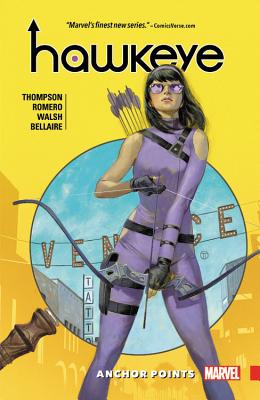
In this four-part series of articles on LitReactor, you’ll hear from Kelly Thompson, Kickstarter crowdfunding author legend and the writer behind Heart In A Box (Dark Horse Comics, 2015). Kelly also writes Hawkeye, Phasma, Star Wars, Ghostbusters, A-Force, Jem & The Holograms, Misfits, Power Rangers: Pink, and Mega Princess, a creator-owned middle grade comic book series.

hawkeye-kate-bishop-by-kelly-thompson

Thompson’s Hawkeye is pitched as Veronica Mars meets superheroes. Shop Volume One from a local indie bookseller at IndieBound

Don’t Write Comics: How to Write Comics Part One

If you’re interested in comics solely because you think it might be easy or that it might be a shortcut to another end (like having a movie made of your comic) let me just stop you right here and point you towards the exit.  While it’s true that some screenplays get reverse engineered into comics, and then after being successful comics are turned into successful films (30 Days of Night springs to mind), there’s nothing “quick and easy” about making comics. In fact, if you’re not well connected to artists (and possibly some publishers) and/or willing to lay out your own money upfront in some cases, then it can be the very opposite of quick and easy. In order to make good comics, I truly believe you have to already love comics. It’s the love that’s going to get you through.

Identify What You’re Writing
Read, Read, Read
Getting Professional Help


Part Two

So, against all my advice last time, you’re still planning to write a comic book series, huh?  And you’ve done all your research as detailed in Part I, right?

All right then, let’s talk about what you need to pull together in order to pitch the project to publishing houses.  

What You’ll Need
Specifications
The Script [Also check out my (Lara’s) post on Formatting a Graphic Novel]
Stumbling Blocks
Accepting Reality


Part Three

Now comes the hard part. Because now you have to find someone way more talented than yourself to invest emotionally, mentally, and physically in your project.

And if you want the really good art, you’re probably going to have to pay for it. 

Paying Is Key
Sequential Pages Are King
Where to Look
‘The Right’ Artist


Part Four

I always recommend using an agreement, whether you are strangers or best friends, because no matter how well-intentioned everyone is at the outset it never hurts to have clarity between all parties, and a clarity that is written down, dated, and signed, is best.

Agreements
Collaboration

Swallowing Frogs, Biggest to Smallest

This quote from Mark Twain is one that I have kept coming back to over the past year (whether I follow the advice is another story).

A frog. Not a toad, though bumpy, because apparently if it's moist, it's a frog. Yum.


If it’s your job to eat a frog, it’s best to do it first thing in the morning. And if it’s your job to eat two frogs, it’s best to eat the biggest one first.—Mark Twain

Look on the bright side, you might have to eat some frogs today, but at least you’re not eating toads?

“Toad’s skin lets out a bitter taste and smell that burns the eyes and nostrils of its predators, much like a skunk does.” —KidZone

What are the biggest frogs you need to swallow this morning?

Feedback on #70pit17

Well hi there!

Maybe you were expecting to see the Twinners and lottery winners here.

Frankly, so was I. But I am still deliberating and narrowing down the Twinners, and I have to do that before I can announce the lottery winners.

One of the issues was how many entries I had to disqualify, both from the Twinner nominees and the lottery winners.

Now, submission guidelines are not new for writers.

But I know that some of the #pg70pit rules are quirky and/or complicated. They were for the following reasons:

  • For you to have fun with the contest
  • To help make things easier on contest judges
  • To narrow down the list of entries for us, since narrowing it down ourselves to just a few is so difficult!

Still, so many entries that won the lottery—even ones that were our top picks for Twitter winners!—were disqualified this year that I wanted to take a look at the rules and get your feedback on them.

The whole reason of doing #pg70pit is to amplify voices that might be missing out from other contests. (You know the ones—they have a different focus than pg70pit, and they are very successful! But not all manuscripts are made to fare well in those types of contests.)

Can you respond to the following survey to give me some feedback and improve the contest for everyone involved?

In the meantime, I’ll be figuring out the Twinners to post here ASAP.