LAY VS LIE—Should you worry about the proper use of “lay” or “lie” in your informal or creative writing? It depends on your character.
If one of your contemporary or casual characters is speaking or narrating in first person, don’t worry about being proper—be natural, but be consistent. If your narrator is in third person or one of your characters is historical or proper, that character (or narrator) probably should know the difference.
Lay needs an object, a noun that is being positioned. Look at the verb and ask, What is getting positioned? By whom?
Lie has no object, but often has some direction. Look at the verb and ask, In what manner? Or, How? Where? With what?

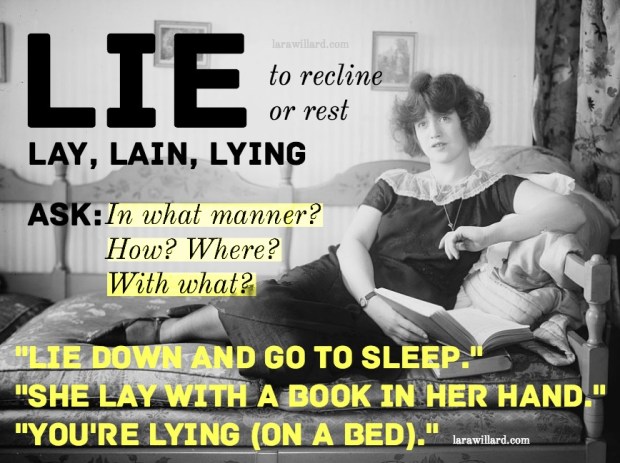
The words get confused because the past tense of lie is lay.
These are the present tense, past tense, past participle, and present participle of each:
- Lay, laid, laid, laying
- Lie, lay, lain, lying
(A participle needs a “be” helping verb: be, is, am, are, has, have, was, were, had)
Here are a few phrases to help you remember:
- People can lie all by themselves. (Q: Lie . . . how? In what manner? A: All by themselves.)
- Lie down. (Q: Lie . . . where? In what manner? A: Down.)
- She lay with a book in her hand. (Q: In what manner? A: With a book.)
- Lay down your head. (Q: Lay . . . what? A: Your head.)
- Lay it on me. Lay it again, Sam. (Q: Lay . . . what? A: It, whatever it is)
- I got laid. (Q: Laid . . . by whom? A: The narrator hasn’t told us)
Nobody says “Lie it on me” or “I got lain.”
If you see a “lay” in your manuscript and aren’t sure if it’s correct or not, see whether it’s in the right tense (past tense or present tense) and ask the questions above.
Did you find this post helpful? Consider enrolling in my revision workshop, which includes a workbook full of practical applications of grammar and editing for storytellers. If you fill out this survey, you’ll be entered for a chance to win free tuition!
For more revision tips delivered to your inbox each week—along with writing prompts and publishing tips—subscribe to the Writer Reveille.


 incomparable Lara Willard. Awesome.


 Lara Willard