Ask the Editor—Elizabeth Buege

Earlier this week I shared my Q&A for Pitch to Publication 2016. Well, two more of my MS Editors are participating as well! I wanted to feature them both here, too, so you can get to know them a bit better. First up is Elizabeth Buege. 

Website: http://www.elizabethbuege.com

Twitter: @ekbuege

Bio:

Elizabeth Buege is a Midwestern girl with a lifelong love of words. She graduated from the University of Northwestern—St. Paul with a B.A. in English writing and internship experience in nonprofit writing and book editing. She now teaches secondary writing classes for homeschool students through a local co-op, where her job is to help teens fall in love with words and learn to express critical thought clearly. Elizabeth also loves helping authors become better writers, so she offers book critiques and editing services at elizabethbuege.com, where she blogs writing tips and related topics to help authors grow in their craft. When she’s not editing books or grading research papers, she’s probably reading, writing, or enjoying the world around her.img_0695

What is your writing and editing background?

I’ve been writing since I was six years old. I jumped at the chance to major in English Writing in college, but when I left with degree in hand, I was burned out on technique lessons and needed quite a bit of time to find my own sense of story again. Taking on the “those who can’t, teach” mindset, I went into editing (first internships, then freelance) instead of keeping up writing at first. I have absolutely loved working with other people’s stories, and I wouldn’t choose any other job! Thankfully, though, time and space have helped me rediscover a love for my own writing, so I’m working more and more of that into my life, too.

What are your major editing accomplishments?

First of all, being here right now! My college adviser told me that I would never be assertive enough to run a freelance business, so my greatest accomplishment is proving her wrong. In the work itself, I get a real sense of accomplishment when I see what a client does with their book after receiving a manuscript critique. I know that’s mostly thanks to the authors’ own talents, but it feels good to look and think, “Hey, my knowledge, skills, and suggestions helped them get there!”

Do you have a general philosophy for how you approach your editing work?

I always ask myself, “What does this book need?” Sometimes, that looks like changing up my normal manuscript critique format to something better suited to an author’s questions, goals, and struggles. Other times, that looks like letting go of my ideas of what would work best and helping an author make their way work, even if I don’t agree with it. It always involves understanding what the author is trying to accomplish and getting behind them. If my goals aren’t the same as theirs, then I’m doing something wrong.

What types of books do you enjoy working with?

I love books where I can really get into the main character’s head and heart and connect with them. I don’t necessarily need to be able to relate to their lives. In fact, most of the characters I work with live lives totally different from mine, but there’s something about being human that comes through in all the best books. There are certain genres I get sent more than others, especially science fiction and fantasy, but I’m always getting excited when I find the humanity in genres and subgenres that are new to me.

What are the most common mistakes you see in new writers work?

The two biggest mistakes I see are (a) copying other simple writing styles without knowing why and (b) getting sloppy with point of view. I’m always questioning writers: Why did you choose this tense? Why did you choose this way of describing things? I often hear “I’m not sure” in response. Know what your tools are and how you can them–don’t copy the people around you, because they might not know what they’re doing either. Also, use just one viewpoint at a time, and don’t share information the POV character wouldn’t know. They’re your filter between story and reader; make good use of them.

What’s the one thing most novelists don’t understand about the art of revision?

Making major revisions isn’t a sign of bad writing; it’s a necessity of good writing. You can’t just throw out a draft and then proofread it; you have to revise on the structure, scene, and sentence levels in individual drafts–sometimes, even more than once per level.

What’s one easy thing every writer can do right now to make themselves a better writer?

Read books from different eras. I can tell when writers haven’t read widely–they start to sound like everyone else who is writing right now. Pay attention to how story works and how language works, and then practice writing. Get good feedback from an editor or qualified beta reader/critique partner and then accept it. There is always room to grow, and it’s better to ask for help than to get offended by it.

What is the most important consideration in selecting a book editor?

Are you comfortable with each other? This will look different for everyone, but it’s important. Communication-wise, I’m a good fit for people who like things in writing, but I was a bad fit for a client who was uncomfortable with long messages and wanted phone conversations. What I include in a manuscript critique will look different from what another editor includes. Likewise, my style suggestions on a line edit will look quite different from those of another editor. Communicate with multiple editors and get samples. Read their websites. Who do you feel most comfortable with? Work with that one (after making sure they own and use The Chicago Manual of Style, of course!).

Why would a writer need a book editor?

A writer, no matter how skilled, isn’t going to catch every plot hole or awkward sentence in their writing. You need an outside eye. Qualified critique partners and beta readers can do a lot, but an editor will have the education and experience necessary to give your book a stronger read-through. They’re being paid a lot to do what they do, too, so it’s in their best interest to give it their full attention.

 What do you do for fun that does not deal with the literary scene?

It feels like I don’t have a ton of time for things that aren’t reading, writing, editing, and grading papers. When I can, though, I try to make room in life for cooking, gardening, photography, playing games, and exploring parks. I love to experience the world around me!

Seriously, we need to know your favorite meal and why?

I’m in a weird transition period right now as I deal with my lactose intolerance. I think my favorite nondairy meal right now might be salmon with rice and salad, but that might change by tomorrow. My favorite non-meal food is fresh-popped popcorn. I could eat it every day and never get sick of it–salt, not sugar, is my food weakness.

MOST IMPORTANTLY What kind of entries are you looking for in your Pitch to Publication query box? Please bullet point your wish list.

  • Age category doesn’t matter–MG, YA, or Adult entries are fine!
  • Speculative fiction, especially fantasy, science fiction, and magic realism.
  • Genre-benders–I want stories that don’t fit in a box.
  • Character, character, character! I want to love them and care about their needs.
  • NONE of these, please: horror, erotica, or paranormal (some urban/contemporary fantasy can be okay, but I’m not particularly interested in zombies, demons, vampires, and the like).
  • I’m NOT the best fit for stories whose intent is to address hot social issues like gender, race, orientation, or specific political issues. There are editors who are much better than I am at bringing these stories to life! I tend to stay away from stories that are also causes; the fine line between the two is hard to walk.

 

Ask the Editor—Pitch to Publication Q&A

Pitch to Publication round two is coming! Last year I picked two writers and both got an agent. Whooooooo will be this year’s winner? I’m very excited to find out.

Here’s my interview, full of writing advice and insider information.


Bio

Lara is a freelance editor and story coach specializing in fiction and comics. She graduated summa cum laude from the University of Northwestern–St. Paul in Interdisciplinary Studies (Literature, Writing, Editing, and Design). She love genre-benders, graphic novels, coffee table books, and smart, geeky fiction.

What is your writing and editing background?

I started tutoring writing and literacy in 2005. From 2008–2009, I was an acquisitions editor for my university’s literary journal. I’ve been freelance editing fiction since 2009, comics since 2013.

My passion is actually editing, to the point where I do that in my free time—hence participating in this contest!—but I do write, too. I’ve had half a dozen poems and some short fiction published in literary journals and magazines. My blog (writelarawrite.wordpress.com) gets more of my attention than the long-form fiction I’ve written.

What are your major editing accomplishments?

I’m not sure I can distinguish between “major” and “minor”—I care more about the writer’s growth in their technique than their frequency of book deals. Whenever a writer says that I’ve helped his or her craft, that’s huge! But I’ll admit I get proud when agents and other editors compliment me on my editorial insight. Both of my picks from last year’s P2P got agents, and I actually cried happy tears for them. They did so much work, I am beyond proud of them.

Okay, I will add the following:

1) Seeing my name in the acknowledgements of published books. Tears!

2) Reading my clients’ names and their manuscripts I worked on in PUBLISHER’S MARKETPLACE—a very exciting thing that results in many emoji and all caps. Especially when they’re tied with names like Knopf and Tor. (Can you tell another one of my clients is about to share some good news?)

My next editorial life goal is getting a Newbery sticker on a book that has my name in the acknowledgements.

Do you have a general philosophy for how you approach your editing work?

Writing for publication is a collaborative effort with a goal of creating experiences for the reader. Editorial choices acknowledge and affirm the reader’s participation in fulfilling the fictional world.

Editing is also collaboration between writer and editor. It’s a mutual partnership. It’s a conversation. I encourage my current and potential clients to ask questions and voice concerns. Some writers need more nurturing. Others want to improve at any cost. Either way, I give honest, encouraging feedback. I’m never harsh, but I do respectfully snark sometimes. Editors and agents are snarky creatures. It keeps us sane in the slush.

What types of books do you enjoy working with?

Immersive stories populated with distinct characters. I like my tropes subverted, and I like “happy for now” endings. I do like romance, but I want just as much (if not more) time spent on friends and family relationships. No human is an island.

What are the most common mistakes you see in new writers work?

Writing the unremarkable: if it’s not remarkable, why remark on it? Summarize or cut anything not crucial to the story (a character believably interacting and conflicting en route to a goal).

Over description and underestimation of the reader: Pick a “divine detail” to set the scene. Be specific. Paint a few meaningful, distinct strokes, and let the reader fill in the rest. Readers don’t want to be lectured; they want to participate in the story.

What’s the one thing most novelists don’t understand about the art of revision?

The first draft is about exploration and expression. It’s about the writer. Revision is about creating experiences for the reader.

What’s one easy thing every writer can do right now to make themselves a better writer?

Nothing about writing is easy! But reading omnivorously (poetry, fiction, popular hits, literary gems) will improve your writing. You write as well as you read.

Regardless of skill, writers who are easy to work with will find better success. Be a good listener, be professional, respect your readers, and remember that agents and editors are readers, too.

What is the most important consideration in selecting a book editor?

Qualifications and personality are equally important.

QUALIFICATIONS—Require either formal education in the field or experience being published at a national level. (An objective, literary authority should have acknowledged the editor’s writing or editing ability).

PERSONALITY—Decide whether you’d get along with the person. Read bios, interact online, and ask for a sample edit of your work before you agree to a quote.

Why would a writer need a book editor?

Every writer needs an editor, even editors themselves! Not everyone needs hire a freelance editor before getting an agent, however. Having beta readers can definitely help iron out the major kinks. I recommend writers invest in a freelance editor if they know they need professional insight.

What do you do for fun that does not deal with the literary scene?

Besides being a constant mom of two boys? Haha. When the halflings are in bed, I like to play board games with my husband while watching TV. I’m always thirsty for stories, whether I’m reading or not.

Seriously, we need to know your favorite meal and why?

Are we talking about a specific meal, or a favorite dish? I’ll take steak and potatoes in any form. But if we’re talking specific meals, here’s my top 3:

1) My BFF’s mom’s enchiladas
2) Original Beau Jo’s pizza (Idaho Springs, CO) with honey on the crust
3) Slice of bacon and a mug full of salted caramel ice cream with crushed pretzels (the only “meal” I ate the day Alan Rickman died)
Comfort and nostalgia, that’s why. And taste. …Is this a metaphor for what I like to read?

MOST IMPORTANTLY What kind of entries are you looking for in your Pitch to Publication query box?

  • Historical middle grade
  • Historical YA involving a natural disaster, mystery, or doo-wop group (historical fantasy is OK)
  • Illustrated novels (any age category, any genre except erotica)
  • An adventure story with a plucky, geriatric protagonist
  • Any “blue hearts” or “pears” from last year’s contests (I believe in second chances!)—I do still have my list of favorites, so no cheating. In other words, if you got a request from me last year, or were one of the winners of #pg70pit, you can submit a polished manuscript to me during #pit2pub16. Use the same email address you used last year.

Playing Lawyer: Defending your Story with Evidence

Sometimes I live-tweet writing advice while editing. I can’t help it; I’m a writing coach!

Here’s a lesson from today:

You never want a reader to say “I’ll have to take your word for it,”
the response to when you tell us something w/o showing us.(Tweet)

Telling DOES have a place, but you need evidence to support it—
something the reader can experience. Play lawyer; give us Exhibit A. (Tweet)

When revising, look for abstract/subjective adjectives (bad, good,
beautiful, mean, sad)—then PROVE IT to the jury: the reader.(Tweet)

To sum up:
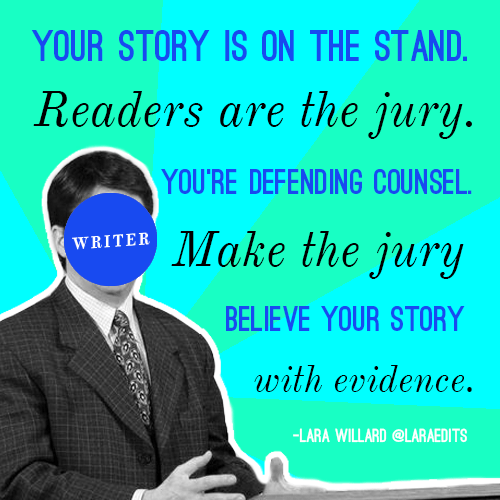
Your story’s on the stand.
Readers are the jury.
You’re defending counsel.
Make jury believe your story with evidence.(Tweet)

And here’s a Making a Murderer meets John Baldessari image to pin or share:

Playing_lawyer

How’s your writing going, by the way? Getting ready for all the upcoming pitching contests?

If you need help, check out my editing services. Here’s a look into my inbox, and the feedback from clients I’ve been getting:

“I really appreciate all of your comments. You’ve given me a lot to think about and great specific ideas on how to make my story better.”

“Thank you so much for taking the time to do this critique. Seriously. Your ideas and insight into my story are incredibly helpful. You are the first person to suggest not only using comps, but you are the first person who gave me some titles to consider using.”

Act Three: The Final Exam (NaNoWriMo Final Week)

Psst…Are you on Twitter? If so, follow @LaraEdits! Today I tweeted the difference between formal and fiction writing.

Act3-Final-exam

Posts in this series so far:

I talk about the second act in my series on plot. Here I’ll continue examining how these 8 C’s of Plotting combine with Theme in Toy Story‘s second act.

Last time we left Woody, his motivation changed—instead of being motivated by his desire for position (both the physical spot on Andy’s bed and as the head honcho among toys), he’s now motivated by a desire to be a good friend. The “Break into 3” is the comprehension, as you’ll remember:

Comprehension

BUZZ
Come on, Sheriff. There’s a kid
over in that house who needs us.
Now let’s get you out of this thing.

WOODY
Yes Sir!

Once out of the gloom, the character needs to make a new plan, which starts Act Three.

Act Three

Act Three’s Action, Curveball, Final Battle, Culmination, and Resolution are similar to Act Two’s Preparation and Problems through its Elation period. Here’s how they match up:

Act Two Act Three
Preparation & Problems Action
(last, worst problem) Curveball
Confrontation Final Battle
 (end of confrontation) Culmination
Elation Resolution

The differences between the three acts are motivation, growth, and theme.

Motivation

  1. In Act One, the immediate goal is introduced and the ultimate goal is suggested.
  2. In Act Two, the immediate goal is achieved or changed and the ultimate goal is realized.
  3. In Act Three, the ultimate goal is achieved or changed.

Growth

  1. In Act One, the protagonist starts with a sense of normalcy, which gets threatened and thrown into chaos.
  2. In Act Two, the protagonist learns how to adapt to that chaos (or “ocean”) by learning abilities and gaining allies.
  3. In Act Three, the protagonist uses everything he or she learned in Act Two to gain a new normal.

Theme

  1. In Act One, the protagonist has an established belief about the world.
  2. In Act Two, that belief is challenged (sometimes also demonstrated by a B story)
  3. In Act Three, the protagonist develops a new belief.

Sometimes the theme is demonstrated by a dilemma: The character is put in an impossible situation, needing to choose between A or B. Both are important, and the loss of either would be deeply felt. The character comes up with a new option, Choice C, which is chosen at the Culmination.

Brian McDonald, story consultant to Pixar and an expert on the subject, sums up the theme’s progression through the acts in two ways:

  • Thesis, Antithesis, Synthesis
  • Proposal, Argument/Proof, Conclusion

Read his thematic analysis of The Godfather here.

 Let’s breakdown Toy Story‘s Act Three.

Action

Woody’s in “jail,” Buzz has a rocket strapped to his back, and here a moving truck comes to take Andy away forever. A nice reminder of that ticking time bomb. We have to know—What’s next?

  • Buzz helps Woody get out of the milk crate (sequel)
  • Sid wakes up, grabs Buzz, and takes him outside to blow him to space/smithereens. (new goal)
  • Scud (the dog) sees Woody, but Woody slams the door on him. (Tiny victory for Woody, but also a pinch point / foreshadowing)
  • Woody asks Sid’s toys for help, hinting they’ll “break some rules” (character development, foreshadowing)
  • Goal/pinch point montage: Andy is shown sad to leave both Buzz and Woody, Sid is shown building a launch pad, Scud is waiting outside the door to eat Woody
  • Woody makes a plan (this is implied with a visual and three lines of direction to other characters—it’s not spelled out for the audience. They’ll have to keep watching to see what the plan is)
  • Partakers in the plan get into places
  • Achieve plan part one: get HANNAH (previous character) to get rid of SCUD (immediate threat)
  • Set-up for plan part two (keeping up mystery of this plan—not even telling Buzz)
  • Achieve plan part two: teach SID a lesson and scare him away from Buzz (immediate threat) and any other toy (greater good) by breaking the toy rule and coming to life, but not before SID gives Woody a match (foreshadowing, tool)
  • Sequel: Sid is afraid of Hannah’s dolls now, Woody & Buzz shake hands.
  • Van horn honks: Andy and his family are saying goodbye to their house.
  • Woody runs to van, but Buzz is stuck in the fence. Woody leaves the van to go save Buzz (character development)
  • Van drives away (problem), Buzz and Woody duck to avoid moving truck just in time (character development—compare to the gas station semi), they wake up Scud (antagonist)
  • Buzz and Woody both manage to catch up with the moving truck. Scud catches up with them and starts pulling Woody off.

We end with some character development…

WOODY

I can’t do it! Take care of Andy for me!

…before Buzz sacrifices himself for Woody, jumping off the truck to tackle Scud. (mutual relationship development)

Curveball

Woody unlocks the back of the truck and looks for something—he’s got a plan, but we don’t know what it is. He tears into a box labeled “Andy’s toys.” The toys react, but he ignores them (more development) and looks in another box. He finds the RC car and its remote, then throws RC out of the van. The other toys scream—now they have no doubt Woody is a toy murderer. Woody drives RC over to Buzz. The toys charge Woody. Woody’s being attacked by toys while trying to drive RC and Buzz toward the moving truck, away from Scud, and through traffic. It’s a chase and fight scene full of obstacles, and it ends with the Curveball:

The mob of toys lift up Woody (still holding the remote) and
head for the open back.

WOODY
No wait! You don’t understand!
Buzz is out there! We’ve gotta
help him!!

MR. POTATO HEAD
Toss ‘im overboard!

WOODY
No, no, no, wait!

The toys toss him out into the road. As the truck drives
off, the toys CHEER.

MR. POTATO HEAD
So long Woody!


Final Battle Exam

The “Final Battle” is the last fight in the war. However, perhaps a better way of seeing it is as a final exam. Everything that the character learned is now put to the test.

First, a sequel to the curveball: Woody gets up, is nearly run over, and then gets swooped up by Buzz and RC. Then he’s ready for his final test. Let’s see how he does:

  • Woody successfully drives RC through traffic.
  • The other toys see him with Buzz and realize they were wrong, and Woody’s been telling the truth all along.
  • Woody tells the toys to lower the ramp, and they listen to him.

Another twist! RC’s batteries start running out. The toys are seen (but only by Andy’s baby sister). RC’s batteries deplete.

  • The rocket (tool) could get them back. Woody has a match (tool).

A car drives by, extinguishing the match. Miniature gloom as all hope seems to be lost.

  • Woody uses (ally) Buzz’s helmet like a magnifying glass (tool/ability) to light the rocket, which takes them off toward the moving truck.
  • Woody deposits RC into the back, accidentally but successfully.

The rocket hurtles upward higher and higher.

WOODY
Ahhh!! This is the part where we blow up!

Culmination

The culmination is the end of the final battle.

BUZZ
Not today!

Buzz confidently presses the button on his chest. Wings jut out of Buzz, severing the tape that holds him to rocket. The toys separate from the rocket just before it blows up. The toys plummet.

Just then Buzz banks under some power lines and soars upward
again. Woody takes a peek.

They’re flying.

WOODY
Hey, Buzz!! You’re flying!!

BUZZ
This isn’t flying. This is falling — with style!

WOODY
Ha ha!! To Infinity and Beyond!!

They soar gracefully towards the moving truck, but then pass
over it.

WOODY
Uh, Buzz?! We missed the truck!

BUZZ
We’re not aiming for the truck!

Buzz and Woody fly right over the van’s sun roof and then
drop into the car.

Buzz gets his character development, too. The B Story is tied up nicely.

Resolution

Andy finds Woody and Buzz in the seat beside him. He hugs them, and the two toys wink at each other.

At Christmas (this scene could be considered a small Epilogue), Andy’s toys are anxiously waiting to hear what new toys Andy will be getting—a nice parallel to Andy’s birthday at the beginning of the movie. The toys have hit a new normal. Woody isn’t afraid of not being the best or the favorite anymore.

But Buzz might be nervous about Christmas. He asks if Woody is nervous.

WOODY (laughing)
Now Buzz, what could Andy possibly
get that is worse than you?!

SFX: BARKING

ANDY (O.S.)
Wow! A puppy!

We ZOOM BACK through the window to a CLOSE UP of Buzz and
Woody.

They look at one another with a half-smile, half-grimace and
laugh weakly.

Fade out.

THE END

Theme of Toy Story

Remember Woody’s belief/goal from Act One and his experiences in Act Two:

Being the best and favorite toy (act one) + making a friend (act two) =

Being the best isn’t as important as having a best friend.

Let’s check that theory with what characters say, with what they do, and with the music.

  • When Sid is torturing Woody, he says: “Where are your rebel friends now?”
  • When Woody is trying to convince Sid’s toys to help him, he says: “There’s a good toy down there and he’s—he’s going to be blown to bits in a few minutes all
    because of me. I’ve gotta save him! But I need your help. Please. He’s my friend. He’s the only one I’ve got.”
  • Woody and Buzz both give up chances to be with Andy in order to save each other.
  • From “You’ve Got a Friend in Me”: “When the road looks rough ahead
    / And you’re miles and miles from your nice warm bed / You just remember … you’ve got a friend in me”
  • More from the theme song: “Some other folks might be a little bit smarter than I am / Bigger and stronger too, maybe / But none of them will ever love you the way I do / It’s me and you”

Writing Act Three

What does your character believe in Act One? How will her experiences in Act Two change that belief? What is the final theme or message of your story?

Did you use any tools or abilities you’ll need to later implant in the “Preparation and Problems” section? Make a note of those to include while revising—don’t go back to the beginning until you’ve finished your first draft.

Did writing your ending give you ideas for starting your story in a different place? Is there a way you can wrap up the story that would pay homage to your beginning?