The 8 C’s of Plotting: Reaction and Complication

This is Part 4 of The 8 C’s of Plotting. Read parts one and two first, if you please. Click here for the whole series on the 8 C’s. Click the image below to be taken to the General Fiction Feed.

With the Prologue, Opening, Captivation, and Change we discussed last time, the Reaction and Complication flesh out the rest of Act One, if you are familiar with the 3-Act structure.

I told you that I’d start using The Lion King and The Hunger Games as examples to illustrate. To get you up to speed, here are the Prologue, Opening, Captivation, and Change for each. I’m not hiding these, because even if you haven’t seen either, this information is pretty standardly given in a movie trailer.

The Lion King

Prologue—The Circle of Life, Simba introduced

Captivation—Lions! In Africa! Great Soundtrack!

Opening—Simba Just Can’t Wait to Be King

Change/Inciting Incident—Elephant Graveyard; Scar makes a plan to become king

The Hunger Games

Prologue (Movie)—Panem, District 12

Captivation (book)—It’s the Reaping. What’s the Reaping?

Opening—The Reaping

Change/Inciting Incident—Katniss’ sister is chosen as tribute in the 74th Hunger Games. Katniss volunteers in her place.

Up to speed? Here’s the Reaction and Complication. They don’t need very long descriptions.

Reaction

The reaction is anything that happens after the Change. How does the protagonist (and/or the antagonist) react to the change?

In The Fugitive, Dr. Richard Kimble (Harrison Ford) is convicted of killing his wife, though we are pretty sure he didn’t do it. The conviction is the change. The reaction? He is sent to be executed.

In The Lion King, (highlight the area between brackets to read the spoiler) [Simba still trusts his uncle Scar, so he willingly, naively, sits at the bottom of a canyon waiting for his dad, not knowing that Scar intends to trample him with a stampede of wildebeests.]

In The Hunger Games, [Katniss and Peeta go to the Capitol and train. Katniss isn’t very cooperative (or likable) as far as Haymitch is concerned. This includes the parade, the training, and the arrow through the apple.]

The reaction can play out in different ways, but whatever the Protagonist does during the “reaction” stage, he or she will do something else after the complication.

Before or during the Complication, it’s a good idea to show what the antagonist is doing.

Complication/Campaign

This is whatever happens to make the protagonist stop reacting (likely due to a “complication” or obstacle of some sort), and start acting (setting upon a “campaign”).

It can be a switch from passive to active, like in The Lion King.

Or it can mean a change of direction or a different approach, like in The Hunger Games.

It might also be the entrance into a new world or setting, like in the monomyth.

In a character-driven story like Toy Story, the complication:

  • is a bad decision, mistake, or accident
  • which grows out of the Reaction
  • and ends unfortunately,
  • resulting in the need to make new plans—the “campaign” of Act Two.

—”Act One: Threatened Characters Make Mistakes

The Complication corresponds with the 3-Act structure’s First Plot Point or the End of Act One and is often a MAJOR SCENE. Major scenes have their own beginning, middle, and end.

In The Fugitive, Kimble is riding the bus, on his way to be executed. His fellow convicts plan an escape, but that backfires. A guard gets shot. Kimble, a doctor, is unchained to help the guard. The bus crashes. It crashes on a train track. The train is coming. Kimble has to escape from the train. Once he escapes from the train, a fellow convict frees him. Now he’s free…a fugitive on the run. And because he’s a fugitive, the US Marshalls get put on the case. This introduces Gerard, the antagonist and in some ways, a secondary protagonist.

In The Lion King, [Scar kills Mufasa and blames Simba, Simba runs away.]

In The Hunger Games, [Peeta declares his love for Katniss during the interview. She freaks out, but Haymitch teaches her that she needs to play up the audience to get sponsors]

complication

(See my deconstruction of Toy Story’s Act One and how it relates to the story’s theme.)

Any questions? Ask below. Just don’t include spoilers. If you disagree with my assignments of plot points, all the power to you, as long as you are thinking critically.

Next week I will devote the entire post to the Preparation and Problems segment, which nearly always takes up the longest chunk of narrative, and is what Blake Snyder calls “Fun and Games.”

The Hunger Games: Analysis to come!

I interrupt my vacation to let you know that this week I’m reading The Hunger Games.

And also to let you know that I’ve decided to use The Hunger Games to illustrate my 8 C’s of  plotting.

So if you don’t want the whole plot of the first book given away to you, I’d advise you pick up the book or watch the movie before April 13th. If you don’t, I’ll try whiting out the spoilers, so you have to highlight them to read them. Still, The Hunger Games seems like the best choice right now, since so many people have read the book or seen the movie. If you can think of another movie that has seen such a big audience, let me know and I can try using those. I think The Lion King is a pretty good choice. If I must, I can refer to Titanic, but I’d rather not.

In other news, never try blogging on WordPress.com from your iPhone, unless you want to be seriously annoyed and unable to italicize reasonably. Yeah, there’s probably an app, but apps take up waaaay too much space on my phone. Space I can use for movies or videos of my child roaring at dinosaurs.

Until next week.

Write now.

The 8 C’s of Plotting: Worksheets

8C-worksheet

If you haven’t read Part One, the introduction to the 8 C’s, read it here!

Use these worksheets to:

  • plan out the main plot skeleton of a novel
  • reduce a complex novel into one, overarching plot
  • understand the main plot of your novel, all the better to pitch with
  • get an idea of what to put in your synopsis
  • recognize how virtually all movies and novels use a similar structure
    • (and how each modifies the structure to fit its own needs)
  • make your other writer friends jealous of how organized you are

Do not use these worksheets to:

  • make money publishing or reposting my work
  • create your own blog post on the 8 C’s without linking back here
  • make paper airplanes (unless you recycle, of course)

Continue reading

Diction: Latinate versus Anglo-Saxon

Here for a school assignment? Click here for citations you can use. Best of luck!

Diction = word choice

Synonym = a word’s twin in meaning, e.g. “big” and “large” are synonyms.

Ever wonder why English has so many synonyms? Because it’s the lovechild of Germanic and French languages. (French isn’t called a romance language for no reason.) While having so many choices can be a wonderful thing, it can also be disastrous. With great vocabulary comes great responsibility. I’m talking to you, Christopher Paolini. Step away from the thesaurus.

You’ll notice the language split when two political candidates start campaigning and one plays the “smarter than thou” card and the other plays the “average Joe” card. Smarter-than-thou is going to try to dazzle you with an academic, million-dollar vocabulary. Average Joe is going to give you a pat on the back with neighbor-speak. Go back in time and see the difference between John Kerry and George W. Bush—two polar opposites in terms of diction.

See my post on dialogue at The Better Novel Project for an example of diction in The Hunger Games. Can you guess which quote belongs to which character?

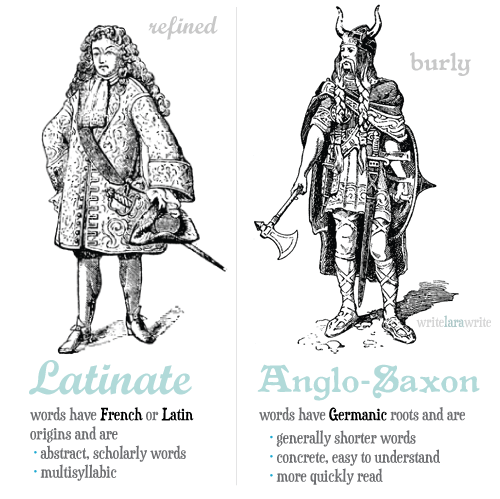
Latinate words are sometimes also known as “purple language,” “flowery” or “five-dollar” words. These are the ones that hike up your reading level and slow down your audience. While they are pretty standard in academic works, nonfiction and romance, multisyllabic Latinate words are best used in moderation. If a reader doesn’t understand your words, your words are meaningless (to them). Jargon tends to be Latinate.

But Latinate words are also ones to spend time with. They are contemplative. They can be romantic.

Generally speaking, Anglo-Saxon words come from Germanic roots (i.e. Old English, German, and Old Norse) and are common words. They are shorter and simpler than Latinate words. Action, Adventure, and Thriller genres will use more of these because they read faster, quickening the pace and heightening the suspense. This, writers, is the kind of vocabulary you want to have your word babies with during those intense scenes.

Latinate words slow down the pace, so save them for when the action is over and the characters and readers have a moment to think.

There’s nothing wrong with Latinate words. Literary works tend to favor them, and commercial works can sometimes use more of them. Middle grade writers often use Latinate diction to introduce new words to vocabulary-voracious children.

Balance is best!

Writing picture books, humor, or commercial fiction? Use more Anglo-Saxon words than Latinate.

Has someone told you that your voice sounds “too MG” or “too YA” when you’re writing for an older audience? Try adding in more Latinate words, but keep the majority to two or three syllables, sprinkling four-syllable and longer words in less frequently.

Want a list of examples of Anglo-Saxon words and Latinate words? Wikipedia saves the day.

Watch and listen to Latinate diction from Ferris Bueller’s Day Off and a mix of Latinate and Anglo-Saxon diction from The Dead Poets Society.

More resources that I found after Googling the subject:

Additional resource:

5-Minute Writing Exercise

Write down a list of 5–10 adjectives describing yourself or your protagonist. Look them up in the dictionary and see if they are based on Latin/French roots or Germanic (or Old English) roots. Then come up with a syllable for each word that comes from the other family.

For example, “masculine” is Latinate. “Burly” is Old English.

Have fun! Share here if you’d like.

Related Exercise: Analyzing diction in your favorite speech, short story, or poem

Citations

MLA:

Willard, Lara. “Diction: Latinate versus Anglo-Saxon.” Lara Willard, 21 Mar. 2012, larawillard.com/diction-latinate-versus-anglo-saxon/.

APA:

Willard, L. (2012, March 21). Diction: Latinate versus Anglo-Saxon [Blog post]. Retrieved from /diction-latinate-versus-anglo-saxon/

Chicago (Footnote):

Lara Willard, “Diction: Latinate versus Anglo-Saxon,” Lara Willard (blog), March 21, 2012, /diction-latinate-versus-anglo-saxon/.