Formatting your Novel Manuscript

How do I format a manuscript? | Novel Formatting from Editor Lara Willard

Contents

Choosing a Font
Emailing Requested Pages
Formatting your Manuscript
Keeping Punctuation Consistent
Receiving an Offer of Representation

Choosing a Font

The choice of font for your manuscript is one that’s been made for you. You need to use 12 pt. Times New Roman, double-spaced.

The size 12 font and double spacing is non-negotiable. The typeface is. Still, after asking dozens of literary agents about their preferences, I urge you to choose Times New Roman.

Why TNR?

Personally, as a typesetter, reader, and graphic designer, I loathe Times New Roman. But here’s why you should use Times New Roman for standard manuscript formatting:

  1. I polled 20 agents, and all of them accept TNR. Not so with other fonts.
  2. It’s standard. It’s been the standard since TNR was the default typeface installed on home computers.
  3. It’s a serif font. Publishers prefer serif fonts, and that preference has carried over to literary agents. It’s what we associate with books.
  4. It’s available on any device or browser. There are only two serif typefaces available on any browser or device: Times New Roman and Georgia. If you use any other font, there’s a definite chance that your recipient’s device won’t have the font and will switch it to TNR. You might think “Well, that’s fine. It switches for them.” But every time I get a manuscript in Cambria (the current default typeface for Word), I get a little pop-up that says “An Error Occurred” that I have to acknowledge and close. Yes, most agents will have Cambria on their computers, but Mac users might not, and it’s still not considered a web-safe font.
  5. TNR is very easy to read or change on e-reading devices. Many agents now read requested partials and fulls on Kindles or tablets. Times New Roman is easily changed into the typeface and size of their preference.

Courier has been a standard since the days of snail-mail manuscript mailing because, as a monospaced font, it yields approximately the same number of words per page. It has serifs (though it’s technically a slab serif), and it’s available on any device or browser. I prefer Courier while editing because it gives the most white space. My eyes are used to it, and it feels natural. I also know that I’m in “editing mode” whenever I’m reading Courier. However, some agents passionately hate Courier. They aren’t going to reject you because of your font, but they will switch it to something else, likely Times. Courier is also not easy to read on e-readers.

Bottom line:

Write in whatever font you darn well please. You could type in Webdings if it will help you from revising while getting out your first draft. Revise in something legible: a serif, a monospaced slab (like Courier), even a sans-serif (like Arial). Before you submit to agents, revise one last time in a typeface from a different family—you’ll be surprised how many things you catch when the words aren’t always in the same position on the page! Submit to agents using 12 pt TNR, double-spaced, unless they’ve stated differently in their agency guidelines.

Pasting Pages in the Body of the Email

Word uses a bunch of formatting that doesn’t always translate to web use, like italics, non-breaking spaces, space after paragraphs, double-spaced lines, and centered text. It’s always a good idea to strip the formatting for blog posts or emails, either by putting it into a text-only program like Notepad or TextEdit or by choosing “use destination formatting” while pasting. I hold down shift while pasting: shift+control+V

My pages will have a consistent look with my query letter, rather than be in a different font or format. Then I make sure there are spaces between my paragraphs, so it doesn’t look like one huge blob of text.

I’ve received pasted pages that weren’t stripped of formatting. Sometimes the spaces between words are gone. Sometimes the text is in one single horizontal line that scrolls on to the right, forever. Sometimes the query is gigantic or microscopic in comparison to the pages. Make it easy on the agent to read your pages. Don’t give him or her an easy way to say no.

Emailing Requested Pages

Subject Line

If you are emailing requested pages to an agent—that is, an agent asked you to send him or her pages after you queried—your subject line should be obvious that you are replying with requested materials.

A subject of Partial Request: BOOK TITLE Age Category Genre is a good starting point.

I’d reply to the email that they sent. An agent might mark your initial query email as important, reply directly to that (re: Query: CYCLES MG Fantasy) with a request for pages, and then if you reply to their email (re: Query: CYCLES MG Fantasy), your new email, because it’s part of the same thread, will also be marked as important.

However, if you’re replying to something they rejected, then your reply will also be marked as rejected. Resist the urge to send a “thank you” or “what about this other manuscript?” reply. If rejected, you can query with another manuscript in 6+ months. If you got a revise and resubmit, resubmit in 6+ weeks.

Content

Be professional, polite, and concise.

Dear Mr. Agent,

I am delighted to send you these pages you requested. Below I have included my initial query letter.

I look forward to hearing back from you.

Sincerely,

Your Name

[Initial query letter—the same one sent to this specific agent—pasted without formatting]

Make sure you are following agency guidelines. Don’t attach pages if they want them pasted in the body of the email. If they request your query or a synopsis as separate files, follow their instructions!

Naming your Document

When sending a partial or full request to an agent, name your document Surname_TITLE_Partial or Surname_TITLE_Full (including the .doc extension). That way, if an agent saves your document to her computer or e-reader, she will immediately know 1) what and whose it is before she opens it, 2) the query that got her interested, and 3) where to send her response if she lost your initial e-mail.

Formatting your Manuscript

Start out with 1-inch margins all around and left (not justified) alignment.

Page i—The Query Letter

Paragraph Style: “Title Page”—12 pt TNR, single-spaced, no indent

Because many agents read requested pages on e-readers, they may have forgotten your query when they start reading your pages. I recommend including your query in the body of the email (see above) as well as before the title page of your requested pages.

Use 12 pt. Times New Roman, single-spaced with an extra space between paragraphs (like your email query). Make sure you are sending the same query you sent the agent originally. Don’t send a partial to Ms. Sally Agent with a query to Mr. Hans Agent, listing the specific reasons why you want him as your agent!

Then insert a page break.

How to Format your Novel Manuscript and Query Letter

Page ii—The Title Page

This page should be in the same paragraph style, with no headers.

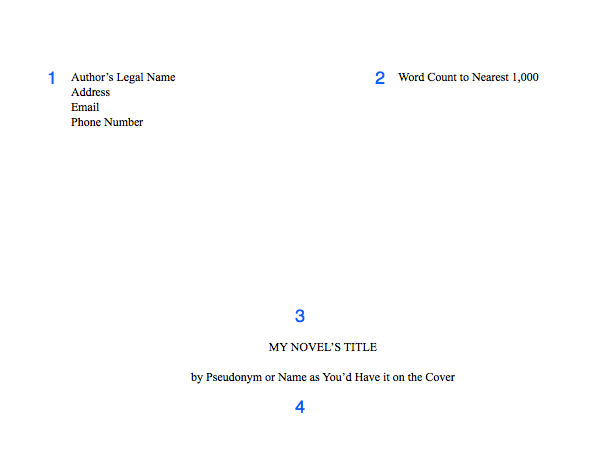
1. Include your contact information, especially your email and a reliable phone number. Agents offer representation over the phone! But they will email you to let you know if they’d like to call you, so you can schedule a time.

2. After you type your name, add a tab stop with a right alignment to your ruler on the right margin. Then enter your word count, rounded to the nearest 1,000. If text keeps dropping to the next line, make the tab option a decimal alignment.

3. Halfway down the page, include your title in all-caps. Keep it in 12 pt. font, and do not bold, italicize, or underline it.

4. Two lines down (or one line, if you double-space this part), include your name as you’d like it to appear on your cover. Note that if your legal name is Steven King, you will probably need a pseudonym to avoid confusion with the famous SK.

Then insert a section break.
How to Format your Novel Manuscript and Query Letter

Your Manuscript

Page one of your manuscript and following pages will have the same formatting.

Be sure to include your header in the header section, not in the body of the page.

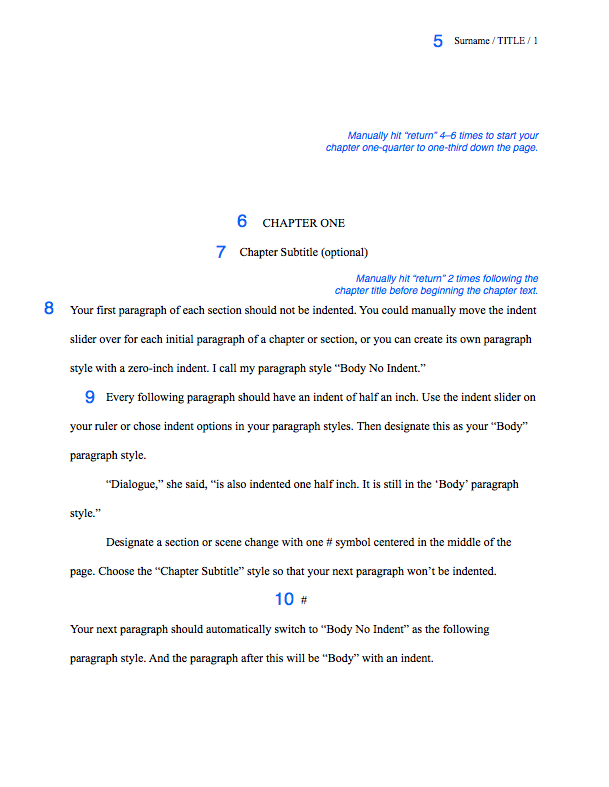
5. Headers should include your surname (whichever surname you have been using in your correspondence with the agent), an abbreviation of your title (if it’s longer than 3 words), and the page number (insert the page number). The page number will automatically show as 2 or 3. In your section settings, change the page numbering to start at 1. Learn how for Word. In Pages, in your inspector window, chose Layout > Section > Start at 1.

I prefer headers to be aligned on the right side so my eyes don’t have to skip over them every time I scroll down or flip to the next page.

Paragraph Style: “Header”—10 or 12 pt. TNR, right aligned
How to Format your Novel Manuscript and Query Letter

6. Manually hit “return” 4–6 times to start your chapter one-quarter to one-third down the page.

Paragraph Style: “Chapter Title”—12 pt. TNR, center alignment, all-caps, no indent, following paragraph style: “Chapter Subtitle” (if using), otherwise “Body No Indent”

7. If you have a chapter subtitle, put it on the next line down.

Paragraph Style: “Chapter Subtitle”—12 pt. TNR, center alignment, Title Capitalization, no indent, following paragraph style: “Body No Indent” 

8. Manually hit return 2 times before beginning your first paragraph. Do not include drop-caps or decorative initials.

Paragraph Style: “Body No Indent”—12 pt. TNR, left alignment, no indent, following paragraph style: Body (default)

9. Each subsequent paragraph should have a half-inch first line indent using the ruler, not a tab key. Highlight this indented paragraph, right-click on the default “Body” paragraph style, and select “Redefine style from selection.” Note that if anything else had been set as Body before now, its style will change.

Paragraph Style: “Body” (default)—12 pt. TNR, left alignment, 0.5″  indent

Use the indent formatting set to 0.5″. DO NOT USE THE TAB KEY or type five sentences to indent your first line. If you have done this, set your paragraphs to indent automatically. Then find/replace all tabs by typing “^t” into “find” and leaving “replace” blank. You’ll do the same with double spaces after each sentence.

Unless you are typing on a manual typewriter, indents should come from formatting, not the tab key or the space bar.

Unless you are typing in a monospace or typewriter font like Courier, do not hit space twice after each sentence.

10. Separate scene changes with a hash (#) or three asterisks (***), centered, in either of the Chapter title/subtitle styles, whichever one has the following paragraph style set as “Body No Indent.”

11. (not pictured) For long quotes, excerpts, or letters: Indent one inch on both the left and the right side for long quotes. These can be single or double-spaced. Either way, they need an extra line break both above and below, to set them apart from the rest of the body. They can also be italicized. Personally, I’d italicize only if the text were a “letter” from one character to another.

Paragraph Style: “Long Quote”—12 pt. TNR, left alignment, right indent 0.5″, left indent 0.5”

Dear Reader,

This is a letter or lengthy handwritten note (longer than a few words). Indent 1/2 inch on both sides (I prefer 1 inch). Short handwritten notes can be formatted like signs, below.

Don’t put these in different fonts. Let your designer choose typefaces.

For signs or short handwritten notes: Include an extra line break before and after, and center the text without an indent.

FOR SALE: apples
Come ‘n get ’em!

For text, instant, or direct messages: Indent a half inch on both sides using the ruler settings. For a dialogue or back-and-forth messages, I like to right-justify the POV character and left-justify anyone else. How you designate the characters’ identities is up to you. Note: In verse novels, authors will often continue the main character’s voice on the left and other character’s words will be on the right.

Friend: Hey.

Me: Hi.

Here’s a long message that
we’ll add line breaks to so
it looks more like a text.

Yeah. I think my phone only
allows like 32 characters per
line or whatever. But 6ish words
is about right, too. Really you
can add line breaks wherever,
like poetry.

I created a new message here
by hitting “enter” like usual.
Enter line breaks by holding
shift while you press “return.”
You’re adding a line break, not
a new paragraph.

If you’re typesetting an actual
book and not submitting a MS,
then I still recommend right-
justifying single-line texts,
like the “Hi” above, but…

For longer text messages, left-
justify and indent 4 or 5 inches. That way you avoid awkward short lines on the right side of the page, like the “like poetry” above.

You don’t have to add line breaks if you indent this far, but you might want to just in case someone accidentally removes
all indents.

Otherwise your text messages will just look like normal text again. Pro tip: write the message and edit it before figuring out formatting, otherwise you’ll be spending too much time prematurely adding and removing line breaks.

Miscellaneous

DO NOT add two spaces after a period unless you’re submitting in a monospaced font like Courier (which you shouldn’t; see above)

DO NOT hit the return or enter key after each line of prose. On a computer, the words will wrap automatically. For poetry or verse, then yes, you can manually add line returns.

DO insert a page break after each chapter.

DO NOT use the “tab” key or type five sentences to indent paragraphs (see #9)

DO NOT add an extra space between paragraphs when double-spaced (see #9)

DO add an extra [vertical] space between paragraphs when single-spaced (e.g., the query email). Hit the return key twice.

DO NOT use bold or underlining for emphasis, unless typing in Courier. Only use italics, and use sparingly. If you paste into an email, check to make sure the italic formatting transferred over.

DO NOT include epigraphs, song lyrics, or poetry set apart before the first chapter. Agents want to read your words, not someone else’s. You can discuss epigraphs and the like when writing your dedication and acknowledgments. More info here.

Congratulations! As a reward for reading the miscellany, go here to download my free template for the MS standard format.

Keeping Punctuation Consistent

Inconsistent punctuation isn’t going to be a deal-breaker, but if you want to ensure that your punctuation is consistent (specifically your ellipses, dashes, and quotation marks), read Part 2: Hard-core Manuscript Formatting.

Receiving an Offer of Representation

Read “When an Agent Requests your Manuscript”  by Susan Dennard (now a NYT bestselling author!) at Let the Words Flow for advice on what to do when an agent offers you representation, especially if you still have pages being reviewed by other agents.

Did you find this information useful?

Subscribe to my blog! Writing courses and editing services are on hiatus while I complete my MFA.

#CPPitch—Choose your Top 5

If you entered #CPPitch before September 1st, you may choose your five top picks below. It might be a good idea to have the list open in another tab while making your list here. Remember that you can choose from any category. On September 3rd or 4th, you’ll receive an email from me with the query letter and first 250 words of their MS. Reply to that email with the names of your top 3 choices by 11:59 on September 6th.

On September 8th, I’ll email everyone with their CP matches. Depending on everyone’s top 3, you might be critiquing someone’s MS, and a different person might be critiquing yours. That isn’t to say that you can’t ask other people to be your CP! The point of CPPitch is to give you a sampler before you pick a CP, and also to make sure that as many people as possible get a critique partner.

All CPPitch-ers have been matched! Thank you for participating.

#CPPitch List

cppitch

Here’s your list of fellow “single” writers searching for a CP! These will be arranged alphabetically by first name on the 22nd and every two days following. That way, if you come check the list again in two days, you can see who was recently added.

Want to enter? Find the Rules and Entry Form here.

Entries are closed! Thanks to all who participated!

Bold entries below are ones selected for an edit of their query and first chapter.

Comp Titles

Does one of these pitches remind you of another book or author? Tweet the author to let him/her know. I know how difficult it can be to find comp titles to put in my own query! Remember, the best Comp Titles tend to be less than 5 years old or were debut novels.

Spread the word

The more the merrier! Consider mentioning #CPPitch to your friends on social media or by email to get them involved.

New entries are marked with an asterisk. More entries will be posted on the 28th.

Fantasy

To protect the kingdom he’s sworn to serve, Morgan McRobbie must become its worst enemy.
Keith Willis‘s TRAITOR KNIGHT, adult, 124K

In the 12th century, time-traveling musicians must save their kidnapped sister from almost certain marriage.
Lara Willard‘s ROBIN EVANS AND THE WORLD SONG, adult, 65K

One girl’s magic makes her an outlaw from her own people, and she must join with those who burned her home in order to save herself. (Note: MC is a teen, but there are multiple POVs)
Mary W. Jensen‘s FEY MOON, adult, 98K

A gangster in a heathen port city learns that he’s becoming a god, only to find out that they die too.
Justin D. Herd‘s OF GODS AND MADNESS: THE FAITHFUL, adult, 85K

Fantasy Romance

When twenty-year-old Aidelle smashes a timepiece as her fiancé leaves her, sealing herself in a timeless reality, she must cross the volatile ‘timestreams’ to rewrite their argument or be erased from existence.
Alexandrina Brant‘s WHEN THE CLOCK BROKE, adult, 80K

A slave and a prince work together to catch a murderer and find themselves falling (illegally) in love along the way.
Melanie DeWitt‘s DUSTRIEL’S BLESSING, adult, 74K

In Mithos, where True Love is the strongest form of black magic, Martia must make a choice—kill her other half or submit to their wild new power.
Tiffanie Lynn‘s THE SINNER ROSE, adult, 90K

Beta tried to forget the alien freaks that took her. But they aren’t having that. To survive she needs to remember what they did to her—fast, or risk everything she loves.
Colleen Myers‘s CAN’T FORGET, new adult, 65K

Historical Fiction or Historical Romance

Forgotten silent film star Hester Carmella chronicles her rise to fame in 1920s Hollywood, her career given an unexpected boost when her sister is brutally attacked by the future Black Dahlia killer.
Erin Foster Hartley‘s HOT TAMALE: THE LOST MEMOIRS OF HESTER CARMELLA, adult, 98K

The tangled love story of a tortured hero who must choose between letting go of the pain of his past, and the love of a woman he tried so hard to hate. WWI Europe.
Sarah Bailey‘s ALONG CAME RUTH, adult, 71K

A family sacrifices everything, including each other, in order to build the Brooklyn Bridge.
Tracey Wood‘s A BRIDGE BETWEEN US, adult, 78K

Treating his invention of a time machine like a superpower, Horatio becomes The Forever Man and returns to Belfast of 1909 to prevent the Titanic disaster—before the ship even sets sail.
SM Rose‘s THE FOREVER MAN: THE BELFAST MISSION, adult, 107K

Romantic Comedy Crime Solvers & Fighters

Texan Colt Ryder uncovers a cryptic letter in Dublin Castle and the hunt for the Irish Crown Jewels is on!
Anne Lipton‘s THE EMERALD EYE, adult, 76K

Single mom/artist/house-cleaner Jules must uncover how her deeply unpopular boss Ray ended up in a tote filled with bloody fish and slush, hopefully without ending up in a fish tote herself, a challenge for someone with her testy disposition and abrasive personality.
Diane Carley‘s THE PROBLEM WITH RAY, adult, 73K

Other Genres, Either Funny or Romantic

When Diggs, a physically unfit graphic artist, unwittingly signs himself up to run a half marathon, it pits him not only to accomplish the training and finish the race, but to save his town from extinction.
Alden Gilroy‘s NA Contemporary LOOK HOW FAR YOU’VE COME, 79K

Every book has a story to tell, separate from the one written on its pages.
Ashley Brannan‘s Adult Contemporary (w/ paranormal elements) SILVERTHORNE AND BLOOM USED BOOKS, 80K

Monsters versus Mobsters versus Monsters in 1929 New England.
D.R. Perry‘s Historical Paranormal THE CHANGED, NA, 74K

Fresh from a breakup, Michelle Fortes moves to France to heal her broken heart with cheese and wine, but instead finds culture shock, medical mysteries, and her wildest fantasies come true in Alexandre.
Elle Marr‘s Romantic Mystery HEARTS IN ROUEN, NA, 76K

A duffel bag of money found under the floorboards of a double-wide trailer funds Mara’s fresh start, but when her past and her present begin to overlap, Mara is forced to face the lies she’s been telling and the dangerous man that’s hunting her down.
Jillian B. Paige‘s Contemporary Romance THE LAST BITTER WORD, NA, 61K

While hoping to find a cure for a sexually-transmitted disease, Scarlett, a university student, has to avoid becoming sexual prey to a professor. A retelling of Little Red Riding Hood.
Jo Wu‘s Steampunk Fantasy PLAYING PREDATOR, NA, 85K

An angel-museum curator is drawn into the secret world of a real winged warrior she is forbidden to desire.
Kimberly Cooper‘s Paranormal Romance THE SKYRIDERS: RISE OF THE SUNBIRD, adult, 80K

Astrid just had the best day of her life with Theo, the man of her dreams, but a day later she has completely forgotten him.
Margarita Montimore’s Upmarket Contemporary AWAKE AND ASTRAY, NA, 91K

Jody’s grandmother burns her own house down with Gramps still inside, and Jody must decide whether her loyalty lies with Gram or with the deceased Gramps.
Gabby Gilliam‘s Women’s Fiction THE FARMER’S WIFE, Adult, 67K

Ivy knows that she could have avoided the whole scene, shown Adam the door and then quietly and consistently stalked him like good girls do, but quiet desperation just ain’t her style.
Jessica Boothe Frye‘s Contemporary Romance SOME GIRLS DO, NA, 67K

Twenty-five-year-old doctor in love with her shy, stuttering best friend must overcome her mother’s disdain and his insecurities to live happily-ever-after.
Shaya Roy‘s Contemporary Romance WWW.PERFECTMATCH.COM, Adult, 82K

LIFE AFTER REDBY is a magical romp through the mind of a deranged ex-soldier reliving her survival in Zombie Hell.
Kaitlin Caul‘s Thriller LIFE AFTER REDBY, Adult, 74000

Professional demon-hunter Lazarus will take on any challenge, certain that anything he can’t punch through, his beloved boss can guide him around—but this time, his deadliest enemy is the one inside his own mind.
Melanie Weisberg‘s Urban Fantasy CHAINBREAKER, Adult, 115,500


Do you see an ad below? I receive nothing for WordPress advertisements. To never see them again, log in with a free WordPress account.

#CPPitch—a Critique Partner Mixer

cppitch

Have you written (or are you writing) an adult or new adult novel?*

Do you want a critique partner to work with and improve BOTH of your novels?

Is your novel between 60,000–120,000 words?**

*For the case of this mixer, any novel with a main character 18 or older, or a novel with a young protagonist but adult themes (like The Ocean at the End of the Lane) in the genres listed below will be eligible. A “New Adult” novel has a protagonist between 18-25 and concerns itself with the transition into adult life: starting a new career, navigating college, or engaging in a serious relationship.

Young adult, middle grade, or other children’s books are not included in this mixer. However, if you decide to organize your own, I will link to your information!

**If your novel is not yet finished, you can still participate if you have written at least 60,000 words in this novel. You will need to critique your partner’s work first, and he/she should not critique yours until you are finished and have edited it yourself. If you have written more than 120,000 words, you can’t expect your CP to read more than that. My advice? Cut the fat, then have your CP read your novel. Otherwise find a CP with a longer word count also.

Genres

Since I’m running this shebang, I’m picking my own genres to include. If you write straight-up romance or mystery, you can easily find critique groups online. If you wrote erotica, please organize your own CP mixer! 

Is your novel one of the following genres?

  • Fantasy
  • Fantasy + Romance
  • Historical Fiction (also Historical Romance)
  • Romantic Comedy Crime Solving / Crime Fighting (Yes, I am that specific. Think Stephanie Plum novels, The Thin Man, Mr. & Mrs. Smith, or the TV shows Castle and Veronica Mars)
  • Other (Other genres like mystery, thriller, contemporary, or literary MUST include a generous helping of either comedy or romance. Erotica is not accepted.)
  • Time Travel (I can include this under Historical Fiction or Fantasy—whichever you think will be the best fit. For Science Fiction that is not time travel, it must include either romance or comedy, and it will be listed in the “other” category.)

These are how I’ll arrange your pitches. If you wrote a time travel novel, for example, decide which category has the most family resemblance. If you wrote a funny mystery or a romantic thriller, those would go in the “other” category.

I’m going to pick one pitch from each category and give that person a free line-edit of their first ten pages!

What I will not accept

Do not enter this mixer if:

  • …your pitch/query/first 250 has words in it that will trigger my safe search or result in my getting spam emails for penile enhancement
  • …your novel is erotica, a novel about a person’s sexual journey. If the O is more important than the connection made during a sex scene, then it’s too erotic for this mixer.
  • …the romance contains infidelity
  • …the film version of your novel would garner a NC-17 rating, either for gore or sex

This mixer is for fantasy, Historical fiction, and genre fiction with romance. One or two sex scenes is fine! Rated-R sexiness is fine! If you wrote a different genre but your novel is funny, enter it into the “other” category.

Again, if you organize a mixer for other genres, let me know in the comments and I will link to your information. 

How to enter

Here’s what you’ll need:

  • Your name
  • Your Twitter username (if you want people to connect with you)
  • Your email (this is how I will communicate with you. It will NOT be released to anyone else without your permission)
  • Your novel’s title
  • Age category
  • Genre (see above)
  • Word count
  • A one-sentence pitch (If your protagonist is in college or is younger, include that in your pitch)
  • Your query letter (Just the main pitch, not your bio or any salutations)
  • The first 250 words of your novel (250 words MAX. Stop mid-sentence or go under.)

You have until August 31st at 11:59 pm EST to enter. 

I will post your name, Twitter handle, word count, age category, genre, and one-sentence pitch in a new post on September 2nd. Entrants will be organized by genre, not age category.

See the current list here! Check back September 1st to see the final list.

If you write several one-sentence pitches and don’t know which one to enter, tweet them with hashtag #CPPitch, ask your friends to vote, and see which has the most favorites.

Add other authors and follow them on Twitter!

September 1st and 2nd

Pick 5 stories you think you’d like to read, at least 2 from your category. (That’s right! If you wrote a fantasy, that doesn’t mean you can’t pick a funny mystery to read!) I will publish a form on the 1st which you will use to submit your list to me.

September 3rd and 4th

I will mark any entrants that got chosen to be #PitchWars mentees. Congrats to them! But they can’t participate in #CPPitch. Then I’ll email each of you the query and first 250 words from each of your top 5.

(If there are more than 100 entrants, I am NOT going to email everyone. See disclaimer below.)

September 5th and 6th

Narrow down your top 5 to just 3. Email me back with your choice by 11:59 on September 6th.

September 7th

Wait patiently while I play matchmaker. Do not email me on any other subject, please. If you have questions, ask on Twitter. I will not respond to other emails at this time.

September 8th

Continue to wait patiently until you receive an email from me with the name of your critique partner(s).


Disclaimer

I have no idea how the turnout for this mixer will be. I will sort up to 100 entrants, starting with Fantasy and working my way down. If more than 100 enter, then I’ll still list the entrants and pitches for the remaining categories, but y’all will have to choose CPs amongst yourselves.


Final words:

Of course, you can ask other members if they will critique your work, but no one is obligated to work with anyone else. Besides, you want a CP that will enjoy your story, right?

I recommend exchanging one to three chapters at a time. If it turns out one of your CPs isn’t contributing, you don’t have to give them feedback. Then you don’t critique 50 pages for someone that only critiques 2 for you in return.

Remember, be cordial to each other. Be professional. Set reasonable deadlines, but be understanding if something comes up. And be honest if something comes up for you that will keep you from contributing.

Above all, be an easy person to work with.


Submissions are now closed. Thank you to everyone who participated!

(Do you see an ad below? If so, it’s a WordPress ad. I receive nothing from those sponsors. If you log into WordPress, you will not see ads.)