It’s been a long time since I’ve written regularly. Years.
Back in December, I put in my notice of resignation, two years later than I should have. I’ve been burnt out as a teacher for two years, burnt out from the state of the world for about a decade, and burnt out from the hustle for even longer.
I wanted to check in with you all and see how you are doing. Have you written anything since last you saw me in your inbox? If not, this is a safe place to say so. You can build up a goal using the questions below or just sit with that confession (as I’m more likely to do).
I’m desperate for some REST, which I haven’t really had since 2016. I’m hoping that with rest, I can rediscover my love for writing, but I also know that it’s OK to rest without expectation of any sort of output whatsoever.
So I’m sharing this old post, specifically these questions, as a way of setting goals for myself, but don’t feel like you need to participate. Do tell me how you’re doing. I definitely miss spending time with the writing community, and I’d love to support you from my side of the keyboard.
Here are the questions:
Where are you at with your writing right now? Are you certain? Uncertain? Bruised? Overwhelmed?
What would the midpoint look like for that goal? How would you know that you’re halfway there?
What would half of that look like, the quarter point?
What are your daily or weekly goals? If being a “daily doer” hasn’t worked for you, take any daily goal you set for yourself and turn it into a weekly goal.
Now cut that daily or weekly goal in half.
I’m going to take some time to answer them for myself in the comments. Then I’m going to share some encouraging quotes that I’ve been letting feed into my spent soul. That post will go live on Wednesday, so check back in or subscribe to get it in your mailbox.
Plan Several Months at Once with a Quarterly Calendar
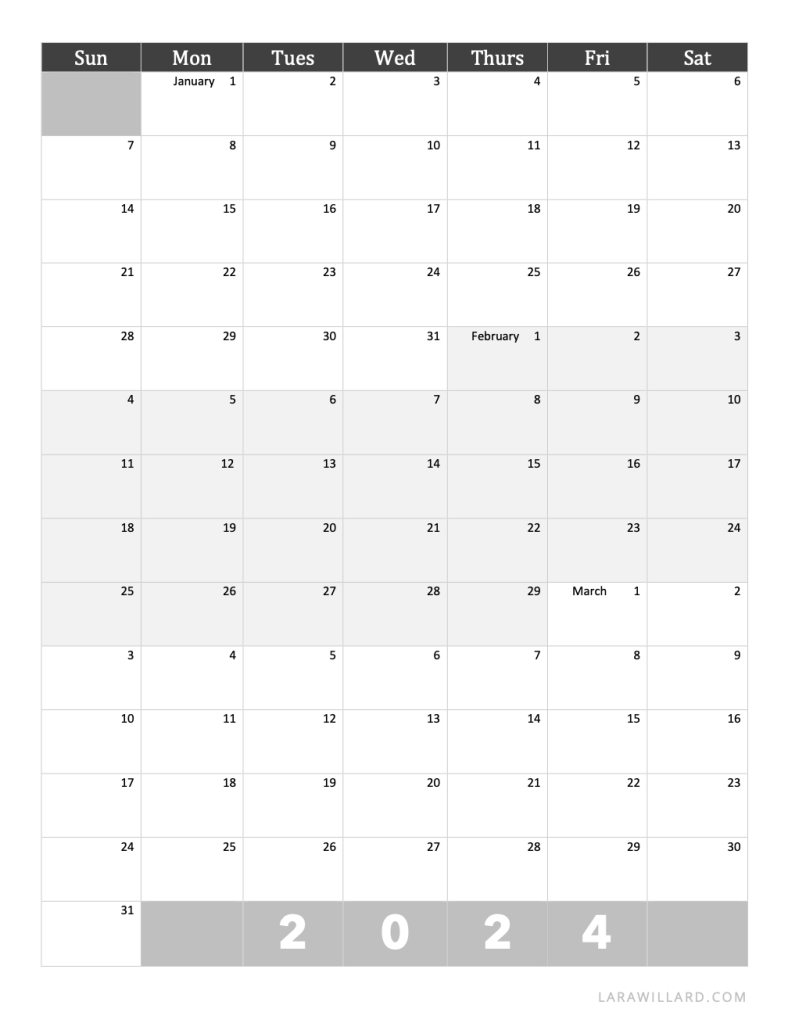
I’ve been using this quarterly calendar since 2015 as a family planner, color-coding events and appointments for each family member. We can see the whole year at a glance, and I use it daily! It also works really well for planning projects in advance. You could also use highlighters to create Gantt Charts on your calendar.
Now I use them as a teacher to help my students keep track of their deadlines!
These are super simple, and I’m letting you download them for free. The only conditions are that you may not upload this calendar to your own site, you may not redistribute it (you can send people here, though), and you can’t profit from the calendar in any way. If you want to profit from a quarterly calendar, you’ll have to make one yourself, from scratch. 💛
Subscribe to my blog (don’t worry, you won’t get many updates from me!), and then download the grayscale calendar here or click either of the image links below:
If you find these printables helpful, you can also support my work by sharing links to my site with friends, or by dropping a tip at Ko-Fi.com/larawillard.
Related posts
Love charts? Love planning? Need help with either? You might be interested in these posts:
Since I first stumbled on this idea, I’ve found it oddly comforting. If I have a story that is a mess, full of places I can’t live with, instead of thinking, you know, “And you call yourself a professional writer? Just look at the mess you’ve made!” I try to think, “Ah, you have skillfully revised yourself into a place where the key to getting the story to its higher ground lies in this little handful of messy places. Good for you! And look, there are only, like, six of them. And they are messy because—well, because they have the potential to be really beautiful, but they don’t know how yet, the poor things.”
The whole article is worth a read. (Note to sensitive readers: it references sex but doesn’t describe sexual acts.)
I wish I was back in that uncertain-writer stage rather than here, in the overwhelmed-slug stage.
I spent two wonderful and difficult years busting my tail writing in my MFA program, and now I’ve spent two years… not writing. I could blame it on the pandemic, on moving across country during a pandemic, on completely switching careers during a pandemic, on getting my teaching license and crafting curriculum—from scratch, no less—for eight completely different classes while teaching and nurturing 200 high school students and keeping small humans and dogs alive, half of the time as a solo parent.
It makes sense why I’m burnt out, and I need to remember that energy, especially for someone with a chronic illness, is finite.
Yet there’s still that little part of my brain, the part that is usually occupied with imposter syndrome when I’m writing, that has declared dead my passion for writing, adding, Maybe I never liked writing anyway, and why should I spend my limited energy doing something I don’t like?
And my heart says, But you do like writing. You smile when you think of your characters. Nothing can come close to that dopamine hit of discovering a perfect line of dialogue, of making a creative breakthrough in a story.
So many writers I know, especially querying writers, have had their hearts bruised or even broken and are ready to give up. Their heart is saying, “I want to keep going,” and they’re saying, “Hush now, you’re hurt. It’s time to rest.”
I’m going to be honest. Writing is generally not fun for me. It’s often excruciating. I feel like an idiot…most of the time. Why can’t I make this work? Why can’t I just write something, anything, without getting distracted?
It’s easy to just not do things that are hard, especially when you’re tired and are running on fumes and can barely bring yourself to watch a television show.
It’s OK to do the bare minimum. To be in survival mode.
It’s difficult to pull yourself out of survival mode.
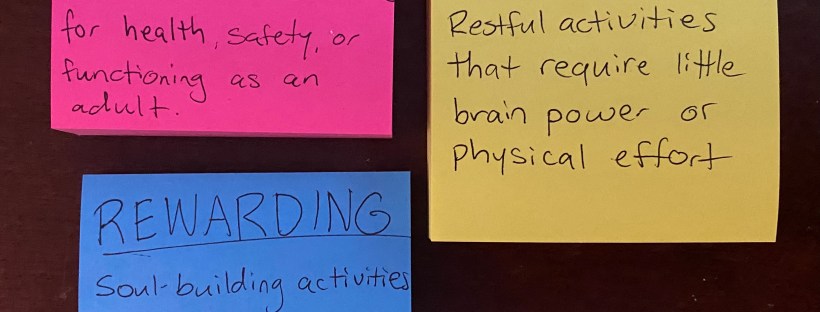
This summer, I’m trying to drag myself out. One thing I’m trying is looking at tasks in one of three categories:
Required (things to do to “function” as an “adult”)
Refreshing (restful activities that require very little energy)
Rewarding (hard things that make me feel like a human being rather than a robot doing)
Thanks to the hierarchy of needs, I’ve realized it’s pretty hard for me to do anything rewarding when I’m overwhelmed by those required tasks.
Thanks to ADHD, it’s pretty difficult for me to accomplish any of those required tasks without an immediate reward.
So I’m pairing as much of the refreshing things with the required things as possible. I need to do outdoor chores (required)? OK, I need to listen to an audiobook at the same time (refreshing). That TV show I’ve been wanting to watch for months? I will watch it. In fact, I need to watch it, because I need to sort through my kids’ old clothes.
I’m starting small, pairing one required with one refreshing task per day and choosing one rewarding thing per week. My hope is way more frequent than that, but I’m trying to go easy on myself.
I’ll read poetry and paint every day! No, I’ll read poetry and paint once a week.
What would the midpoint look like for that goal? How would you know that you’re halfway there?
What would half of that look like, the quarter point?
What are your daily or weekly goals? If being a “daily doer” hasn’t worked for you, take any daily goal you set for yourself and turn it into a weekly goal.
Now cut that daily or weekly goal in half.
Something is better than nothing. Many writers are perfectionists, who think that something has to be 100% (or an impossible 110%) or it may as well be 0%. Take yourself out of that all-or-nothing mindset. You may know that done is better than perfect, but 10% is infinitely better than 0%.
“One page a day can be a novel draft in a year” doesn’t sound like a lot of effort, but it is a marathon, and we’re not all marathon runners!
One sentence a week is a paragraph per month.
One book written in five years is still a #&%@!$* book.
I know I’ve said goals need to be SMART, and therefore quantitative, but whether you set your goals in minutes or words, when you are trying to determine whether a writing session was a success or not, try not to focus so much on the quantitativeness of your work but instead reflect on the experience.
We are not human accomplishers, we are human beings. Spend some time this week being a writer, just enjoying the process and what you can learn from it.
Smooth seas never made a skilled sailor. We can only write greatness by navigating through an ocean of not-great words and ideas. Every session is a learning experience.
Approach your next writing session like Saunders, saying, “What’ve we got here? Let’s see what we can do. It’s going to be all right.”
I’ve always been a collector. First it was rocks, then Hot Wheels cars, then words and names. I usually copy new-to-me words on the last blank page of the book I find them in, but that doesn’t work for borrowed books.
To increase my kids’ literacy over the summer, I created these vocabulary bookmarks that can be folded or left unfolded and printed on white, colored, or patterned paper. I was inspired by some bookmarks I found online, but I couldn’t find exactly what I wanted, so I made my own, and now I’m sharing them with you, free for personal or classroom use.
(You’ll need to print on colored paper to get this effect)
Each page fits two bookmarks. If you wanted to get creative with your copying, you can copy them front and back in landscape mode (or short-side bound). Then you’d get 4 per sheet.
For one-side copies, cut the pages in half to separate the bookmarks and then fold them along the dotted line, text out. You’ll get a bookmark that is regular sized, with page numbers and vocabulary words on the front and definitions on the back. Fold or unfold your bookmark to hide or reveal the definitions.
I grabbed a pink one for myself and have added a couple of words from Ada Limón’s The Carrying:




 Lara Willard