Query #10 March 2015

Below is the tenth public query critique I’m offering up on the blog. To enter, see the rules here. If you want a guaranteed critique (plus line edit) of your query or synopsis, private ones cost $35 each.

My comments are in blue below. To read the original query first, simply read only the black text.

Dear Agent:

Aristocrat Tanner Mills, in theory, knew not to trust anyone his parents haven’t you switch to present tense here, then switch back. extensively vetted. In theory, he should have been in school instead of the bar close to the docks How old is Tanner? Is he a schoolboy, a Yale man?You never give his age or the age category of this novel—please do…and then quickly finds himself I’m not a fanof “finds himself,” because it’s a passive cliche. If you want to use passive tense to show that he’s a victim, then you can cut the wordiness and say “is tied,” etc. tied, gagged, and bound if you want to use the bound and gagged trope, that’s fine. I love tropes! But “bound” and “tied” are redundant here. on an airship where the city of London is nothing more than a distance dot wrapped in cloud cover. I’ll be honest, the first time I skimmed this, I completely missed the “air” part and the “cloud cover” part. Since this is steampunk, and setting is muy importante in steampunk, I’d like that up front. Start with what makes your book unique, not with a trope.

I’d recommend starting with a personalization, then leading into your genre paragraph, then starting immediately with the hook (the shanghaiing of the aristocrat, not the disobedience of the aristocrat). It might look like this: Continue reading

Query #9 February 2015

querylara

Below is the ninth public query critique I’m offering up on the blog. This will happen once a month (as long as I get a response). I choose one query per month. If your query is not selected one month, it will be in the drawing for the next month. Please do not resubmit unless you’ve made significant edits. To enter, see the rules here. If you want a guaranteed critique (plus line edit) of your query or synopsis, private ones cost $35 each.

My comments are in blue below. To read the original query first, simply read only the black text.

Greetings…,
Her life is a lie but Fiona doesn’t know it, until a chance encounter and a brush with death blows the lid off her neatly packaged world. These are all cliches. “Blows the lid off” is a cliche, too, but you’ve made it fresh with “neatly packaged world.” Still, this hook doesn’t tell me what makes your book unique.
Fiona’s in the spotlight cliche again, and this time it’s a little more serious than a step from the closet. Is this a reference to her coming out of the closet? Because that’s not clear. A mysterious girl, created in a lab as an eternal sixteen-year-old, plops beside her on a park bench, and instantly ensnares her mind. Now, she’s smack in the middle of a deadly pursuit.
Cut the cliches and the set up of these two paragraphs and get to what’s important: “When a lab-created girl plops beside her on a park bench and ensnares her mind, __teen-year-old Fiona is about to get even more unwanted attention than when she came out of the closet.”
A black ops team is on the hunt; their project’s running loose, and if she becomes active, the entire world will suffer. I’m not sure what’s going on here. Is the girl who sat next to Fiona and ensnared her mind this “project”? What is that girl’s name? I want to know more about her, even if it’s just a sentence, so that I’m really concerned when I read that a black ops team is looking for her. And how will the world suffer? Give us a precise idea of what could happen. The squad of government-trained assassins will stop at nothing cliche, especially in queries. to keep their secrets from surfacing, but Fiona’s determined to safeguard this long desired sense of belonging, which stems from her new friend’s presenceThis is a bit awkward and needs to be its own sentence. Flip it to make it less awkward: But Fiona has long desired the sense of belonging which stems from her new friend’s presence, and she’s determined not to lose either.
On the run, confused, and desperate, Fiona turns to the strongest person she knows, her girlfriend/martial arts instructor, Isoko. With the help of the woman she loves, Fiona fights to uncover the truth behind Project Snowfall. However, the more she digs, the more her own existence begins to unravelI don’t know what this means. I know what the words mean, but I don’t know what it means in the context of the story. It’s too vague. What kind of things come into question? How can someone’s existence unravel? When I hear that, I picture the melting Nazis in Raiders of the Lost Ark.
Your title is stellar. If you want to share it in the comments, feel free, but I need to keep the workshops anonymous. [GREAT TITLE], a YA techno-thriller, is complete at 53,000 words. Told in an omniscient third, this LGBT themed novel is geared toward general suspense lovers, literary action seekers, and those with a flair for the romantic. This is pretty much akin to saying “everyone will like my book.” Again, be specific. Marketers can’t sell books to everyone—they need a direct audience to target. That’s why agents and readers like comp titles. Try “my book will appeal to fans of ___ and ____.” While [TITLE] works as a stand-alone, it has series potential; comma, not a semicolon. and would appeal to mature teen readers through adults.
Thank-You Just “Thank you,” no hyphen. for the time you took in considering my query.
This is a great start, and your concept alone should garner some requests, but I’d like to see fewer-to-no cliches and some more specifics. Feel free to revise and resubmit to continue the workshop.
Still from cafeteria scene in film NEVER BEEN KISSED, of protagonist Julia dressed in outrageous clothes, wondering with whom she should sit at lunch.

Literary? Mainstream? Commercial? What Genre Is This Anyway?

What’s the difference between commercial and literary and mainstream fiction? What do those words mean, anyway? What about “upmarket”? Where does my book fit in?

Sometimes it’s really obvious where your novel fits in with others.

Other times, you show up querying your book and have no idea where to put it. It’s awkwardly similar to high school (at least the movie version of high school). Everybody else seems so neatly sorted into groups.

A group of skater-pothead high schoolers from the film CLUELESS.

And then there’s you…

Still from cafeteria scene in film NEVER BEEN KISSED, of protagonist Julia dressed in outrageous clothes, wondering with whom she should sit at lunch.

But you want your book to find readers, which means your book needs to find something in common with other books (ones that have readers). Hey, you know which books have the most readers? Commercial fiction. Let’s start there.

Commercial Fiction

Commercial fiction is any fiction that has ONE of the following characteristics:

  • It sells a lot of copies, OR
  • It has a tight, fresh premise that’s easy to pitch (like a logline), OR
  • It has a very specific, established audience.

So genre fiction is considered commercial fiction, because genres can sell a lot of books to their target readers. Children’s books can often be considered commercial because all kids are encouraged to read, but children’s books are categorized by age first, genre second. Commercial writers are often prolific ones, churning out book after book after book for their very happy fan base, regardless of their genre.

BOTTOM LINE: Don’t call your own work “commercial fiction”—that’s a term defined by sales. Know the difference between age categories (adult, young adult, middle grade, etc.) and genres (what this post is about).

Genre Fiction

Genre fiction adheres to specific tropes. For example, if you’re writing a romance, your story must have a happily ever after. If it doesn’t, it’s not a romance.

Read heavily in your genre. What do you expect when reading that genre? That’s what readers will expect from your book if it’s put on that shelf.

Established genre families, often with their own shelves in stores or libraries:

  • Mystery
  • Romance
  • Suspense / Thriller
  • Speculative Fiction (includes fantasy, science fiction, horror)
  • Western
  • Adventure (sometimes grouped with thrillers)

Did you write speculative fiction? Read about my guide to Science Fiction and Fantasy Sub-Genres.

Cross-Genre

A cross-genre novel or story is one that borrows tropes from two or more genres. If your book is about an elf and an ogre falling in love and living happily ever after, you’re borrowing from the Romance and Fantasy families.

take-on-me

But do you call it Fantasy Romance or Romantic Fantasy? The first word in a genre pairing is the adjective qualifying the second, more prominent genre. In other words, a fantasy romance is primarily a romance with some fantasy elements. A romantic fantasy borrows more from the fantasy genre than the romance genre, but it still should have a happily ever after, or you can’t call it “romantic.”

Many stories have romantic elements. That doesn’t mean they are romances.

If your story has romantic elements, then say it’s “______ with romantic elements” if you must. But the romantic elements should be evident from your pitch.

A lot of colors have blue in them, but when we add a bit of it to yellow and mix it throughout, we call the result “green,” or maybe “yellow-green,” not “yellow with blue elements.”

BOTTOM LINE: If you think your book fits in one or more genres, look up the tropes for each genre. Read multiple authors of those genres to see where your book fits best. 

mean-girls

Your book doesn’t fit in with any of those genres? Don’t give up yet.

Mainstream or General Fiction

If your book wouldn’t sit on one of the five “shelves” listed above, it will likely be placed in a section called “General Fiction” or simply “Fiction.”

Historical fiction will likely be shelved here, along with contemporary fiction. Women’s fiction is general fiction promoted mainly to female readers. If your book is one of these genres, call it by one of those names. It’s better to be specific than vague, and it shows that you know your audience.

Mainstream fiction might appeal to a broader audience, but it can be more difficult to market. Marketers need to know where to direct their efforts.

Without a specified audience, your book will be a much harder sell.
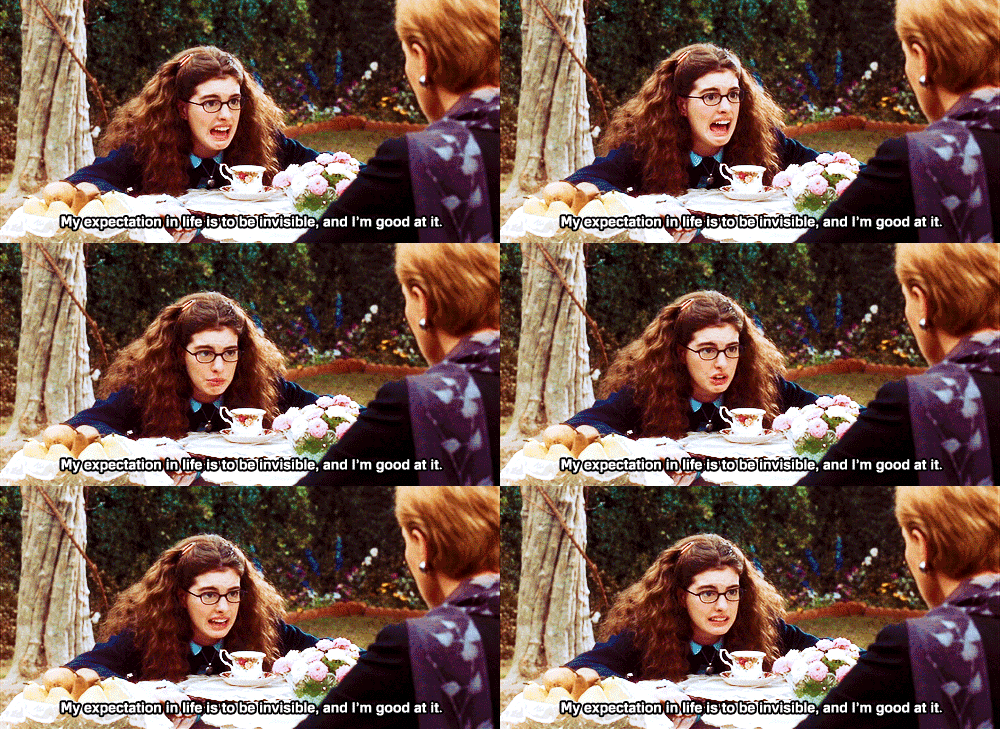
GIF from The Princess Diaries: "My expectation in life is to be invisible, and I'm good at it."

Literary Fiction

Literary fiction has its own audience—one who has high expectations for prose and subtext.

If literary fiction gets its own shelf, that shelf is often called “literature,” though many readers are rightly annoyed at the suggestion that genre fiction can’t be considered literature. We won’t get into what constitutes a work of fiction being considered “literature” here. As far as I’m considered, that’s the same as debating the definition or worth of “art.”

What we will talk about is what constitutes literary fiction.

Elements of literary fiction:

  • The language is vivid and fresh. Frequently in literary fiction, how an element is presented is more important than what is presented. The words are like visible brushstrokes in a painting.
  • It might be more concerned with subtext, theme, or atmosphere than action.
  • It’s more likely to subvert tropes than genre fiction, which upholds tropes (to the satisfaction of its expectant readers).
  • Literary fiction is more likely to allude or respond to other forms of art, especially classical poetry and literature.
  • The structure might be experimental, playing with timelines, points of view, or different forms (incorporating poetry or illustrations or other forms of media).
  • It might be more concerned with a character’s internal struggle than external conflict.
  • It might play with what defines a “novel” or “story” or “literature” (see Metafiction)
  • It might be delivered to a select few (like the first collection from Facsimile Press, which publishes fiction only via fax).
  • Some readers might not consider it accessible because it attempts the unexpected.

Read more: Literary and Commercial Fiction as Paintings

Like “commercial,” the term “literary” is subjective and is doubted by readers when self-applied. Some readers might not agree with your label.

GIF of a man throwing a book out the window in frustration

If you’ve studied or discussed literature at length, or if your writing has been recognized or published by a literary community, then you might be fine calling your work literary. Show that you understand what literary means in a query letter by including a statement in your bio paragraph, like “I majored in literature at Such-and-Such University” or “my fiction has won [recognizable literary accolades not based on commercial genre].”

BOTTOM LINE: Err on the side of calling your work contemporary or historical (whichever fits) until an authority in the literary sphere—an agent, reviewer, award-winning author, or publisher—assigns the “Literary” qualifier to your work. 

Upmarket Fiction or “Book Club Books”

Upmarket Fiction is mainstream fiction with both literary and commercial elements. These are often books read by book clubs, because not only are the books entertaining and accessible, but they also have finely crafted prose, universal themes, or head-scratching concepts that beg to be discussed with other readers.

You can call your work upmarket, but there’s no shelf for upmarket books. “Upmarket” is an adjective. Use it paired with another genre or category label, for example, “upmarket fantasy” or “upmarket contemporary novel.”

BOTTOM LINE: Upmarket fiction is approachable, but beneath its fresh, commercial premise lie layers of subtext.

pretty-in-pink

Conclusion

When pitching your book, you need to show how it’s both different from and similar to books on the market.

From The Breakfast Club: a popular boy makes a really weird sandwich, eliciting looks from his peers.

To be a success, your book needs to fit in with others while having unique qualities of its own.

In a query letter, the main content of the pitch should show how your story is unique. The informational paragraph with word count, genre, and age category should show where it fits in. This is where you can include comp titles: books or related media that might share a specific audience with your readership. “[MY TITLE IN ALL CAPS] would appeal to fans of [two or three recently published books, still-writing authors, or related media].”

What's the difference between literary, mainstream, commercial, and upmarket fiction?Click to save on Pinterest

January-March Pitching Opportunities 2015

pitch

There are so many pitching opportunities coming up in the next few weeks and months that I might be forgetting one. If you know of any more contests, please let me know in the comments! Note that I am only including contests and pitching opportunities that are open to unpublished writers and which either have no entry fee or give professional feedback

Contents:

  • AgentMatch
  • SunVsSnow
  • Adpit
  • PitMad
  • Ink & Insights
  • Carina Pitch

Writers Seeking Agent #AgentMatch

For: PB–A

Submission Date: Send before Feb 5th at 8pm EST.

Submission Package: hook (one-sentence tagline), query, optional photo (see blog for specifics)

Entries: 150

Winners: unclear, but I believe each entry will be sorted by age category to make it easier for agents to scroll through.

Twitter: Cheer each other on using the #AgentMatch hashtag.

Sun Versus Snow #SunvsSnow

For: MG, YA, NA, and Adult genres, excluding erotica

Submission Date: Jan 26, 4pm EST (submission closes after 200 entries!)

Submission Package: heat vs cold paragraph, query, first 250 words (see blog for specifics)

Entries: 200

Winners: 30—fifteen entries will be chosen by each side (snow and sun), which will receive critiques from mentors before their revised queries and pages are posted for the agent round (Feb 9-11)

Twitter: Root for your favorite entries using the #SunVsSnow hashtag.

AdPit

For: Adult and New Adult manuscripts only

Submission Date: Feb 8

Submission Package: Pitch, Query (see blog for upcoming info)

Entries: 150

Winners: 11—six will be critiqued by “slushies” and the top 5 will receive a full critique from a secret agent / editor. All 11 will appear on the blog.

Twitter: Pitch party on February 13th open to all A and NA complete manuscripts

Pitch Madness #PitMad

For: PB, MG, YA, NA, A

Submission Date: Feb 20

Submission Package: 35-word pitch, first 250 words (see blog for more info)

Entries: 500+

Winners: 60 entries go onto the agent round.

Twitter: Pitch party on March 11th open to all complete manuscripts

Ink & Insights (Contest)

For: MG, YA, NA, A

Submission Date: March 1

Submission Package: first 10,000 words, $35 entry fee

Entries: ~200

Winners: Every entry gets professional feedback from 4 judges (that’s what the entry fee is for). Top 3 entries are read by 7 agents.

Twitter: n/a

Picture and Chapter Book Party!

For: Picture Books and Chapter Books

Submission Date: March 16

Submission Package: query, plus first 50 words (PB) or 100 words (chapter book)

Entries: 15–20

Winners: Every entry gets professional feedback from 4 judges (that’s what the entry fee is for). Top 3 entries are read by 7 agents.

Twitter: #PBParty (Date TBA)

#CarinaPitch

See the press release for more information on how to pitch directly to Carina Press editors on March 19th.

Twitter: Pitch party on March 19th from 9am–9pm EST