“Best Dressed,” the Comic, Pitch, and Script

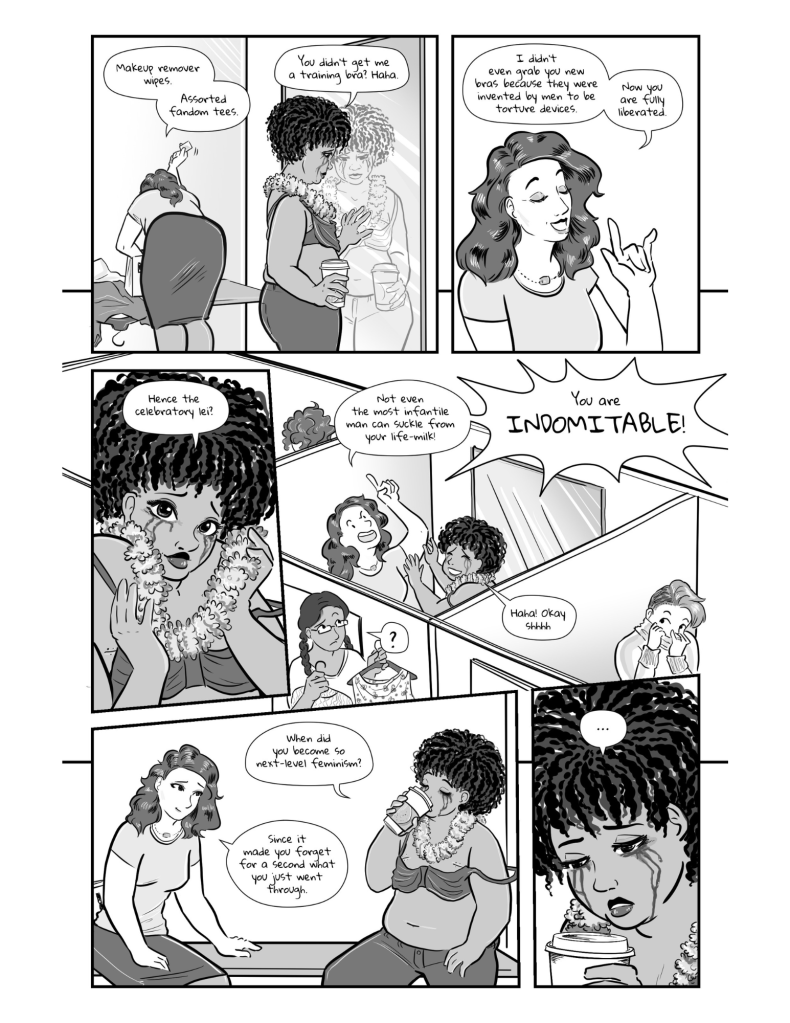
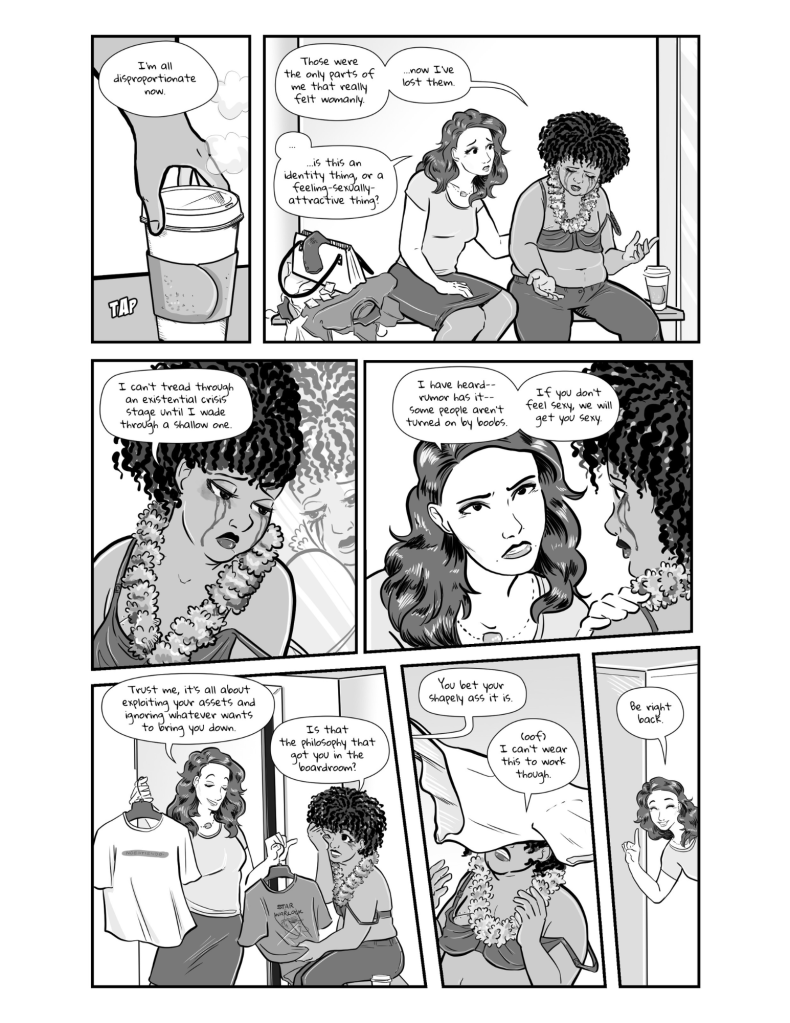
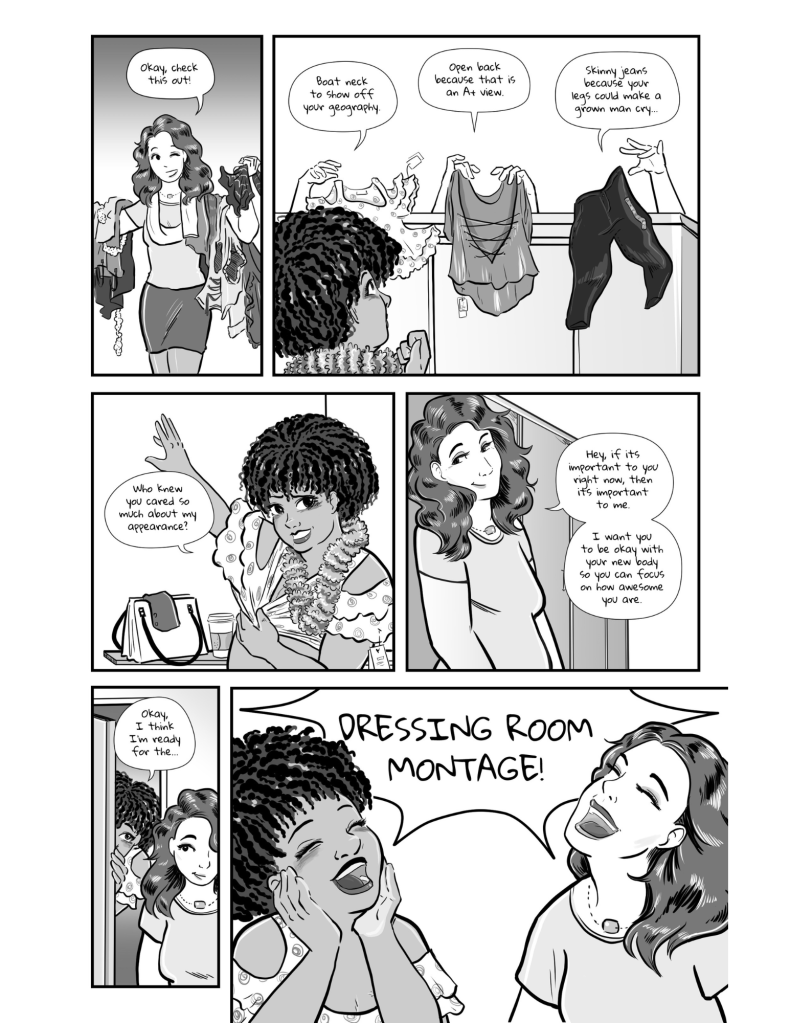
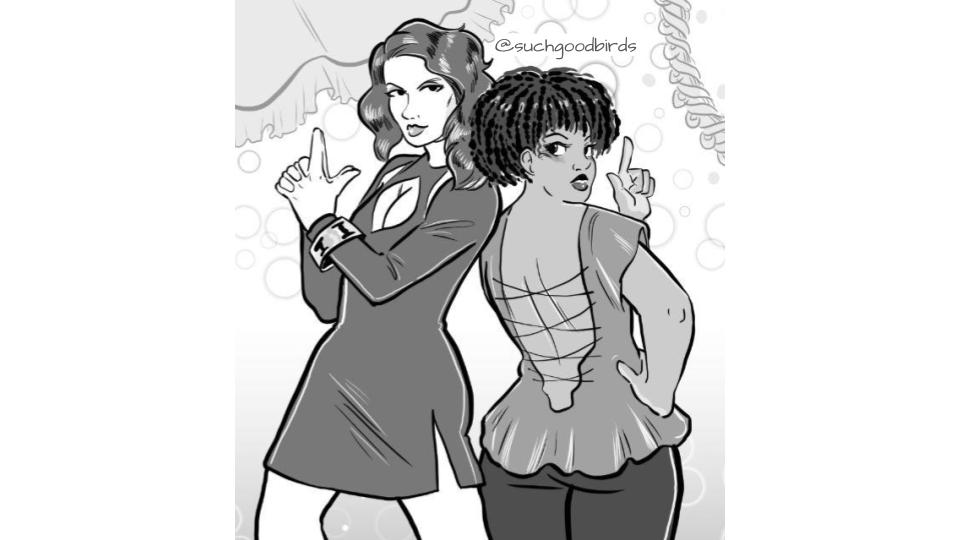
With the sad news of POMEmag closing its doors August 31st, I wanted to share the comic that I wrote and Julia Hutchinson illustrated. This comic, about a woman struggling with body issues after a double mastectomy and her best friend hyping her up, appears in the comics anthology Group Chat, a Prism Award nominee.

I’m sharing our finished comic pages, but I’ve also included our pitch along with the full script! Text copyright Lara Willard, 2019, and illustrations copyright Julia Hutchinson, 2019.

Use discount code POME50 so you can save 50% off anything in the POME shop, including Group Chat!

Read a review of Group Chat here.

Buy Julia’s awesome stickers at suchgoodbirds.com and follow her on Instagram at @suchgoodbirds!

“Best Dressed,” the Comic

If you find the text hard to read, skip down to the script, below.

The Pitch

BEST DRESSED SUMMARY  

Best Dressed is a 6-page comic which finds an executive bailing on work in order to support her best friend, who’s holed-up in a department store dressing room after a double mastectomy leaves her feeling depressed and unattractive. Through gifts, pep talks, and even a dressing room montage, the two friends leave the store uplifted, together.

  • ROCIO drops an important call and leaves her corner office when her BFF BRENNA texts her in a panic from the hell-on-earth that is a department store dressing room stall.
  • Rocio arrives on the scene with coffee, geeky tees, and a gag gift to cheer Brenna up. After having both her breasts removed, Brenna is despondent, unable to reconcile herself to her new body.
  • Rocio gives her a heartfelt pep talk and comes back with more clothes she knows will either make Brenna look stunning or make her laugh.
  • They both model some sexy and silly outfits before leaving with a bagful of new clothes for Brenna, arm in arm in pursuit of wine and froyo.

Lara Willard is a writer and designer by day and comics editor by night, scribbling in margins and gutters of indie comics like Lora Innes’ The Dreamer. Lara lives in the Twin Cities with her husband, sons, and dog-show dropout Havanese.

Julia Hutchinson is an illustrator and comics artist currently based in New Jersey. Her work has appeared in comic anthologies such as Lilies, Fresh Romance Vol. 2, and Chrono Party. She loves retro video games and all kinds of birds.

The Script

Note, changes—for the best!—were made from the script to final pages. That’s the beauty of collaboration with an illustrator and editor!

PAGE ONE (six panels)

Panel 1. ROCIO, a late 20s-early 30s woman in a business blazer and skirt, is on the phone at her corner office desk when her mobile phone starts buzzing. She has a tiny pink ribbon pinned to her lapel. Rocio is a tall Latina, closer to 6 feet than 5.

Panel 2. CLOSE ON Rocio’s mobile. She’s already responded to BRENNA’s text message. Rocio is still on the phone at work.

BRENNA (Text Message):
Dressing room paralysis. Can’t move.

ROCIO (Text Message):
Coming. Send me your position.

ROCIO (OP):
MmmHmmm. Yes.

Panel 3. The dropped pin on the map.

ROCIO (OP):
Absolutely, Mr. Peterson. I will.

Panel 4. Rocio leans in toward her desk, ready to hang up but ear still on the receiver.

ROCIO:
You’ll have to excuse me. I have a family emergency to attend to. … Thank you.

Panel 5. Rocio rushing out of her office, phone and purse in hand.

Panel 6. Rocio, without her blazer, carrying her phone, purse, and now a coffee, has just entered a Target-like department store.

PAGE TWO (five panels)

Panel 1. Rocio speeding through the party section, grabbing a lei.

Panel 2. Two t-shirts are deftly pulled from the middle of the rack by Rocio. She knows exactly what size she needs. These t-shirts can be of any fandoms, and we will see more of them in a later panel. Visual puns would be great so we don’t get in trouble for using logos. The word “Rebel” over a picture of a bass guitar, for example, for Star Wars. “No entiendo” in the “Nintendo” logo style.

Panel 3. Hallway of the dressing room. BRENNA peeks her head out one stall, mascara running, lip trembling. She’s late 20s, early 30s like Rocio. Dark hair.

BRENNA (OP):
Rocio?

Panel 4. Rocio wafts her hands at Brenna to get back into the stall. BRENNA is a plus-size bombshell. In this and forthcoming panels, we will see that she’s in an old bra, but it’s really loose. She’s just had a double mastectomy.

ROCIO:
Ugh, Brenna. You disgust me. Even your ugly cry is gorgeous. Get back in there before someone falls madly in love with you.

Panel 5. Brenna and Rocio are both crammed into the stall. Brenna is wearing the lei, wiping a tear.. Rocio hands her the coffee.

ROCIO:
Snagged it off the coffee cart on my way out. Don’t even insult me by asking—it’s just the way you like it. Should be the perfect temp, too.

BRENNA (small, whispered):
Thanks.

PAGE THREE (six panels)

Panel 1. Rocio unloads her haul onto the bench next to Brenna.

ROCIO:
Makeup remover wipes. Assorted fandom tees.

BRENNA:
You didn’t get me a training bra? Haha

Panel 2. Brenna buries head in hands, about to sob.

ROCIO:
I didn’t even grab you new bras BECAUSE they were invented by men to be torture devices. 

ROCIO (continued):
Now you are fully liberated. 

Panel 3. Brenna looks up at Rocio, eyebrow raised.

BRENNA (small):
Hence the celebratory lei?

Panel 4. Rocio’s pointed finger sticks up over the stall door, and her voice carries up and over.

ROCIO:
Not even the most infantile man can suckle from your life-milk! You are INDOMITABLE!

Panel 5. Brenna is laughing and trying to hush Rocio down. 

BRENNA:
Okay shhh

Panel 6. Rocio pulls down her shirt, which rode up due to her enthusiasm. Brenna takes another sip.

BRENNA:
When did you become so next-level feminism?

ROCIO:
Since it made you forget for a second what you just went through. 

PAGE FOUR (seven panels)

Panel 1. Brenna sets down the coffee, avoids looking at Rocio.

BRENNA:
I’m all disproportionate now. Those were the only parts of me that really felt … womanly. Now I’ve lost them.

Panel 2. Rocio leans back against the stall wall. She’s ready for Real Talk. 

ROCIO:
Is this an identity thing, or a feeling sexually attractive thing?

Panel 3. Close on Brenna as she opens herself up further. Maybe she looks guilty, maybe she still averts her eyes. 

BRENNA:
I have to wade through the shallow stage before I can tread through the existential crisis stage.

Panel 4. Rocio leans in close, hand on Brenna’s shoulder, and looks her in the eyes. Serious.

ROCIO:
I have heard–rumor has it–some people aren’t turned on by boobs. If you don’t feel sexy, we will GET YOU SEXY.

Panel 5. Rocio holds out both of the t-shirts, considering, weighing them. Brenna feels the hem of one of them between her fingers.

ROCIO:
Trust me, it’s all about exploiting your assets and ignoring whatever wants to bring you down.

BRENNA:
Is that philosophy what got you in the boardroom?

Panel 6. Rocio tosses a t-shirt on Brenna’s head. Brenna speaks from under it.

ROCIO:
You bet your shapely ass it is.

SFX (small):
toss

BRENNA:
I can’t wear this to work though.

Panel 7. Rocio exits the stall.

ROCIO:
Be right back.

PAGE FIVE (five panels)

Panel 1. Full width. Rocio tosses each article of clothing over into Brenna’s stall.

ROCIO:
Boat neck to show off your geography.
Open back because that is an A+ view.
Skinny jeans because your legs could make a grown man cry…

Panel 2. Brenna is pulling one of the new shirts on.

BRENNA:
Who knew my physical appearance was so important to you?

Panel 3. Rocio sits out in the hall, waiting, with her purse on her lap, looking down at her phone.

ROCIO:
If it’s important to you right now, it is. I want you to be OK with your new body so you can focus on how awesome you are. 

Panel 4. Brenna starts opening the stall door…

BRENNA:
Okay, I think I’m ready for the…

Panel 5. Both women, in unison, heads back and hollering with jubilance.

ROCIO & BRENNA (unison):
DRESSING ROOM MONTAGE!

PAGE SIX (panels TBD)

Panels 1-X. The dressing room montage. They are having fun now. One panel with them both doubled over laughing.

Panel X. Both women sit on the floor, tired, clothes scattered about. Brenna arches an eyebrow.

BRENNA:
Froyo and wine?

ROCIO:
Fro-you know it.

Panel X+1. Final panel. The women leaving the store, silhouetted by sunset. Rocio has one arm around Brenna, the other with the purse is out—she’s talking animatedly. Brenna is carrying a large bag full of clothes.

CAP:
End.
How to Fold (and Plan) a Zine

One concentration during my MFA in writing for children and young adults was comics! I’ve been teaching comics now for five years, and my favorite thing to teach is how to make a zine.

“Zine” comes from “magazine” and is pronounced the same way—zeen. It’s a mini booklet that is independently made, produced, and distributed.

Zines can be on any topic. To get my students started, I like to have them make a zine out of a poem or a recipe. Think SMALL, because zines are little books.

An 8-page zine from a single sheet of copy paper is just one way to make a zine, but it’s always my students’ favorite. I thought I’d share the resource I created for them, with you!

Here’s how to fold a zine. Click on the image for the PDF.

Click on the image above to download and print my handout on how to fold AND how to plan an 8-page zine (or a 6-page zine with a front and back cover).

In the future, I’ll share some of my zines that you can read here or print to create your own library, so be sure to subscribe for more goodies!

I would love to see your zines. Share them on social media and tag me @larathelark or link to them in the comments!

Why You Should Write & Submit Short Works

Pssssst: It’s my birthday today! Usually I wouldn’t advertise that, but it’s my 30th, so yeah, I’m going to unapologetically ask you to check out the Kickstarter project I’m involved in.

Contents:

The Importance of Writing Short Pieces

Back in 2017, novelist and screenwriter Tim Federle, asked, “Writers who’ve been at it a while, what’s one piece of craft advice you wish your younger self had known?”

This was my answer, based on my experience and the decades’ experience of my editing clients:

Write (and finish!) more short works before attempting that three-volume novel or ten-year comic. Advice teaches you how others write, but each new story you write teaches you how to solve problems with your unique brain.

If your current WIP (work in progress) is long-form fiction or essays or a book-length project, you could go months before finishing something. Writing something shorter can grant that feeling of accomplishment so many of our brains depend on to keep motivation up.

In “The Psychology of Checklists: Why Setting Small Goals Motivates Us to Accomplish Bigger Things,” Trello blogger Lauren Marchese says:

When we experience even small amounts of success, our brains release dopamine, which is connected to feelings of pleasure, learning and motivation. When we feel the effects of dopamine, we’re eager to repeat the actions that resulted in success in the first place. Neuroscientists refer to this as “self-directed learning.” This is why achieving small goals is such an effective way to stay motivated during long-term projects and processes.

[links original to post]

Write a draft you can finish in a day or week: flash fiction, a short script for a comic or skit, a poem, an outline of a picture book. A fifteen-blinker—300-800 maximum words for prose, fewer than 30 lines for poetry.

If you’re between projects or stuck on one, if you’re feeling uninspired or pressed for time, write something short. Something completely different from what you are currently writing on. Let the madman loose and write without rules. Don’t edit, don’t revise, just finish the thing.

And OK, once you’ve finished the thing, and if you’re not on deadline for something else, revise that work and submit to contests, anthologies, or magazines. Shorter works are quicker to revise, so you can submit more frequently, which gives you a better chance of getting published (that is, if you keep improving as a writer and aren’t a jerk to the publishing community…).

Sure, you might get a bunch of “No”s, but rejections hurt less for works you didn’t invest as many months into.

And any “yes” is an upvote for your skill as a writer and an addition to your writer bio.

So how do you submit, anyway?

Submitting to Literary Magazines and Journals

Before you ever sign a contract, I recommend having a lawyer look over the terms. If you can’t afford a lawyer, research the terms and any person or entity involved in the contract before signing your name.

Submitting to a literary journal or nonprofit press is not the same as submitting to a commercial publisher. They want different things. A commercial publisher wants a query letter that will help them gauge whether you or your work will sell to a commercial audience. (That isn’t to say they don’t want good writing or that they won’t accept quiet works from unknown writers!) Still, query letters have to market your writing.

A cover letter for a journal or nonprofit press should include how your work will fit in with their oeuvre of published work. Literary journal and nonprofit press editors often skim or skip the cover letter—they care more about the story and voice than the pitch or concept. However, no matter how excellent your work is, it still has to fit within their brand. Your Hugo-worthy political fantasy will get rejected by Stymie, a literary magazine focused on sports.

Find literary magazines and journals to submit through Poets & Writers search or Writers Market. The latter requires a subscription. One year is the best deal, but you can pay $6 for one month and then cancel. You can order the physical book online for half price or pick up a copy of the book at a bookstore. Your local library may have a free copy of Writer’s Market to borrow, but it might be out of date.

Always check online to see if the submission information is accurate and to see if the magazine or journal has specific requirements for their cover letter.

Submitting Comics to Anthologies

Before you ever sign a contract, I recommend having a lawyer look over the terms. If you can’t afford a lawyer, research the terms and any person or entity involved in the contract before signing your name.

If you are part of a comics community, you might catch word of anthologies and open submissions through your network. Otherwise check out Find Anthologies! on Twitter.

Each anthology will have their own submission requirements. Most likely, if you aren’t illustrating your own work, you will need to have an illustrator up front. Together you will create a proposal with a cover letter, pitch, and sample pages or character designs.

Group Chat, a Comics Anthology about Friendship, Is Now Live on Kickstarter!

This whole blog post comes from personal experience. I frequently need to feel like I’ve finished something tangible, or else I get discouraged.

While working on long pieces, I often need to distract myself, especially when I’m feeling stuck or uninspired, by writing something short. I’ll write poetry, picture books, and short comics.

Well, one of those short comics is being published in an anthology!

Read the description below. Emphasis mine, because that’s the comic I wrote!

Group Chat features 24 up-and-coming creators, all telling stories about the people who have your back no matter what.
Group Chat spans genres from sci-fi to slice-of-life; from westerns to witchy shenanigans to coming-of-age stories. These comics —feeling good about your body after a mastectomy, two friends supporting each other through the creation of a trans fashion line, learning to appreciate your best friend’s chucklehead boyfriend, and others—were carefully chosen for their humor, heart, and beauty from a wide range of up-and-coming creators.

See the project on Kickstarter. If you watch the project video, “Best Dressed” is featured at 1:45. You can catch an additional sneak peak on Twitter or in my @larathelark Instagram Stories (Stories only available on mobile).

“Best Dressed” is a feel-good comic about dressing-room anxiety.

Want to read the original comic script?

Pledge at least $10 to the Kickstarter (the price for a digital copy of the whole anthology, 200+ pages) and email the pledge confirmation to querylara (at) gmail (.)com.

Julia Hutchinson is an illustrator and comics artist whom I follow on Twitter. She was looking to collaborate on a couple anthology submissions, and I sent her my idea for a comic for Group Chat. When I needed inspiration while writing the comic, I looked to the Leslie Knope / Ann Perkins friendship from Parks and Recreation and Julia’s previous artwork to solidify the characters. I wrote the skeleton, but Julia’s art brought my script to life with muscles and skin and spirit. She’s awesome, and I’m really proud of the comic we made together!

How to Format and Submit Graphic Novels

Are you an agent or publisher accepting graphic novel submissions? Get the best work in your slush by giving clear submission guidelines like these

Pop Quiz

Question 1: What do you need to get your graphic novel published? (Choose all that apply)

  • A writer
  • An artist
  • A colorist
  • A penciller
  • An inker
  • A letterer
  • Thousands of fans
  • A pitch or proposal
  • An artist portfolio
  • A dummy (sketched mock-up of finished work)
  • A complete manuscript
  • A complete script in comics format
  • A completely finished, inked/colored work

Question 2: Once you’ve got everything ready, how do you get your graphic novel published?

A: Self-publish online or digitally.

B: Crowdfund and then publish using a print-on-demand company.

C: Send a query letter to an agent, who will represent you in finding a publisher.

D: Send a proposal to a comics publisher.

E: Send a proposal to a literary publisher.

Answers: Any of the above have worked in the past. It all depends. But don’t worry, I’ll do my best to demystify the best solution for your goals.

formatgnbanner

Contents

How are graphic novels published?

Graphic novels, I tell you. They’re published by comics publishers and literary publishers. They’re self-published, they’re crowdfunded, they’re submitted through agents, they’re submitted without agents. Though the medium of graphic novels has been in the literary world for decades now, writers, agents, and acquisitions editors still have no universally standard format or submission policy.

As a freelance editor for comics and graphic novels, I wanted to be able to provide these clients with a resource like the Formatting a Novel Manuscript post I made for my fiction clients. Through my research and correspondence with agents, editors, and comic creators, I’ve found a variety of submission possibilities to share with you.

Illustrated and hybrid novels

Illustrated novels are prose novels with occasional (or multiple) illustrations, like Miss Peregrine’s Home for Peculiar Children and dozens of chapter books. Their pages will look more like prose manuscripts. It’s more precise to call these “illustrated novels” in your query letter. Link to images you’re providing, or include brief illustration notes in brackets.

[Illustration: Like this]

Hybrid or multimedia novels include sections of concrete poetry, imagery or ephemera which are not supplemental, but integral. The visual aspects are meant to be read or analyzed along with the text, like IlluminaeHouse of Leaves, Extremely Loud and Incredibly Closeor Ship of Theseus. A hybrid novel might be part comic panels, part sketches, part handwritten notes, part typed prose, part photographs. If you are creating the graphic aspects of your novel, then also consider yourself the “illustrator” below.

What’s your destination?

To figure out which route you should take to get a graphic novel published, you need to understand your goal.

  • Do you want to work for a well-known comics publisher (like Marvel, DC, Image, or Dark Horse)?
  • Do you want to assemble your own team of artists, writers, colorists, and letterers?
  • Do you want to write and illustrate a graphic novel to be published with traditional literary publishers?
  • Do you just want to make the art for graphic novels?
  • Do you just want to write graphic novels?

Recommended routes for each:

If you want to work for a well-known comics publisher, you can try to get an internship, but the best way to become part of the comics world is to create an amazing portfolio of either illustration or writing samples, network with creators, and self-publish a short comic or zine by yourself or with a team of creators (see next paragraph). You can pitch your work at comic cons, recruiters can find your comics online and hire you that way, or you can join a comics community like Comics Experience, which includes a workshop and has options for publishing with IDW. Skip to the Comic Format section below to see how to format your comic scripts.

If you want to assemble your own team of creators, your first step is likely to be self-publishing. If you don’t care about being paid and just need the experience or exposure or portfolio, create a webcomic. Tapastic and Tumblr are both popular venues for webcomics, but if you have a big enough fan base, you can publish on your own website, like The Dreamer or XKCD. Some successful webcomics get book deals. Nimona, my favorite graphic novel of 2015, started as a webcomic and was published by Harper (a literary publisher—Stevenson has a literary agent). The Dreamer turned into three graphic novel volumes of comics, published by IDW (a comics publisher—Innes entered the agreement with IDW as an independent creator). Hark, a Vagrant! has gotten Kate Beaton an agent and several book deals. You might also find good success crowdfunding your graphic novel on Kickstarter. Of course, you could also become your own publisher and use a print-on-demand service to sell at cons or turn them into eBooks or PDFs to sell online.

If you want to write and illustrate a graphic novel to be published traditionally, you can do what Innes or Stevenson or Beaton did above and get your work out there first, or you can create a graphic novel proposal to send to agents. If you don’t have a complete, finished graphic novel to pitch, you’ll need a link to your portfolio (see resources in next paragraph) and a complete script.

If you want to do pencils or inks or colors, you’ll need to create an outstanding portfolio. Then you’ll do portfolio reviews to meet editors and art directors, or you’ll get an agent, who will share your work with acquisitions editors and art directors. I have heard nothing but good things about Chris Oatley’s online Painting Drama class. Oatley did character design for Disney, and his students learn how to instill deep emotional impact into their drawings and paintings–exactly what art directors are looking for. If you’d like to illustrate graphic novels and picture books for children in particular, I highly recommend KidLit411 as a resource.

If you just want to write graphic novels, you’ll need to read a lot and write a lot in your genre. Then you’ll need to write an entire script and a) query an agent to represent your script, or b) send your script to a comics publisher open to script submissions.

Graphic Novel Script and Manuscript Formats

Comic Script Formats

You may have heard of the Marvel Method, and you might have seen Alan Moore’s micromanaging scripts, but unless you are Stan Lee or Alan Moore, I recommend using Dark Horse’s suggested format. See and download a host of comic script examples at the Comic Book Script Archive and at Comics Experience’s Script Archive.

If you are really serious about writing comics, I cannot recommend Superscript enough. (This is not a paid nor requested endorsement.) Superscript is built for comics writers and has comics-specific short codes and automatic smart formatting. You can also export to PDF or Word in a number of formatting styles. It has saved me SO MANY HOURS of formatting time. See pricing and get a one week free trial.

Formats for writer/illustrators

As both writer and illustrator, you can write your script however you’d like, as long as you have a complete graphic novel to show for it or it’s legible enough for an agent to read. See how Innes and Oatley, both writer/illustrators, wrote and formatted their own scripts here. Innes uses a modified comic script, and Oatley writes his more like a screenplay. At the link, you can download their script pages and see how the script changed from draft to pencils to final colored pages.

Formats for writers seeking literary agents (and literary publishers)

If you’re looking for a literary agent and are not illustrating, read what agents are looking for below. Whether you write a more classic comics-like script or write more of a screenplay style, include golden details to guide and ground the illustrator. If you are writing real-life or historical settings or characters, add links to photos or videos for references. Tell the story through action and dialogue and, if necessary, captions. Shannon Hale, a NYT best-selling novelist, shares her style for graphic novels here (Update: this link has sadly now been removed. Check out Chris Oatley’s scripts in the previous section and read Brent’s preferences below).

What agents are looking for

If you’re wondering what comics publishers are looking for, see this Definitive List of submission guidelines.

Bree Ogden wants a query letter with a link to the script and/or artwork. She wants scripts in the comic style.

1. I look for proper formatting. Little mistakes here and there are fine. But screenplay formatting and/or prose are unacceptable. It shows me so many things, namely that you’re not familiar with the genre you want to write in.

2. Outside of formatting, I look for things like: are the captions too long? Does the dialogue in the panel give enough information without being verbose? I usually storyboard the first few pages (if it’s just a script without sample panels) and see how it pans out as an actual graphic novel. You’d be surprised how easy it is to make a mess of captions!

3. I look to see that the writer has a grasp on description and an eye for detail. This makes working with an artist so much easier.

[…]

It should look like this:

Dear Agent,

Blah blah *query letter* blah blah.

I’d love for you to take a look at the first five pages of my graphic novel script and some sample art. You can view both on my website http://www.___________.com. The password to view the script is __________.

[Closing remarks]

(Read the full article on LitReactor)


Brent Taylor wants a query with scripts written in a less formal style:

I typically prefer a query along with sample script pages pasted into the body of the message, with a link to art or samples attached as a PDF. The one thing that I will say that is more craft related is that I really like GN scripts to be written in a more “Hollywood” way. When GN writers get too caught up in art direction and minute details [like Moore’s style!] it detracts from the character and story, and I find it’s much easier to sell a GN when the script is written in a really readable manner for those who aren’t as familiar with formal comic formats.

(Source: Personal communication)

What? Bree and Brent want completely opposite things in their scripts? Bree describes a comic-like graphic novel with panel breakdowns. She probably has connections with comics publishers. Brent is looking for more prose-like graphic novel scripts, which means he’s probably not going to submit your script to comics publishers; he’s going to submit it to book publishers.

Generally agents want different things depending on whether you’re also illustrating the graphic novel.

If you are writing only, send a query letter once your script is complete and polished. Check submission guidelines to see if you can paste the first five pages below your query letter or include a link to your first five pages in your bio paragraph.

If you are illustrating and your script is complete, send a query letter with a link to your portfolio and sample pages (unless the agency requests proposals in their submission guidelines).

If you are illustrating and your script is not complete, send a cover letter and proposal (unless the agency requests something else in their submission guidelines).

Some more agent responses:

Please research agents and publishers before you submit or sign any contract. Inclusion in this post is not endorsement. I also do not update this post if/when agent wishlists change.

Editor responses:

  • Rachel Stark is accepting MG graphic novel submissions at Sky Pony Press. Email cover letter and attach complete script. If illustrating, attach first three chapters as a PDF. If your work is complete, you can include a link to your finished work.
  • McKelle George is looking for hybrid novels like Illuminae or A Monster Calls for Jolly Fish Press. She’d prefer a proposal or a link to complete work.
  • See editorial preferences for comics publishers here

Difference between a query and a proposal

Query letters are like cover letters.

A query letter is a one-page pitch addressed to an individual agent which gives the details of the story’s characters, goals, and obstacles. Don’t tell the ending, but make the reader need to know what comes next. Include a short paragraph with details about the graphic novel: title, genre, and word count (page count only if you have an idea of how your graphic novel will be laid out, and it’s within standards). Give a 1- to 2-sentence bio, and then sign the letter/email. You can send query letters to any number of agents, but address them to each personally, and before you submit, be sure to check each agency’s submission guidelines and whether they even accept graphic novels.

See an example of a successful query for a graphic novel.

If you are writing but not illustrating, only send query letters when your script is complete.

If an agent asks for samples of pages or artwork, never include attachments unless expressly asked to do so. Instead, paste text at the bottom of the email or include a link to your portfolio or pages in your bio paragraph.

Proposals are like interviews.

A proposal is a multi-page pitch which proves that you are capable of entering into a contract to complete a graphic novel. In other words, you may not have a complete graphic novel finished, but you do have a complete grasp of what you need to finish it. Check with the agency or publisher’s guidelines to see what they require. Some things you might be required to include:

  • A cover letter (generally required)—one page, addressed to appropriate person by name—who are you, what do you write or make, and why are you a good fit for this agency’s or publisher’s line-up?
  • A CV—usually optional unless you have prior publications to include
  • Synopsis (usually required)—full synopsis of what happens in the story, from beginning to end
  • Sample chapters (generally required for writers or teams)—usually 3 chapters or 10,000 words
  • Sample artwork (generally required for artists or teams)—the best pieces in your portfolio. Try to pick images which tell a story and set a scene; posed pin-ups or portraits are not the best choice for a storytelling proposal

Formatting, Submitting, and Publishing Graphic Novels | LaraWillard.com

Did you find this information useful?

  • Please share on social media! ❤
  • Consider subscribing to StoryCadet.com, my online portal for writing workshops. I offer courses in drafting, revision, and pitching/querying. By subscribing, you’ll be notified when courses will be offered.
  • If you’d like to book me for editing services, I have a page just for visual narratives (graphic novels, comics, picture books) on my editing site.