Here for a school assignment? Click here for citations you can use. Best of luck!
Diction = word choice
Synonym = a word’s twin in meaning, e.g. “big” and “large” are synonyms.
Ever wonder why English has so many synonyms? Because it’s the lovechild of Germanic and French languages. (French isn’t called a romance language for no reason.) While having so many choices can be a wonderful thing, it can also be disastrous. With great vocabulary comes great responsibility. I’m talking to you, Christopher Paolini. Step away from the thesaurus.
You’ll notice the language split when two political candidates start campaigning and one plays the “smarter than thou” card and the other plays the “average Joe” card. Smarter-than-thou is going to try to dazzle you with an academic, million-dollar vocabulary. Average Joe is going to give you a pat on the back with neighbor-speak. Go back in time and see the difference between John Kerry and George W. Bush—two polar opposites in terms of diction.
See my post on dialogue at The Better Novel Project for an example of diction in The Hunger Games. Can you guess which quote belongs to which character?
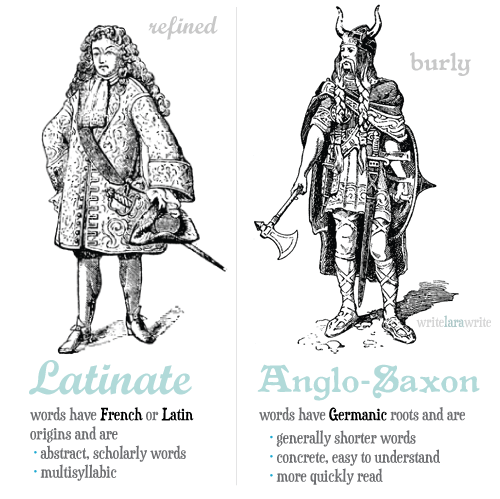
Latinate words are sometimes also known as “purple language,” “flowery” or “five-dollar” words. These are the ones that hike up your reading level and slow down your audience. While they are pretty standard in academic works, nonfiction and romance, multisyllabic Latinate words are best used in moderation. If a reader doesn’t understand your words, your words are meaningless (to them). Jargon tends to be Latinate.
But Latinate words are also ones to spend time with. They are contemplative. They can be romantic.
Generally speaking, Anglo-Saxon words come from Germanic roots (i.e. Old English, German, and Old Norse) and are common words. They are shorter and simpler than Latinate words. Action, Adventure, and Thriller genres will use more of these because they read faster, quickening the pace and heightening the suspense. This, writers, is the kind of vocabulary you want to have your word babies with during those intense scenes.
Latinate words slow down the pace, so save them for when the action is over and the characters and readers have a moment to think.
There’s nothing wrong with Latinate words. Literary works tend to favor them, and commercial works can sometimes use more of them. Middle grade writers often use Latinate diction to introduce new words to vocabulary-voracious children.
Balance is best!
Writing picture books, humor, or commercial fiction? Use more Anglo-Saxon words than Latinate.
Has someone told you that your voice sounds “too MG” or “too YA” when you’re writing for an older audience? Try adding in more Latinate words, but keep the majority to two or three syllables, sprinkling four-syllable and longer words in less frequently.
Want a list of examples of Anglo-Saxon words and Latinate words? Wikipedia saves the day.
Watch and listen to Latinate diction from Ferris Bueller’s Day Off and a mix of Latinate and Anglo-Saxon diction from The Dead Poets Society.
More resources that I found after Googling the subject:
Additional resource:
5-Minute Writing Exercise
Write down a list of 5–10 adjectives describing yourself or your protagonist. Look them up in the dictionary and see if they are based on Latin/French roots or Germanic (or Old English) roots. Then come up with a syllable for each word that comes from the other family.
For example, “masculine” is Latinate. “Burly” is Old English.
Have fun! Share here if you’d like.
Related Exercise: Analyzing diction in your favorite speech, short story, or poem
Citations
MLA:
Willard, Lara. “Diction: Latinate versus Anglo-Saxon.” Lara Willard, 21 Mar. 2012, larawillard.com/diction-latinate-versus-anglo-saxon/.
APA:
Willard, L. (2012, March 21). Diction: Latinate versus Anglo-Saxon [Blog post]. Retrieved from /diction-latinate-versus-anglo-saxon/
Chicago (Footnote):
Lara Willard, “Diction: Latinate versus Anglo-Saxon,” Lara Willard (blog), March 21, 2012, /diction-latinate-versus-anglo-saxon/.





 Lara Willard