These character packets will help you organize your characters’ traits in one central location.
Have you ever written a character who had short, lustrous hair in chapter one and frizzy ankle-length hair in chapter fifteen? Okay, maybe not. But perhaps your character had gray eyes in one chapter and green ones in another. Or maybe his or her last name changes halfway through the book.
Collect all of your information together with these worksheets in lieu of scraps of paper and sticky-notes all over your office, kitchen, computer, and sister’s house. Continue reading →
Backstory is whatever happened to the characters before the story starts. It’s the stuff that the writer knows (or discovers), but what doesn’t show up in the story that the reader is reading.
Backstory is the reason we have Pottermore. Rowling had so much backstorythat she could make an entire interactive experience for her readers out of it. An obsessive fan base and millions of dollars to create it doesn’t hurt.
Anyway, the most logical visual for backstory is an iceberg. All the stuff under water might be interesting, in fact, it might be really really good. But if it isn’t absolutely necessary to drive the story forward, then it doesn’t need to appear above water, in the finished piece. Continue reading →
This week I am giving you another little helpful chart about eight divisions of the MBTI types. As before, please see the official Myers-Briggs page here, or read more about typing on blogs dedicated to typing. Again, these are my favorites: Which MBTI Type… and MBTI Types.
Below you will find a downloadable reference I created for the sixteen MBTI types divided into eight groups of two. I gave examples of fictional characters that, I think, embody those types. In real life, people are complex and may not fit neatly into one of the divisions. (I certainly don’t.) Fiction imitates life, so well-written characters are pretty complex, too. See my note about Hermione Granger following the images. Continue reading →
This is Part 7 of The 8 C’s of Plotting. Click here for the whole series on the 8 C’s. Or click the image below to be taken to the General Fiction Feed.
Today is Act Three, the Action, Curve ball, Final Battle, Culmination, and Resolution. If this is your first time joining us, be sure to start at the beginning with Part One.
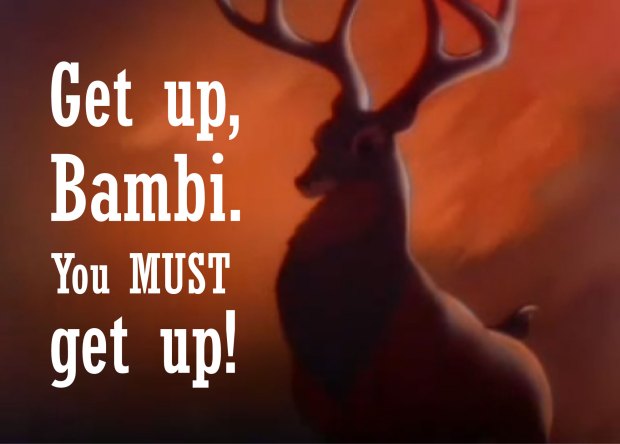
Last week we rounded up Act Two with C6—the Comprehension, which is the turning point, the awakening, the glimmer of hope, the renewed motivation. It is basically this moment:
The hero (protagonist) got a near-fatal blow at the end of Act Two, but is now getting up and wiping off the blood, ready to either finish off the bad guy or die trying.
Action
So Act 3 begins with Action and ends with resolution, the new sense of normalcy. See the dotted line in the chart below? That’s the Normalcy line. Upward movement is progress, and downward movement is chaos.
Action is determination to fight back. If the collapse (C5) brought a death, the action might be revenge. It’s whatever happens as a result of the comprehension (C6).
Update: I detail the whole third act of Toy Storyhere. You’ll see that the “action” section is full of problems and obstacles for the protagonist(s) to overcome!
Simba, ready for action:
In movies, the action to curveball (C7) to final battle to culmination (C8) might only last a few minutes, with more time devoted to the resolution. Unlike some strict proponents of the 3-Act structure, I say: if you have all the stops in the right order, you can decide where you take a rest stop, where you spend the night, and where you drive straight through.
(Highlight between brackets to reveal SPOILERS)
In The Lion King, [Simba climbs back up from the cliff; Simba makes Scar reveal the truth to lionesses; the fight between the lionesses and hyenas begins; “They call me MISTER PIG” flash to Timon and Pumbaa fighting other enemies; Simba corners Scar, who begs for mercy].
In the novelization of The Hunger Games, [Katniss finds Peeta, she nurses him back to health. Katniss goes to the “feast.” The remaining tributes are eliminated except for Cato, Katniss, and Peeta.]
C7—Curve Ball
The Curve ball isn’t strictly necessary, but it will give your third act some interest between the Comprehension and Culmination.
It’s a surprise twist for the hero, the reader, or both.
Sometimes readers know what’s coming before the protagonist. Fewer times, the protagonist (e.g. Sherlock Holmes) knows what’s coming before the reader.
It’s an unexpected obstacle the hero must overcome, most likely with help from friends. Think Harry Potter and the Chamber of Secrets.
It’s a reminder that the hero is still fighting a worthy/evil opponent. A dad chopping off his son’s hand with a lightsaber. The hero’s girlfriend jumping in front of him, taking the bullet instead.
In The Lion King, [Scar flings embers into Simba’s eyes]
In The Hunger Games, [One word: Muttations]
Final Battle
Okay, “Final Battle” is a bit of a misnomer, because in some cases, the entire Third Act is the “final battle” and the stuff between C7 and C8 is more like the “final face-off” or a “final exam.” So…
Final Face-off / Final Exam
Here it is: the climactic scene.
Spotlight on just the protagonist and antagonist—forget about the other characters for just a minute. Chances are, they are watching this unfold anyway. Especially if the bad guy is Voldemort and won’t let any one else lay a finger on Harry Potter.
In The Lion King, the face off is in slow motion. Then Simba [flings Scar down to the hyenas].
In The Hunger Games, [Katniss and Peeta fight Cato on the Cornucopia. They throw him off, and he’s attacked by the muttations. Katniss’ mercy kill. Announcement that there can only be one winner, after all. Berries. (Note: The announcement could also be considered the curveball. It certainly is the curveball in the movie. But in the novel, the realization that the Capitol turned the dead tributes into mutants was certainly an emotional curveball for Katniss.)]
In movies, the final face-off might be less than a minute, like it is with The Lion King. In some movies—and nearly all books, as far as I can tell—the face-off is its own plot within a plot. As in The Hunger Games, there’s a beginning, middle, and end, complete with rising action, climax, falling action, and even a twist.
If the final battle is it’s own mini-story, then the resolution of that story is the culmination. Put into other words, if the final battle is the climactic scene, then the culmination is the climactic moment. Somebody needs to lose. To be more black and white: either the Hero wins, or the Hero dies. Dying can be figurative. Don’t be afraid of gray areas, just stay away from muddy areas.
If it can’t be stated in one, short sentence, it isn’t the culmination.
Lion King: [The hyenas devour Scar.]
Hunger Games: [Capitol changes its mind:Okay, okay—there can be two winners.]
Resolution
The new normal. The word “new” is important because the cast will never return back to the way things were. If the protagonist didn’t change throughout the story, it’s not much of a story. Personally, I don’t like the word “normalcy,” but it has the right sort of connotations. Life might not be the same, but life goes on.
The Lion King: [Simba roars, claiming throne. Rain. Hyenas leave, the valley turns green again.]
The Hunger Games: [Peeta and Katniss are celebrated as victors, but there is a rift between them, and the Capitol is not happy.]
Writers get bonus points if the ending matches up with the WATCH element from the Opening.
Optional: The Epilogue
The epilogue ties off any story strings that were left after the resolution. Usually the epilogue requires a shift in time, setting, or point of view. Otherwise lingering scenes are still part of the main resolution sequence.
Since The Hunger Games is the first book of a trilogy, there’s no epilogue, and the resolution doesn’t tie up all loose ends. If it did, then people wouldn’t HAVE TO read the other books.
But in Disney movies, there is often an epilogue. We want to know if the sweethearts get married. So, in The Lion King, there is an epilogue: [Look! Simba and Nala have a baby. The Circle of Life continues.]
If you have questions, I’ll answer them in the comments or create another post in the series.
I’m currently researching series novels and movies and how their plots work. By researching, I mean I’m reading a lot of books and watching a lot of movies. Today, while I was watching clips of The Lion King, my husband asked me what I was doing.
“Research,” I said.
“I want to watch movies for research.”
“You can watch movies for my research.”
We’ll see if he obliges. In the meantime, what is the next FICTION WRITING TOPIC I should cover on the blog? What do you want to learn about? What do you want me to learn about?
If you want me to learn how to NOT use clichés in my blog, then I will apologize. One, I know how to avoid clichés. Two, this is a blog, so I’m going to be conversational. Three, clichés are handy ways to be concise without trying too hard. Four, the purpose of my blog is not to blow readers away with how creative or literary I can be. The purpose is to describe and discuss elements of writing in plain, conversational English.




 Lara Willard