Update: If you’re here to find your personality type, welcome! Download the quiz or answer the questions at the bottom of this post. You might find that on other quizzes, you will more frequently get E over I, S over N, T if you’re male or F if you’re female, and J over P. Each of us has each quality! The point of MBTI is to discover what you’re like when left to your own devices. If you were apart from all cultural norms, would you still test the same? I hope these simple questions can help bring clarity to each dichotomy.
Being a writer is a blessing and a curse. I really love the show Castle, because the premise is that Rick Castle, being a writer, can figure out how things happen because “That’s the way he’d write it.” Of course, you can’t go wrong with anything that has Nathan Fillion’s name attached to it…
Yeah, this post is going to be interrupted by more photos than usual or necessary, because I’m talking about a host of great writers and stories: Castle, Sherlock, The Hunger Games, Harry Potter, The Avengers.
Ahem. Anyway, I like to compare myself to Castle, because as a writer, I can usually make pretty accurate predictions about what is going to happen. I can often tell if/when a character will die within a few minutes of his or her introduction. Sometimes I even beat Sherlock to the punch, like guessing who the bad guy was in A Study in Pink and the 6-digit combination to Irene Adler’s safe in A Scandal in Belgravia.
That last one I attribute more to being a woman than being a writer.
Of course, mystery writers drop hints—sometimes BIG ones—so that the audience can try to solve the mystery with the detective. That’s why the stories work so well. Let me tell you something straight:
Readers like to feel smart.
That means that 1) they aren’t going to appreciate a writer who tries too hard to look smart. Step away from the thesaurus, Christopher! How many times do I have to tell you? And 2) the readers aren’t going to appreciate a writer who makes things so obvious, there’s no suspense or surprise.
How do you find the line between being too obvious and making the reader feel like an idiot? You make the reader feel like a friend.
I’m going to assume that you don’t use a high frequency of multisyllabic words when talking to your friends over drinks, even if you work at the law firm of Polk, Taylor, Pierce, Fillmore and Van Buren. Don’t talk over your readers, and don’t talk down to them. That means paying attention to your diction. (See my category in the Word menu to check out my posts about word choice.)
Okay, so you know you need to respect your readers. Now we’ll talk about ripping their hearts out.
How to Kill a Character
We aren’t talking the method of the killing, the cause of death. (Though I do have a gruesome list I’ve compiled. Writers are an odd breed.) Rather, we are talking about how the writer deals with the killing. The best way to learn is to look how other people do it. I’m going to go through some case studies, and try to be vague enough so that you might know someone dies, but you don’t know who.
(Yes, that’s who. Not whom. Whom would be incorrect here.)
On to the case studies, in no particular order.
Case Study: The Hunger Games
If you are paying any attention, at all, whatsoever to the premise of the story, you know that LOTS OF PEOPLE ARE GONNA DIE. Even ones you like. Katniss knows this, and the reader should know it, especially since she says it multiple times. Now, I can be a hardened reader. I sympathize with the protagonist (here, Katniss), and I can sympathize with other characters, too. But since I knew, from the beginning, that characters were going to die, I did what Katniss couldn’t do—I never really got very attached. Sure, I liked some of the characters who got killed off, but when I know his/her demise is right around the corner, I don’t get attached.
Maybe it’s because I’m a heartless fussbudget (add that to the 100 Funniest Words).
But I cry whenever Ewok #28 gets killed in Return of the Jedi, so I’m not going to believe that answer. Instead, I’m going to say that I wasn’t attached because I expected the big death. And you know why I expected the big death? Not just because Katniss told me, but also because it was at the ELATION part of the plot, and we’re just waiting for a GLOOM (See the 8 C’s of Plotting for more information about plot).
Lesson #1: Give time for readers to get attached to the character, even if he or she is wearing a red shirt.
Case Study: Any Harry Potter book ever written
I can’t speak for all Harry Potter fans, but I feel each death in the series (and there are so many!), even when I’ve heard spoilers about which character is going to die.
You know why I feel them? Because the deaths feel real: the deaths surprise us, they happen to unexpected people, and they are sudden. In life, death surprises you and hits you in the stomach because you weren’t expecting it. That’s why the first stage of grief is doubt—you can’t believe it happened.
Also, death isn’t fair. In real life, anyone can die at any time. Characters, good characters, die when you don’t want them to and when you don’t expect it. Harry Potter is a morality tale, make no mistake.
Thirdly, plenty of the deaths are sudden. Dying people don’t usually make glorious monologues, though films and books suggest everyone does. Most of the characters in Harry Potter die suddenly from a killing curse. They don’t get any “final words.” Think of a character who has a lengthy dying monologue—there are a few in The Lord of the Rings—and compare that to a character whose death is sudden, without closure. Which death is more memorable, and which one still makes you choke up a bit to remember?
In the second season finale of BBC’s Robin Hood, there’s one of each kind of death. The one that happened suddenly still haunts me.
Lesson #2: Make the death realistic—surprising, unprejudiced, sudden—for a bigger emotional impact.
A word of caution: this effect works best on secondary characters. If you do this to a main character, don’t cheat your reader: give them time to grieve. I can think of two ways I’ve seen this done: One, you let the other characters in the story grieve (the novelization of Harry Potter and the Half-Blood Prince), or two, you let the audience grieve by ending the story with it (Life is Beautiful aka La Vita è Bella).
Case Study: The Avengers
Now, The Avengers is perhaps the only movie I’ve ever seen in which I COULD NOT PICK A FAVORITE.I always choose a favorite character when I watch a movie or read a book. Sometimes I pick two (Samwise, Faramir), and sometimes the favorite changes (Pippin, originally). During and after the first viewing of The Avengers, I have…seven. And no, it’s not just the Avengers who are my favorite. Thor bugs me, but maybe that’s just because I’m Norwegian and he has the worst dialogue.
Anyway, as soon as one of the characters appeared in the movie, I thought, “Oh, I hope they don’t kill this person off.” Guess what? Joss did. But because Joss Whedon is THE BEST AMERICAN SCREENWRITER,* I sat there with my jaw dropped, looking like a big-mouth bass, for several minutes before I closed it again. This guy, Joss Whedon, is amazing. I can’t give away the death, but I can tell you that this is a great way to do it.
Lesson #3: Keep the character awesome, even in death.
In other words, make sure it’s memorable, but not because it is excruciatingly drawn out (The Outsiders) or sappy (Love Story).
Have anything more to say about death scenes? Which movies we should watch or books we should read? Leave spoilers out, if you please!
A few years ago, Dr. Robert Beard compiled a list of the 100 funniest words he had come across in nearly a decade of daily vocabulary emails he would send to hundreds of thousands of people.
Here’s the list of his 100 funniest English words. I’ve always been a fan of brouhaha, canoodle, doozy, flibbertigibbet, hootenanny, kerfuffle, ornery, rambunctious, shenanigan, skedaddle, and troglodyte.
Which one is your favorite? Any funny words you think should be added to the list?
I’m usually in the camp that it’s better to use a majority of simple, short, old words that are accessible to readers when writing fiction. I am not amused or impressed by authors who have a love affair with their thesaurus and shove every possible multisyllabic word into their text. Once again, I am looking at you, Christopher Paolini.
But if there’s a fun word that fits naturally in the tone of the novel, throw one in every once in a while! One per scene, one per page, one per paragraph, more—you decide. Make it a word readers will circle in their books because they love it and want to use it in conversation during their lunch break. Just remember, you want to be readable, not detestable. Understandable, not put-down-able.
This is Part 7 of The 8 C’s of Plotting. Click here for the whole series on the 8 C’s. Or click the image below to be taken to the General Fiction Feed.
Today is Act Three, the Action, Curve ball, Final Battle, Culmination, and Resolution. If this is your first time joining us, be sure to start at the beginning with Part One.
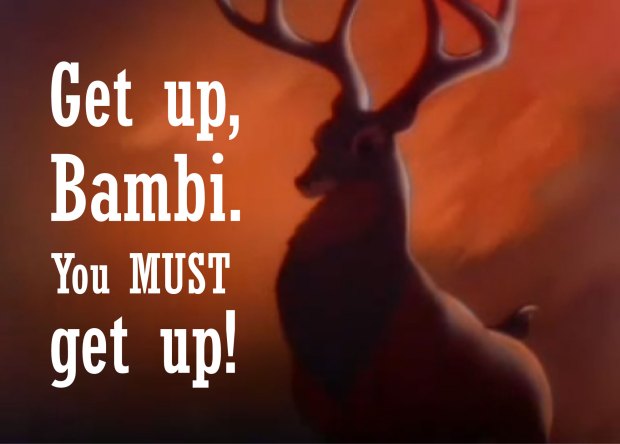
Last week we rounded up Act Two with C6—the Comprehension, which is the turning point, the awakening, the glimmer of hope, the renewed motivation. It is basically this moment:
The hero (protagonist) got a near-fatal blow at the end of Act Two, but is now getting up and wiping off the blood, ready to either finish off the bad guy or die trying.
Action
So Act 3 begins with Action and ends with resolution, the new sense of normalcy. See the dotted line in the chart below? That’s the Normalcy line. Upward movement is progress, and downward movement is chaos.
Action is determination to fight back. If the collapse (C5) brought a death, the action might be revenge. It’s whatever happens as a result of the comprehension (C6).
Update: I detail the whole third act of Toy Storyhere. You’ll see that the “action” section is full of problems and obstacles for the protagonist(s) to overcome!
Simba, ready for action:
In movies, the action to curveball (C7) to final battle to culmination (C8) might only last a few minutes, with more time devoted to the resolution. Unlike some strict proponents of the 3-Act structure, I say: if you have all the stops in the right order, you can decide where you take a rest stop, where you spend the night, and where you drive straight through.
(Highlight between brackets to reveal SPOILERS)
In The Lion King, [Simba climbs back up from the cliff; Simba makes Scar reveal the truth to lionesses; the fight between the lionesses and hyenas begins; “They call me MISTER PIG” flash to Timon and Pumbaa fighting other enemies; Simba corners Scar, who begs for mercy].
In the novelization of The Hunger Games, [Katniss finds Peeta, she nurses him back to health. Katniss goes to the “feast.” The remaining tributes are eliminated except for Cato, Katniss, and Peeta.]
C7—Curve Ball
The Curve ball isn’t strictly necessary, but it will give your third act some interest between the Comprehension and Culmination.
It’s a surprise twist for the hero, the reader, or both.
Sometimes readers know what’s coming before the protagonist. Fewer times, the protagonist (e.g. Sherlock Holmes) knows what’s coming before the reader.
It’s an unexpected obstacle the hero must overcome, most likely with help from friends. Think Harry Potter and the Chamber of Secrets.
It’s a reminder that the hero is still fighting a worthy/evil opponent. A dad chopping off his son’s hand with a lightsaber. The hero’s girlfriend jumping in front of him, taking the bullet instead.
In The Lion King, [Scar flings embers into Simba’s eyes]
In The Hunger Games, [One word: Muttations]
Final Battle
Okay, “Final Battle” is a bit of a misnomer, because in some cases, the entire Third Act is the “final battle” and the stuff between C7 and C8 is more like the “final face-off” or a “final exam.” So…
Final Face-off / Final Exam
Here it is: the climactic scene.
Spotlight on just the protagonist and antagonist—forget about the other characters for just a minute. Chances are, they are watching this unfold anyway. Especially if the bad guy is Voldemort and won’t let any one else lay a finger on Harry Potter.
In The Lion King, the face off is in slow motion. Then Simba [flings Scar down to the hyenas].
In The Hunger Games, [Katniss and Peeta fight Cato on the Cornucopia. They throw him off, and he’s attacked by the muttations. Katniss’ mercy kill. Announcement that there can only be one winner, after all. Berries. (Note: The announcement could also be considered the curveball. It certainly is the curveball in the movie. But in the novel, the realization that the Capitol turned the dead tributes into mutants was certainly an emotional curveball for Katniss.)]
In movies, the final face-off might be less than a minute, like it is with The Lion King. In some movies—and nearly all books, as far as I can tell—the face-off is its own plot within a plot. As in The Hunger Games, there’s a beginning, middle, and end, complete with rising action, climax, falling action, and even a twist.
If the final battle is it’s own mini-story, then the resolution of that story is the culmination. Put into other words, if the final battle is the climactic scene, then the culmination is the climactic moment. Somebody needs to lose. To be more black and white: either the Hero wins, or the Hero dies. Dying can be figurative. Don’t be afraid of gray areas, just stay away from muddy areas.
If it can’t be stated in one, short sentence, it isn’t the culmination.
Lion King: [The hyenas devour Scar.]
Hunger Games: [Capitol changes its mind:Okay, okay—there can be two winners.]
Resolution
The new normal. The word “new” is important because the cast will never return back to the way things were. If the protagonist didn’t change throughout the story, it’s not much of a story. Personally, I don’t like the word “normalcy,” but it has the right sort of connotations. Life might not be the same, but life goes on.
The Lion King: [Simba roars, claiming throne. Rain. Hyenas leave, the valley turns green again.]
The Hunger Games: [Peeta and Katniss are celebrated as victors, but there is a rift between them, and the Capitol is not happy.]
Writers get bonus points if the ending matches up with the WATCH element from the Opening.
Optional: The Epilogue
The epilogue ties off any story strings that were left after the resolution. Usually the epilogue requires a shift in time, setting, or point of view. Otherwise lingering scenes are still part of the main resolution sequence.
Since The Hunger Games is the first book of a trilogy, there’s no epilogue, and the resolution doesn’t tie up all loose ends. If it did, then people wouldn’t HAVE TO read the other books.
But in Disney movies, there is often an epilogue. We want to know if the sweethearts get married. So, in The Lion King, there is an epilogue: [Look! Simba and Nala have a baby. The Circle of Life continues.]
If you have questions, I’ll answer them in the comments or create another post in the series.
I’m currently researching series novels and movies and how their plots work. By researching, I mean I’m reading a lot of books and watching a lot of movies. Today, while I was watching clips of The Lion King, my husband asked me what I was doing.
“Research,” I said.
“I want to watch movies for research.”
“You can watch movies for my research.”
We’ll see if he obliges. In the meantime, what is the next FICTION WRITING TOPIC I should cover on the blog? What do you want to learn about? What do you want me to learn about?
If you want me to learn how to NOT use clichés in my blog, then I will apologize. One, I know how to avoid clichés. Two, this is a blog, so I’m going to be conversational. Three, clichés are handy ways to be concise without trying too hard. Four, the purpose of my blog is not to blow readers away with how creative or literary I can be. The purpose is to describe and discuss elements of writing in plain, conversational English.




 Lara Willard