
In perhaps my most awkward post ever on publishing, I share seven milestones for expectant authors, from puberty (first drafts) to birth day (book launch).
Click the image to read the full post on Ava Jae’s blog.
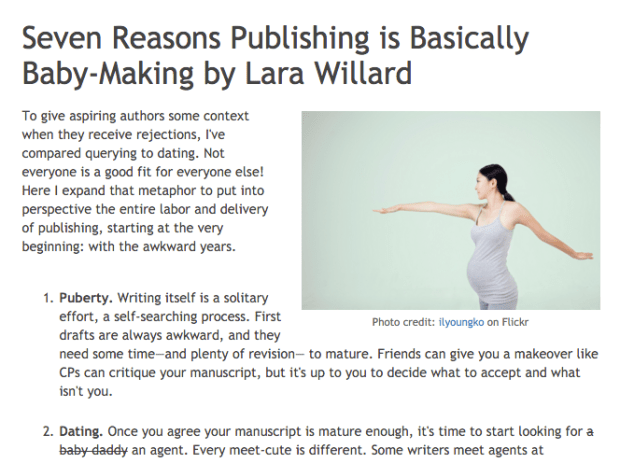

In perhaps my most awkward post ever on publishing, I share seven milestones for expectant authors, from puberty (first drafts) to birth day (book launch).
Click the image to read the full post on Ava Jae’s blog.

Are you an agent or publisher accepting graphic novel submissions? Get the best work in your slush by giving clear submission guidelines like these.
Question 1: What do you need to get your graphic novel published? (Choose all that apply)
Question 2: Once you’ve got everything ready, how do you get your graphic novel published?
A: Self-publish online or digitally.
B: Crowdfund and then publish using a print-on-demand company.
C: Send a query letter to an agent, who will represent you in finding a publisher.
D: Send a proposal to a comics publisher.
E: Send a proposal to a literary publisher.
Answers: Any of the above have worked in the past. It all depends. But don’t worry, I’ll do my best to demystify the best solution for your goals.

Graphic novels, I tell you. They’re published by comics publishers and literary publishers. They’re self-published, they’re crowdfunded, they’re submitted through agents, they’re submitted without agents. Though the medium of graphic novels has been in the literary world for decades now, writers, agents, and acquisitions editors still have no universally standard format or submission policy.
As a freelance editor for comics and graphic novels, I wanted to be able to provide these clients with a resource like the Formatting a Novel Manuscript post I made for my fiction clients. Through my research and correspondence with agents, editors, and comic creators, I’ve found a variety of submission possibilities to share with you.
Illustrated novels are prose novels with occasional (or multiple) illustrations, like Miss Peregrine’s Home for Peculiar Children and dozens of chapter books. Their pages will look more like prose manuscripts. It’s more precise to call these “illustrated novels” in your query letter. Link to images you’re providing, or include brief illustration notes in brackets.
[Illustration: Like this]
Hybrid or multimedia novels include sections of concrete poetry, imagery or ephemera which are not supplemental, but integral. The visual aspects are meant to be read or analyzed along with the text, like Illuminae, House of Leaves, Extremely Loud and Incredibly Close, or Ship of Theseus. A hybrid novel might be part comic panels, part sketches, part handwritten notes, part typed prose, part photographs. If you are creating the graphic aspects of your novel, then also consider yourself the “illustrator” below.
To figure out which route you should take to get a graphic novel published, you need to understand your goal.
If you want to work for a well-known comics publisher, you can try to get an internship, but the best way to become part of the comics world is to create an amazing portfolio of either illustration or writing samples, network with creators, and self-publish a short comic or zine by yourself or with a team of creators (see next paragraph). You can pitch your work at comic cons, recruiters can find your comics online and hire you that way, or you can join a comics community like Comics Experience, which includes a workshop and has options for publishing with IDW. Skip to the Comic Format section below to see how to format your comic scripts.
If you want to assemble your own team of creators, your first step is likely to be self-publishing. If you don’t care about being paid and just need the experience or exposure or portfolio, create a webcomic. Tapastic and Tumblr are both popular venues for webcomics, but if you have a big enough fan base, you can publish on your own website, like The Dreamer or XKCD. Some successful webcomics get book deals. Nimona, my favorite graphic novel of 2015, started as a webcomic and was published by Harper (a literary publisher—Stevenson has a literary agent). The Dreamer turned into three graphic novel volumes of comics, published by IDW (a comics publisher—Innes entered the agreement with IDW as an independent creator). Hark, a Vagrant! has gotten Kate Beaton an agent and several book deals. You might also find good success crowdfunding your graphic novel on Kickstarter. Of course, you could also become your own publisher and use a print-on-demand service to sell at cons or turn them into eBooks or PDFs to sell online.
If you want to write and illustrate a graphic novel to be published traditionally, you can do what Innes or Stevenson or Beaton did above and get your work out there first, or you can create a graphic novel proposal to send to agents. If you don’t have a complete, finished graphic novel to pitch, you’ll need a link to your portfolio (see resources in next paragraph) and a complete script.
If you want to do pencils or inks or colors, you’ll need to create an outstanding portfolio. Then you’ll do portfolio reviews to meet editors and art directors, or you’ll get an agent, who will share your work with acquisitions editors and art directors. I have heard nothing but good things about Chris Oatley’s online Painting Drama class. Oatley did character design for Disney, and his students learn how to instill deep emotional impact into their drawings and paintings–exactly what art directors are looking for. If you’d like to illustrate graphic novels and picture books for children in particular, I highly recommend KidLit411 as a resource.
If you just want to write graphic novels, you’ll need to read a lot and write a lot in your genre. Then you’ll need to write an entire script and a) query an agent to represent your script, or b) send your script to a comics publisher open to script submissions.
Comic Script Formats
You may have heard of the Marvel Method, and you might have seen Alan Moore’s micromanaging scripts, but unless you are Stan Lee or Alan Moore, I recommend using Dark Horse’s suggested format. See and download a host of comic script examples at the Comic Book Script Archive and at Comics Experience’s Script Archive.
If you are really serious about writing comics, I cannot recommend Superscript enough. (This is not a paid nor requested endorsement.) Superscript is built for comics writers and has comics-specific short codes and automatic smart formatting. You can also export to PDF or Word in a number of formatting styles. It has saved me SO MANY HOURS of formatting time. See pricing and get a one week free trial.
Formats for writer/illustrators
As both writer and illustrator, you can write your script however you’d like, as long as you have a complete graphic novel to show for it or it’s legible enough for an agent to read. See how Innes and Oatley, both writer/illustrators, wrote and formatted their own scripts here. Innes uses a modified comic script, and Oatley writes his more like a screenplay. At the link, you can download their script pages and see how the script changed from draft to pencils to final colored pages.
Formats for writers seeking literary agents (and literary publishers)
If you’re looking for a literary agent and are not illustrating, read what agents are looking for below. Whether you write a more classic comics-like script or write more of a screenplay style, include golden details to guide and ground the illustrator. If you are writing real-life or historical settings or characters, add links to photos or videos for references. Tell the story through action and dialogue and, if necessary, captions. Shannon Hale, a NYT best-selling novelist, shares her style for graphic novels here (Update: this link has sadly now been removed. Check out Chris Oatley’s scripts in the previous section and read Brent’s preferences below).
If you’re wondering what comics publishers are looking for, see this Definitive List of submission guidelines.
Bree Ogden wants a query letter with a link to the script and/or artwork. She wants scripts in the comic style.
1. I look for proper formatting. Little mistakes here and there are fine. But screenplay formatting and/or prose are unacceptable. It shows me so many things, namely that you’re not familiar with the genre you want to write in.
2. Outside of formatting, I look for things like: are the captions too long? Does the dialogue in the panel give enough information without being verbose? I usually storyboard the first few pages (if it’s just a script without sample panels) and see how it pans out as an actual graphic novel. You’d be surprised how easy it is to make a mess of captions!
3. I look to see that the writer has a grasp on description and an eye for detail. This makes working with an artist so much easier.
[…]
It should look like this:
Dear Agent,
Blah blah *query letter* blah blah.
I’d love for you to take a look at the first five pages of my graphic novel script and some sample art. You can view both on my website http://www.___________.com. The password to view the script is __________.
[Closing remarks]
(Read the full article on LitReactor)
Brent Taylor wants a query with scripts written in a less formal style:
I typically prefer a query along with sample script pages pasted into the body of the message, with a link to art or samples attached as a PDF. The one thing that I will say that is more craft related is that I really like GN scripts to be written in a more “Hollywood” way. When GN writers get too caught up in art direction and minute details [like Moore’s style!] it detracts from the character and story, and I find it’s much easier to sell a GN when the script is written in a really readable manner for those who aren’t as familiar with formal comic formats.
(Source: Personal communication)
What? Bree and Brent want completely opposite things in their scripts? Bree describes a comic-like graphic novel with panel breakdowns. She probably has connections with comics publishers. Brent is looking for more prose-like graphic novel scripts, which means he’s probably not going to submit your script to comics publishers; he’s going to submit it to book publishers.
Generally agents want different things depending on whether you’re also illustrating the graphic novel.
If you are writing only, send a query letter once your script is complete and polished. Check submission guidelines to see if you can paste the first five pages below your query letter or include a link to your first five pages in your bio paragraph.
If you are illustrating and your script is complete, send a query letter with a link to your portfolio and sample pages (unless the agency requests proposals in their submission guidelines).
If you are illustrating and your script is not complete, send a cover letter and proposal (unless the agency requests something else in their submission guidelines).
Some more agent responses:
Please research agents and publishers before you submit or sign any contract. Inclusion in this post is not endorsement. I also do not update this post if/when agent wishlists change.
Editor responses:
A query letter is a one-page pitch addressed to an individual agent which gives the details of the story’s characters, goals, and obstacles. Don’t tell the ending, but make the reader need to know what comes next. Include a short paragraph with details about the graphic novel: title, genre, and word count (page count only if you have an idea of how your graphic novel will be laid out, and it’s within standards). Give a 1- to 2-sentence bio, and then sign the letter/email. You can send query letters to any number of agents, but address them to each personally, and before you submit, be sure to check each agency’s submission guidelines and whether they even accept graphic novels.
See an example of a successful query for a graphic novel.
If you are writing but not illustrating, only send query letters when your script is complete.
If an agent asks for samples of pages or artwork, never include attachments unless expressly asked to do so. Instead, paste text at the bottom of the email or include a link to your portfolio or pages in your bio paragraph.
A proposal is a multi-page pitch which proves that you are capable of entering into a contract to complete a graphic novel. In other words, you may not have a complete graphic novel finished, but you do have a complete grasp of what you need to finish it. Check with the agency or publisher’s guidelines to see what they require. Some things you might be required to include:


We’re going to play a game: Name that tune. Can you name the songs listed below? No cheating! I picked a variety of decades and artists. See if you can name them all.

That first song has a line which grabs your attention.
The second line sets the scene with sensory details.
The third comes from a song that defined a term for a generation. But it doesn’t tell us the [Urban] Dictionary definition straight out—it shows us through a scene.
The fourth song uses a handful of similes and other fresh imagery.
The fifth song characterizes the singer and her friends.
Together, these five songs show how important a unique voice is—and how popular a strong one can become.
The opposite of strong voice is a generic, impersonal one. To create a strong voice, do the following.
Option One: Read this to find out what a Fifteen Blinker is. Choose five to ten specific words or images from one of the songs below and write a Fifteen Blinker using those words.
Option Two: Pick a song with memorable lyrics. Look up those lyrics. Rewrite the song by swapping out the words and imagery for those of another character’s point of view. Some ideas:
Want more writing exercises? See my tag. Want some critique partners to exchange work with? Join the community at StoryWorldCon. Want a writing workshop tailored to your work and your budget? Choose your course at StoryWorldCon. Subscribe to my blog for course dates!
Click on the links below to read the full lyrics.
I’ve been listening to The Shins for years, but I never actually paid attention to the lyrics in “New Slang” until today. As I referenced above, they’re full of great imagery:
Every time “Royals” comes on the radio (which is very frequently), I am awed by the fantastic diction. This was written by a fifteen year old:
What song has your favorite lyrics? I remember in tenth grade English needing to bring a song in to share with the class. I brought Fiona Apple’s cover of “Across the Universe.”

It’s orientation at StoryWorldCon! Which cabin do you belong in?

I’m still working on curriculum for the StoryWorldCon courses, but in the meantime, check out the campsite, meet and mingle with other campers, and start asking your questions about the courses in the free forum!
If you’ve ever wanted to go to a writing conference but didn’t have it in your budget, this is for you. If you’re a conference junkie, this is for you. If you want to meet other writers and find critique partners, this is for you.
The campsite is only as good as its campers, so tell your friends to join! The forum is going to be year-round, but workshops will happen based on interest and enrollment.
Find out more about StoryWorldCon here. To receive updates on the conference and when the workshops will be available, make sure you subscribe to this blog!
 Lara Willard