Guide to SFF (Science Fiction and Fantasy) Sub-genres

Lara Willard answers genre questions: What's Magical Realism? What's the difference between Science-Fiction and Fantasy? What genre is my novel?

Find out the closest fitting sub-genre for your speculative fiction, or troubleshoot your genre in this guide for writers.

Contents

  1. Major Genres
  2. SFF Sub-genres Used in #SFFpit
  3. The Difference between Science Fiction and Fantasy
  4. What’s the Difference between…
  5. Setting-Based Sub-genres
  6. Literary Fantasy
  7. Fantasy Romance or Romance Fantasy (Order Matters!)

Major Genres

This post is about the sub-genres of science fiction and fantasy. If you don’t think your story falls into speculative fiction, see my post on commercial, literary, and “general fiction” categorization, or watch my seminar on understanding age categories and genres (>1 hr).

SFF Sub-genres Used in #SFFpit

If you are writing speculative fiction and plan on pitching via #SFFpit, or if you are researching #MSWL, you need to know your sub-genres. The total list, as of December 2014, is below. I’ve divided them based on the requirements of the sub-genre.

This list is what what used for #SFFpit in 2014. For current lists or other contests, please visit the contest host’s website or blog.

By Subject (Genre Depends on Specific Tropes)

  • #FA – fantasy
  • #DF – dark fantasy
  • #EF – epic or high fantasy
  • #MYF – mythic fantasy
  • #PN – paranormal
  • #SF – science fiction
  • #DS – dystopian
  • #ML – military science fiction
  • #PA – post-apocalyptic SF
  • #SP – steampunk

By Setting (Genre Depends on Time or Place)

  • #CF – contemporary fantasy
  • #HF – historical fantasy
  • #SO – space opera
  • #TT – time travel
  • #UF – urban fantasy
  • #WW – weird west

Crossovers

  • #FR – fantasy romance
  • #HF – historical fantasy
  • #AH – alternate history
  • #LF – literary fantasy
  • #MR – magical realism
  • #SFR – sci-fi romance
  • #SFT – sci-fi thriller
  • #SO – space opera
  • #TT – time travel

The Difference between Science Fiction and Fantasy

If the not-in-our-reality elements stem from technology, it’s Science Fiction. If they stem from magic or unknown forces, it’s Fantasy. There is crossover. The Force in Star Wars tied the series to fantasy until the Midi-chlorians debacle of the prequels, which tried to sever any ties with the fantasy genre by explaining the Force with science.

The umbrella term for Science Fiction and Fantasy is Speculative Fiction, which is fiction not limited by real-world settings or physics.

What’s the Difference between…

Contemporary Fantasy & Urban Fantasy?

Answer:  If the urban setting is so experiential that it becomes a living, breathing thing, then it’s Urban Fantasy. You could have a historical UF set in 1930s NYC or a futuristic UF. Contemporary Fantasy is contemporary. Internet age. The fraternal twin of urban fantasy is rural fantasy, but “rural fantasy” is better categorized by its setting in time, not place.

Contemporary = Internet age.

Historical = set in the past.

Contemporary Fantasy & Magical Realism?

In Magical Realism (#MR), the fantastic elements aren’t described as extraordinary. “It is what it is.” Examples of #MR would be One Hundred Years of Solitude, The Curious Case of Benjamin Button, and the film Big Fish. The setting is the “real world.” The difference between magical realism (#MR) and contemporary fantasy (#CF) is that CF treats the fantastic as being weird or extraordinary. It explains the magic or calls it magic (or something similar). Disney loves contemporary fantasy. It’s always calling stuff magic.

In a Magical Realism world, magic is real and ordinary. When something falls at a party, we don’t explain gravity to the whole room. It’s just a part of our reality. We accept it.

Genres with Gods and Goddesses—Paranormal, Mythic, Dark, or…?

These can have some overlap.

If the gods are based off classical or pre-established mythology, it’s a mythical fantasy. If they are interacting with the real world, it’s paranormal (specifically supernatural). If it’s set in an imaginary world (Narnia, Middle Earth, Westeros), then I’d just call it fantasy (#FA). If the tone is dark or evil, it would be dark fantasy.

High Fantasy & Space Opera?

They are quite similar. Epic/High fantasy entails a journey, often with a “fellowship.” Think Lord of the Rings, swords & sorcery. An epic fantasy is epic in characters, in setting, and in scope. Journeys span countries, take time. Space Opera is an epic tale, like epic or high fantasy, except the travel is between worlds, and the travel is usually done via space ship. Space Opera, if it contains spaceships, is Science Fiction. The setting is the main difference.

Post-Apocalyptic or Dystopian?

dystopian novel is about a protagonist in a futuristic setting fighting a corrupt state.

If your “dystopian” lacks technology as part of the setting or corruption, it’s probably epic fantasy. It’s the difference between Big Brother (dystopian) and Dark Lord (epic fantasy).

post-apocalyptic novel is about human survival. The story takes place after some major disaster has affected the world. Usually the disaster is a natural disaster (think Day After Tomorrow and other world-disaster movies), a zombie apocalypse (Warm Bodies, World War Z), World War III, an alien or monster invasion (The Book of Eli), or a disease outbreak (Contagion, Station Eleven). A post-apocalyptic novel may also be science-fiction thriller. Warm Bodies crosses over into paranormal romance. Station Eleven is often considered literary fiction.

Post-apocalyptic = after civilization—humanity vs natural disaster, invasion, or aftermath

Dystopian = against uncivilization—humans vs a corrupt State

PA and DS novels have an interesting cause-and-effect relationship. Take current day, add an apocalypse, have people survive, they end up creating a new government which becomes corrupt. That’s the beginning of The Hunger Games. Take a corrupt government, overthrow it in a major war, and you’ve got people trying to rebuild and survive. That’s Mockingjay.

Dark or Paranormal Fantasy?

To be grievously simplistic, paranormal means “monsters.” If your novel contains ghosts, vampires, were-animals, zombies, Big Foot, or any kind of “spooky” type of creature, it’s paranormal. Paranormal can be romance, adventure, or comedy. Generally it is placed under fantasy, but it could be post-apocalyptic (see Warm Bodies, above). If it’s a romance novel with a paranormal love interest, it’s paranormal romance.

dark fantasy has a dark, ominous tone. It might concern death or criminal behavior. Usually a dark fantasy is considered a fantasy / horror crossover.

Not all paranormal fiction is dark. Twilight isn’t a horror novel, it’s a romance. Shaun of the Dead is more of a comedy adventure than a horror movie. I’d probably call it paranormal comedy. If it weren’t funny, but not particularly dark or ominous, just a paranormal adventure, I’d call it paranormal fantasy.

Setting-Based Sub-genres

If your novel prominently features historical settings or characters, it’s Historical Fantasy, Alternate History, or Time Travel.

  • Historical Fantasy (#HF) is set in the past but contains fantastic elements. It’s the fraternal twin of contemporary fantasy.
  • Alternate History #AH asks “What would happen if [historical event] had a different outcome?” While HF focuses on the past, AH focuses on a new present or future.
  • Time travel is either Science Fiction (if it uses tech or science to travel through time), or it’s a portal fantasy (if it uses a magic portal to travel through time).

If your novel primarily features the geography or heavens of a fantasy world (like Narnia, Middle Earth, Westeros, or Mount Olympus), it’s fantasy or one of its subgenres.

If your novel takes place in outer space or has interplanetary settings (it goes from one planet to the other), then it’s more likely science fiction.

The other setting-based genres, as sorted in the list above, should be pretty straightforward.

Literary Fantasy

Literary Fantasy #LF is a new addition to the #SFFpit hashtags. In LF, more emphasis is placed on theme, the human condition, or the prose. If book stores wouldn’t know whether to shelve you with SFF or with “Fiction” (aka General Fiction aka Literature), you may have written LF. Recent examples of Literary Fantasy—The Ocean at the End of the Lane (also Magical Realism), Jonathan Strange and Mr. Norrell (Historical Fantasy), The Magicians.

Genre isn’t about labels, it’s about finding readers. SFF readers look for imagination and adventure that isn’t 100% ground in reality. Literary readers want excellent prose, or to be emotionally or mentally invested in a character or theme. Of course there’s crossover!

For more about the “literary” classification, read my post Literary? Mainstream? Commercial? What Genre Is This Anyway?

Fantasy Romance or Romance Fantasy (Order Matters!)

A Fantasy Romance is a Romance novel with fantastic elements. It takes more after the romance genre than the fantasy genre. That means the novel is primarily about getting two love interests into a relationship.

It’s like the difference between yellow-orange and orange-yellow. Put an “ish” after the first word, and you can tell that yellow(ish) orange is more orange, and orange(ish) yellow is more yellow. If your novel couldn’t stand its own among other romance novels, it’s more likely a romantic fantasy.

Whenever you combine two genres together, the second one is the prominent genre, and the first is the modifying adjective. Which genre readers would be more likely to enjoy your book? That’s your prominent genre.

If you still aren’t sure about genre, leave a question below or tweet your question to @LaraEdits.

Appendix: Am I a reputable resource on this subject?

Well, I think so. I’m a published literature essayist of Sigma Tau Delta, the International English Society. I graduated summa cum laude with an interdisciplinary degree in literature, writing, and English (among other things). Since then, I’ve traded in my academic writing for a conversational tone. As a writing coach, freelance editor, and writer, I have experience in the field and have been reading on the subject of speculative fiction genres for years. I’ve taken into account the opinions of literary agents, librarians, publishers, and readers. Collaborative opinions aren’t something you can cite easily, so don’t look for a works cited page or list of references here. If you’re writing a literature paper on the subject of sub-genres, you can cite me using the following information, based on your style guide: C. Lara Willard / “Guide to SFF (Science Fiction and Fantasy) Sub-genres” / Write Edit Repeat / [link to this post].

Update: Connor Goldsmith, literary agent at Fuse Literary, has shared his definitions on sub-genres, with a section devoted to horror, here.

Query #6 November 2014

querylara

Below is the sixth public query critique I’m offering up on the blog. This will happen once a month (as long as I get a response). I choose one query per month. If your query is not selected one month, it will be in the drawing for the next month. Please do not resubmit unless you’ve made significant edits. To enter, see the rules here. If you want a guaranteed critique (plus line edit) of your query or synopsis, private ones cost $35 each.

My comments are in blue below. To read the original query first, simply read only the black text.

Dear –,

To seventeen-year-old Zéphyrine, the minds of others are playgrounds.

I wasn’t in love with this, but I still liked it. It was just bogged down with sticky words—short, common words that slow the eye down and distract from the important parts. Now it’s tight and snappy.

P.S. Watch your spaces. Some of these paragraphs had extra ones between them.

As a mind witch, she can manipulate thoughts, rewrite events and erase memories. She’s the Ravager’s most useful asset, but after so many years at his service, she’s tired of using her powers to hurt others. Those underlined words I’d usually trim down, but I think here it works in your favor, giving that annoyed, tired voice. If Zeph isn’t annoyed and tired of working with the Ravager, then you’ll want to cut “so many.” You were also missing a space here. The one time she tried to walk away, her father—the Ravager and immune to her powers—burned her half to death, and Zéph fears what will happen if she ever tries to say no again. I feel thrown under the bus here. Telling us that the guy she’s enslaved to is her father shouldn’t be a throwaway statement. That needs its own sentence, or it needs to be the most emphasized part of the sentence. The last few words of any sentence are the most important. So you could say something like “she’s tired of using her powers to hurt others, and she’s tired of the Ravager using her. It didn’t exactly make for the best father/daughter relationship.” Then mention her trying to walk away and what she fears, cutting the immunity part.

Other than that awkward bit, this is a great paragraph. We know what makes her special, what her problem is, and what she wants.

As her father’s hunger for power grows, Zéph is sent deep into the heart of the enemy territory of Almar—the neighboring country her father intends to conquer. Cut the cliches. Her task is straightforward: infiltrate the castle and manipulate the King’s thoughts. Following orders, she compels Her straightforward task/orders didn’t mention the king’s son, so this is confusing. And “compels” is a common enough verb that I didn’t get that she was using mind control. She could have just been nice to him, for all I knew. Agents skim, so you need to be as precise and concise as possible. I suggest “manipulate the thoughts of the royal family. As a result,”  Jasen, the king’s only son, to think thinks of her as a friend and confidente confidant. (Don’t be repetitive; choose the more specific word.), but the respect he has for her intelligence is all his own. delete extra space When Iriae, a mad girl as powerful as the Ravager, asks Zéph to join her in defeating him Wait, who’s “him” here? I read this as defeating Jasen, you know, because Iriae is mad, so why not, and she happens to be as powerful as the Ravager. Is Iriae wanting to defeat Ravager? This is the problem with parentheticals—they can be eliminated from the sentence. Eliminate this one, and Iriae wants to defeat Zeph’s new friend., it’s time to no, cut this. make a choice: shatter the illusion she has with Jasen and ask for his help and his father’s army, or carry on being the Ravager’s mind witch. This seems like a false dilemma. Why does she have to ask Jasen’s help if she can team up with Iriae to defeat her father? If Iriae wants to defeat the prince, then this dilemma makes a bit more sense, because Zeph either has to cancel her mission to save Jasen, or she has to let Iriae win and become just as bad as any of these crazy powerful people.


Zéph makes no commitments, but when her mother, who she thought long-dead, turns up very much alive and on Iriae’s side, Now you’re going to give another reveal in the query, and another dilemma? Do we need this extra information? I don’t think so. she gives in to temptation and risks everything to finally break free of her slave-like existence. Three cliches here. Break free is fine, since you’re using it literally, but the others need to go. But if they fail, Jasen will lose his kingdom, Huh? Is this implying he’s the king now? Iriae and Zéph’s mother What? They’re sisters? will be killed, and Zéph will be condemned to eternal torture at the hands of her father. I’m sure that this is all built up steadily in your manuscript, but all of this thrown into a sentence makes this seem like a melodrama. I expect a radio voice to come in and say, “Will she survive? Come back next time for the next installment of . . .”

MIND WITCH is a YA dark fantasy novel complete at 75,000 words that will appeal to readers of Ubik and A Girl of Fire and Thorns. Why aren’t these titles in all caps? How is this like Ubik? Try to keep any comp titles fairly recent. Within 5 years is best, 10 is okay. Ubik was published the same year as the first moon landing. Like Clive Barker’s ABARAT, it’s an illustrated novel, . . . Arabat is? I’m not seeing any illustrations in any of the Amazon previews. And reading reviews, the revised versions of the novel don’t include any illustrations. Can you think of another, more recent or accessible illustrated novel?  . . . and my portfolio can be found at [redacted]

Your hook and first paragraph are solid, or they will be when you cut the excess. The second one is confusing, and the third is overly complicated. Show us who the character is (check) what she wants at the beginning (check) what stands in her way (check) what the stakes are (check). If you want a third paragraph there, then I want to know what her secondary goal is. Sure, she wants to be free from her father, but what else does she want? Friendship with Jasen? Then tell me that and what gets in her way. Does she want to be reunited with her true family? Then hint at that, without spoilers, and tell me what gets in her way.

Author Chats: Interview with Kate Brauning

Kate Brauning‘s debut novel, How We Fall, is available! Find it at your local independent bookstore, Barnes and Noble, or Amazon (UK).

About HOW WE FALL:

In the wake of her best friend’s disappearance, 17-year-old Jackie throws herself into an obsessive relationship with her cousin, only to find out her best friend’s secrets might take him, too.

author-chats-brauning

Hi Kate, thanks for agreeing to do this interview! 

I always hate the question “Where do you get your ideas?”—but your debut novel, How We Fall, is about a girl who falls in love with her cousin. But it’s also a mystery. Now I’m curious. Which formed first?

The cousin relationship definitely came first. But people rarely have just one thing going on in their lives, and it’s often one thing that makes us see another more clearly. Jackie’s missing friend, Ellie, becomes a determining factor in her relationship with Marcus.

Two of my favorite romances deal with cousins falling in love, actually: the play The Importance of Being Earnest and the movie The Young Victoria. Related or not, who’s your OTP (One True Pairing)—your favorite couple—fictional or otherwise?

Mikael and Lisbeth from the Girl with the Dragon Tattoo trilogy. Lisbeth is such a complicated character, and it’s so difficult for her to relate to people and show her emotions that it was really something to watch her relationship with Mikael change. Watching him change and discover his attachment to her was so compelling, too. Struggle makes or breaks a romance for me, because it shows so much character and really tests the relationship itself.

What’s the best / worst writing advice you’ve ever gotten? (Ed. note: Links added by Lara, post interview, for readers’ benefit.)

The worst advice I’ve ever gotten, I think, is to write what you know. It gets passed around and misunderstood to mean writing about living in your state, or working your own job, or basically writing your own life. That can make for boring, unimaginative stories, or stories we can’t see clearly because we’re still living them. I think a better interpretation is to write things you can identify with—conflict in sibling relationships, revenge, regret, the struggles of first love, etc.

The best advice I’ve received is to study writing fiction, and not just keep writing draft after draft. Practice is definitely important, but there’s so much to storytelling that I’d struggle to pick up just from practicing. How the human attention span works, what makes people curious, what puts them on edge, how to make concepts interesting, the difference between theme and message, identifying and then connecting with your readers, etc. Reading good books on craft and hearing great authors speak has been invaluable to me.

You’re an editor with Entangled Publishing. Did being an editor change the submission process for you?

It didn’t, actually. Publishing is a small world, but my agent had very specific ideas about where she wanted to submit, and she was totally right. Also, I’m new enough to publishing that they were all places where I didn’t know people. It did help me know, though, what kind of imprint I wanted to be with. It also helped to be really familiar with editorial letters, and publishing language, and general timelines. It made it easier to handle some of the stress and nerves!

I love the sixty-nine test—where you gauge whether you’ll really like a book by flipping to its 69th page and reading it. (It is an easy number to remember.) Would you care to share yours?

Oh, that’s a really great test! And I totally would, but I just checked, and that page is super spoilery. So I don’t spill secrets, here’s the first page instead:

Last year, Ellie used to hang out at the vegetable stand with Marcus and me on Saturdays. This year, her face fluttered on a piece of paper tacked to the park’s bulletin board. Most weeks, I tried to ignore her eyes looking back at me. But today, Marcus had set the table up at a different angle, and she watched me the entire morning.

The day that photo was taken, she’d worn her Beauty and the Beast earrings. The teapot and the teacup were too small to see well in the grainy, blown-up photo, but that’s what they were. She’d insisted sixteen wasn’t too old for Disney.

The crunch of tires on gravel sounded, and a Buick slowed to a stop in front of the stand. I rearranged the bags of green beans to have something to do. Talking to people I didn’t know, making pointless small talk, wasn’t my thing. My breathing always sped up and I never knew what to do with my hands. It had been okay before, but now—surely people could see it on me. One look, and they’d know. Chills prickled up my arms in spite of the warm sun.

Marcus lifted a new crate of cucumbers from the truck and set it down by the table, his biceps stretching the sleeves of his T-shirt. Barely paying attention to the girl who got out of the car, he watched me instead. And not the way most people watched someone; I had his full attention. All of him, tuned toward me. He winked, the tanned skin around his eyes crinkling when he smiled. I bit my cheek to keep from grinning.

The girl walked over to the stand and I quit smiling.

Marcus looked away from me, his gaze drifting toward the girl. Each step of her strappy heels made my stomach sink a little further. Marcus tilted his head.

He didn’t tilt it much, but I knew what it meant. He did that when he saw my tan line or I wore a short skirt. I narrowed my eyes.

“Hi,” she said. “I’d like a zucchini and four tomatoes.” Just like that. A zucchini and four tomatoes.

Marcus placed the tomatoes into a brown paper bag. “Are you from around here?”

Of course she wasn’t from around here. We’d know her if she were.

“We just moved. I’m Sylvia Young.” The breeze toyed with her blonde hair, tossing short wisps around her high cheekbones. Her smile seemed genuine and friendly. Of course. Pretty, friendly, and new to town, because disasters come in threes.

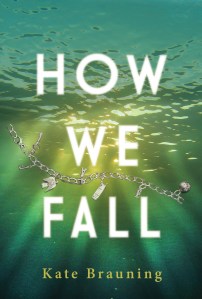
How We Fall Cover

How long did it take you to write How We Fall? Any idea how many revisions you went through? Any darlings you had to murder?

I drafted it in 6 weeks, but then spent several months revising it, queried, did another significant round of revisions, queried again, went through an R&R with my agent, another round after I signed. Finally, I did revisions with my editor. And yes, lots of murdered darlings. 🙂

Whom are you represented by? Are you willing to show us the query letter that got you your agent?

Of course! My agent is Carlie Webber at C.K. Webber Associates. She’s fierce, awesome, and is really great to work with. Here’s my query:

HOW WE FALL, a YA suspense, is complete at 88,000 words.

Making out with your cousin has its pitfalls. Seventeen-year-old Jackie hasn’t been able to end her secret relationship with Marcus since he kissed her on a dare. He’s her best friend, which only makes it harder to quit.

Except she has to, because she’s falling in love with him. It’s not like it’s illegal to date her cousin, but her parents would never approve and the families would split up their multi-family home. Afraid of losing her best friend, she calls it off. She can’t lose Marcus right now: the cops just found her missing friend’s body.

Hurt and angry, Marcus starts dating the new girl, Sylvia. But with Sylvia comes a secret and a stranger. The stranger starts following Jackie everywhere she goes, and Marcus is nearly killed in a car accident. When Jackie finds out Sylvia lied about not knowing her murdered friend, Jackie’s certain Sylvia is connected to the man threatening Marcus.

The more Jackie finds out about Sylvia, the bigger the wedge between Jackie and Marcus, but she doesn’t have long to figure out what’s going on. She may have lost both her relationship and her friendship with Marcus, but she couldn’t handle losing him for real.

If she doesn’t act fast, Sylvia’s secrets may mean their bodies will be the next ones the police dig out of the Missouri woods.


Thank you so much! Final act of business: Hogwarts house and favorite Billy Joel song. Go.

Ravenclaw! And “The Stranger” by Billy Joel is so interesting, it’s definitely a favorite.

brauning-sprite

Are you an author that has been (or will soon be) traditionally published? I’d love to interview you and turn you into your own adorable 8-bit sprite! Contact me on Twitter or e-mail me: lara willard at icloud dot com.