
Or, an updated version of my ancient post on general tips and tricks for pitching on Twitter.
Contents
- How to Find Pitch Events
- Tips for Pitching
- The Importance of Hashtags
- After the Pitch Party
- My Personal SFFpit Results
- Analysis of my Personal SFFpit Results
- Final Thoughts
How to Find Pitch Events
Pitch events are constantly coming and going, even faster than the rate of social media sites and apps (R.I.P. Writing Twitter).
To find current events, I recommend searching for accounts that post current and upcoming events, and following those accounts. I also recommend just following other writers on BlueSky or other social media apps. When they start posting pitches, check out the hashtags and find out about the contest!
Lists and Accounts to follow:
- My list of BlueSky Pitching Events, which I update more frequently than this blog
- BluePit on BlueSky, which posts its own event as well as other pitching events
- DVPit on BlueSky
- Path to Publication on BlueSky
- UnhingedPit on BlueSky
- Revise & Resub on BlueSky and Threads
Current events as of 2025:
- BluePit, for writers and storytellers, in July on BlueSky
- WickedPit, for dark, twisty books—gothic, horror, thrillers, and morally gray fantasy, in July on BlueSky
- DVPit, for pitches from marginalized voices that have been historically underrepresented in publishing, in October—Read DVPit’s page to learn whether you qualify.
- P2Ppit, for pretty much everybody, in January on BlueSky and X
- SmallPitch, for unagented authors pitching to small presses, in July, on its website
- SmallPitch, for marginalized authors pitching to small presses, in January, on its website
- UnhingedPit, for pretty much everybody, dates not specified, on BlueSky
On hiatus:
- SFFpit, for Science Fiction and Fantasy works, biannual
Retired pitch parties:
Tips for Pitching
A hook can be an interesting main character (MC), conflict, stakes, fresh premise, or voice. Pitch whichever is strongest in your novel.
It’s impossible to convey how unique your MC, setting, conflict, premise, or voice is all at once, in one tweet. Which is the MOST different compared to other novels?
If your pitches are falling flat, adjust your selling point. You might be trying to pass a swan story off as a duck one.
Elevator pitches are so short, you have to pick your focus. Character, stakes, conflict, premise, voice…pick two per pitch.
That way, if an agent goes to your feed, they don’t see the same pitch repeated, and they see that 1) your novel is complex, 2) you can pitch in a variety of ways (i.e. you’re a skilled writer), 3) you are open to variance in writing (i.e. you’d be willing to do necessary rewrites)
During Pitch Parties, you might be able to pitch once or twice per hour. That’s 12 to 24 different opportunities to pitch! Vary them by focus and by hashtags, but only use relevant hashtags. Please be sure to check the rules of each event.
You might be able to use a tool like Buffer or Later to 1) schedule your pitches beforehand and 2) see their effectiveness afterward.
I’d recommend at least 6 different pitches, with different focuses, repeated with different hashtags (if more than two are applicable). And out of those 6-12 differently focused, no-words-wasted, intriguing pitches, tweet your most fantastic ones at peak times. That is, as soon as the pitch party starts, and at lunch time EST, lunch time PST, and after-work hours. There will be more tweets then, and that’s likely when agents will do the most browsing, so your tweets then matter most.
There will be too many tweets for each agent to read. That’s why you need to use hashtags effectively (see below). You can always query those you think are a good fit for your novel (check #MSWL).
The Importance of Hashtags
The reason you need to use genre or age category hashtags in social media pitch parties is because that’s how agents filter through the feed. They can’t see every post! One agent was looking for Adult Fantasy works. She searched “#SFFpit #A #Fa” and that’s how she found my tweet.
When pitching in a general pitch party not specific to one particular genre or age category, your hashtags matter so much more. Make it easy for an agent to find you, or they never will. I tried searching for different genres during a PitchMAS party so I could repost, but I couldn’t find them because people weren’t using effective search terms. Use age category tags and genre tags, plus relevant and appropriate keywords (like “Bechdel” or “WNDB”—see my notes on references below).
KNOW THY GENRE. If you write speculative fiction, read my Straightforward Guide to Science Fiction and Fantasy Sub-Genres.
There are two deciding factors in assigning an age category. One is the age of the protagonist. One is the age of the audience, based on the age of protagonist and the content of the novel. If your protagonist is an adult, you can’t pitch it for kids. If your content is too mature for kids, it needs to be pitched at a higher age category. If the tone is too simple or cutesy for the intended audience, that needs to be fixed. Agents will reject YA novels if it “sounds MG.” (See When Voice and Genre Don’t Match)
Calls for Diversity: #WNDB and #DVpit
Remember that diversity is NOT a trend. It is not a label you “add in” as an afterthought to sell more books. If you are wanting to write characters who are marginalized in a way that you are not, invest your time in researching setting, culture, attitudes, worldview, and language, and invest your money in sensitivity reads.
If you are not a marginalized author, do not enter any pitch event that is for diverse or historically marginalized authors. Read DVpit’s notes on marginalization here.
If you do qualify as historically marginalized, you might be able to use the #WNDB or #WeNeedDiverseBooks hashtag in your pitch—if the event includes it as a hashtag.
We Need Diverse Books no longer uses the #ownvoices hashtag or label. Read why.
After the Pitch Party
What to do after pitch parties: STOP. Celebrate agent interest and newfound friends, analyze which pitches worked best, research agents.
DON’T:
- Jump into querying too soon.
- Query more than 1 agent per agency.
- Query agents / presses that seem shady.
DO:
- Query only agents / presses you’d trust your MS (& career!) with.
- Take time to research agents and tailor your query for each. Try to send within the week.
If you sit at the bar and keep using the same line over and over again, it’s not going to be very successful unless you’re Ryan Gosling. You need to tailor your pitches based on the type of agent you want to represent you.
2014 SFFpit Results
Yes. I realize this is more than a decade old, but I do think that the data is still meaningful!
For the sake of this post, all times given are in CST, Central Standard Time.
Remember, #SFFpit is for writers and agents of speculative fiction. Agents looking for other genres might act differently. In fact, I expect they will. Be sure to read my analysis below.
Dan Koboldt, host of SFFpit, posted his results of the 2014 Twitter Party. A quick look:
- 641 authors tweeted 6,000 pitches
- 32 literary agents made 355 requests
- 11 small presses also participated
- 32% of authors received at least one request from an agent
- 14% of authors got requests from 2 or more agents
My results
- I tweeted 24 times, once every half hour from 7am–7pm.
- I pitched 22 completely different pitches for the same manuscript. I re-pitched two.
- During those 12 hours, I received 143 RTs and 17 requests—10 from agents, 6 from small presses (one small press requested twice).
While I will certainly be looking into the small presses, this specific blog post is going to consider what the agents were looking for.
37.5% (9/24) of my pitches received requests from both agents and small presses.
25% received requests from literary agents. According to Dan Koboldt, I had the best results of any author participating.
Here are the 6 winning pitches:
In 1176, a prince’s wedding approacheth. And a 21st-century string trio is gonna crash it. THE PRINCESS BRIDE x LOST IN AUSTEN #SFFpit #tt
- 7:47 am, pinned to the top of my page, 26 RTs and 5 agent requests:
- Tagged: Premise, Voice, Reference
Minnesotans land in 1176, fall in courtly love with locals. Arthurian & Shakespearian retellings in a fantasy comedy of errors. #SFFpit #TT
- 9:47 am, 9 RTs and 1 agent request
- Tagged: Premise, Reference
Feminist geeks in chivalric 1176 must get home before they lose one of their own to medieval execution, self-harm, or love. #SFFpit #LF #YA
- 12:47 am, 1 RT, 1 agent request, 1 press request
- Tagged: Premise, Stakes
What’s that you say? A medieval fantasy with a cast imitating real life? Bechdel, Mako Mori, MedievalPOC? That’s WORLD SONG. #SFFpit #HF #Fa
- 1:17 pm, 1 RT and 1 agent request
- Tagged: Character, Premise, Reference
Stuck in 1176, a 24yo cellist must save his teen sis from an arranged marriage. FANGIRL x PRINCESS BRIDE (#NA + #YA POVs) #SFFpit #FA #TT #A
- 2:17 pm, 4 RTs, 1 agent request, 1 press request
- Tagged: Premise, Stakes, Reference
Picture lovesick Taylor Swift stuck in 1176, depending on Chuck Bartowski to save her. (Yeah, NOTHING goes according to plan) #NA #A #SFFpit
- 3:17 pm, 1 RT, 1 agent request, 1 press request
- Tagged: Voice, Premise, Reference
Audience Choice—Three pitches received 10 or more RTs but yielded no agent response:
Rob has 7 days to figure out inter-world transportation, or he’ll lose his sister to 12th century. Too bad he’s a music major. #SFFpit #TT
- Tagged: Stakes, Voice
In 1176, time-traveling cellist must save sister from almost certain…marriage? Inspired by Shakespearean/Arthurian tales #sffpit #LF #Fa #NA
- Tagged: Stakes, Premise, Reference
Rob has 7 days to figure out inter-world transportation, or he’ll lose his sister to 12th century. Too bad he’s a music major. #SFFpit #TT
- Tagged: Stakes, Voice
The tweet that received the most RTs was actually the first and third “Audience Choice.” It was the clear winner in critique groups, and I thought for sure it would be my most successful pitch. 29 total RTs … zero agent response.
SFFpit Analysis
For the sake of this post, I will only be analyzing the requests from agents, not small presses. Realize that this is an extremely small sample and is particular to my genre and premise.
- Analysis of Timing
- Analysis of Focus
- On Voice
- On Comp Titles and Culture References
- On Fresh Premises and Trendy Topics
- On Hashtags, Again
Analysis of Timing
I started off the day with what I thought were some of my strongest pitches. My second post did better than my first, so I immediately pinned that to the top of my page. It went on to be my most successful pitch of the day, likely because it was pinned to the top of my page.
If you post great ones at the beginning of the day, they will be retweeted throughout the day, getting your pitch in front of more people.
The chart below shows the time the number of RTs and Requests (both agent and small press) by time posted.
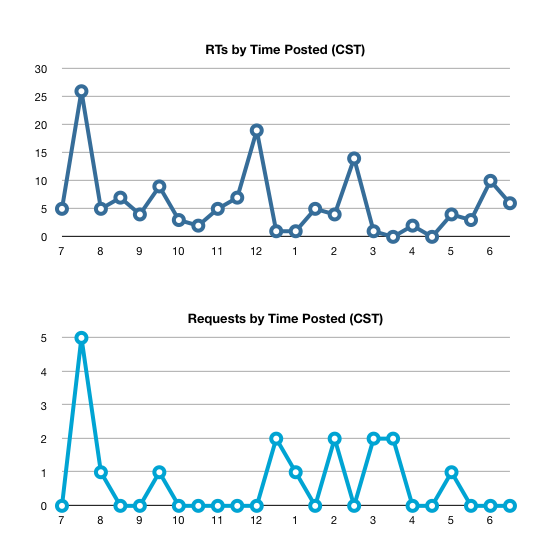
I don’t know how to see when the agents were online, but I vaguely remember a surge of notifications at around 10 am CST and around 3 pm CST.
Analysis of Focus
I tagged my 22 different pitches by their focus:
- Conflict
- Character
- Stakes
- Voice
- References (comp titles, pop culture references, social references, keywords from manuscript wishlists or MSWL)
- Premise
As you can see, the audience favorites were definitely those pitches with clear stakes and a strong voice.
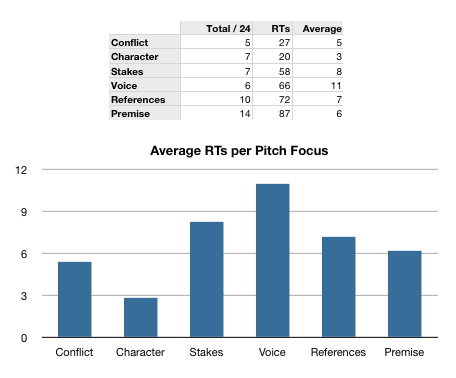
While most advice I see regarding pitching focuses on conflict and stakes, the success rate of my pitches suggests that isn’t necessarily what agents are looking for, at least in SFF, at least in my genres.
Two guesses.
One: Because the past two decades have given us multimillion dollar Science Fiction and Fantasy franchises, agents who represent these genres receive more derivative work than manuscripts from other genres. That’s why, today, in SFF, a fresh premise is important.
Two: Speculative fiction often features a clear antagonist. Whether it’s good vs evil, humanity vs aliens, or one girl against the world, it’s generally assumed that conflict and stakes are a given.
So if you aren’t writing SFF, don’t think that your pitches don’t need stakes!
Granted, my tweets that focused on stakes didn’t do bad at all, but they certainly didn’t do as well as ones with other focuses, as you can see:
All ten agents who requested on one of my tweets selected one tagged “premise.” Nine selected one with a reference of some sort, six chose one with strong voice.

However however however!
Not all of my “premise” tweets were successful. Let’s look at the success rate of each focus based on my 24 tweets.
Out of all six tags, the tweets with references (I’ll go through the references below) had the highest success rate at 50%. Of my 10 tweets with references, 5 got requests.
Those are pretty great odds.
The odds get even better when I start combining tags.
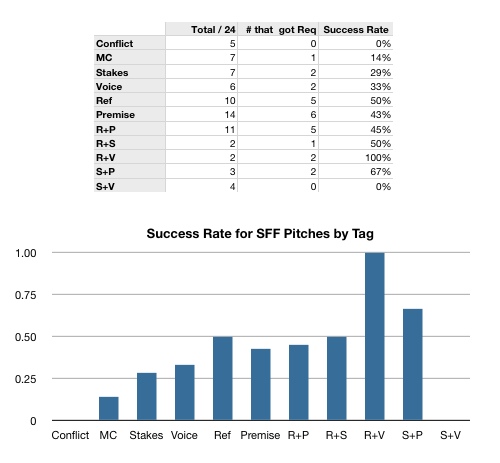
Now, here my sample size is showing, but of the 2 tweets that had both strong voice and a culture reference, 100% got a request.
And I’m thinking that the 0 requests for my Stakes + Voice pitches is more proof that pitching SFF just isn’t the same as pitching other genres. Those poor little babies. Maybe they’ll do better during a general pitching event like PitchMAS.
At bigger sample sizes, the results might not be the same, but one thing’s for certain:
No matter your genre, your pitches with strong voice and apt pop culture references are most likely to get noticed.
On Voice
It takes practice to have a natural voice to your writing. Voice = diction = word choice. Use specific nouns, verbs, and adjectives. See my posts on diction here.
On Comp Titles and Pop Culture References
I’ve spent months trying to find the best comparative titles for my novel. Here’s how to do it.
HOW TO CHOOSE COMP TITLES
1—Choose a novel that matches your novel in at least 2 of the following categories: genre, premise/plot, time, place, protagonist type, conflict, tone, audience, event.
2—Find another work that matches both your book and your first comp title in two or more of those categories.
My most successful pitch was The Princess Bride + Lost in Austen. While it isn’t a novel (I’d love to read it!), Lost in Austen matches my novel in genre (literary fantasy) and premise/plot (contemporary MC goes to a historical, fictional world, tries to get home, falls in love reluctantly with a local). The Princess Bride matches my novel and Lost in Austen in genre, and it matches my novel in tone (the irreverent humor), audience, time and place (medieval Europe-ish), and event (the wedding crashing).
Remember that when you are pitching a book to an agent, you are pitching a book to a reader. A reader that reads professionally. You’re also pitching to a professional. A professional that needs to make a living.
With that in mind, here are my
7 tips for including references in elevator pitches:
- Be relevant—references to classical literature and old books aren’t as successful as ones published in the last two–three years. Show that you’re aware of what’s in the market today.
- Be literary—make at least one of your comparative titles a novel, if possible. Show that you read your genre.
- Be realistic—your references need to work for your novel. See “How to Choose Comp Titles” above.
- Be humble—Don’t claim to be the next [Insert Famous Author Here].
- Be specific—compare your characters to well-known characters (I picked Taylor Swift and Chuck Bartowski. Yes, I realize Taylor isn’t a fictional character)
- Be savvy—if you can make a reference to a still-current social or political movement that affects publishing, do, but only if it applies to you or your manuscript (Examples: LGBTQ, Bechdel and Mako Mori feminism tests. Read my note on calls for diversity in the hashtag section.)
- Be awesome—refer to something geeky or a cult classic that hasn’t been mentioned for a while and will stir up nostalgia. See what everybody else is mentioning (recent blockbusters, huge franchises, Buffy) and think of something else.
On Fresh Premises and Trendy Topics
By “fresh premise” I mean pitching something that the market isn’t currently saturated in. Pay attention to agents who post their responses to queries (#tenqueries, #querylunch, #500queries), and you’ll see what they are receiving a lot of. In winter 2014, they were receiving a lot of paranormal, dystopians, fairy tale retellings, and urban fantasy: Ghosts, angels, demons, werewolves, mermaids, psychics, empaths.
So if you’re pitching something trendy, focus on what makes your novel different and what makes yours unique, not on what makes it trendy.
The good news about publishing is that it’s cyclical. So you can try to grab the readers now, while they are hungry, by self-publishing, or you can wait a couple of years until the big publishers come back to it. Remember that anything that is trendy now, won’t be in two years when the books being written now are being put out on bookshelves. You either have to be a year or two ahead of the market, or a couple years behind.
Remember vampires, which weren’t popular in 2014 but agents were aflutter for in 2018, and which had a moment in books published in 2020 especially, and then again in 2022–2023, two years after the Dracula movie. With Nosferatu out in 2024, you can expect another bump in vampire books published in 2026. Vampires really are the undying genre.
On Hashtags, Again
Use them. Of the agents who requested from my pitches, here are the total number of requests they made during the SFFpit event, in descending order:
40, 34, 33, 33, 7, 6, 5, 3, 3, 3
If you take into consideration all the favorites and the 32 agents who participated, a single agent, on average, chose only 11 pitches. Out of six thousand.
That suggests to me that they are searching for things that might be on their Manuscript Wishlist or #MSWL and requesting those, rather than reading thousands of pitches at random.
Final thoughts
Research what agents are looking for. See which Wish Lists are compatible with your novel, and then try to guess what that agent might search for during a pitch party. If one of your favorite agents is looking for space opera, use that hashtag, or if there isn’t a designated hashtag list, use those words in one of your pitches. That way when an agent searches “#SFFpit space opera,” your pitch will pop up.






 Lara Willard